Machine Safety Compliance
Compliance Corner
Where do I start if I want to improve machine safety?
Machine safety is not completed when the guarding project is installed. Engineered safeguards must work together with the manufacturer's procedures, training, lockout/tagout practices, inspection, maintenance, supervision, and ongoing management of the equipment. PowerSafe focuses on the engineered risk-reduction side of that equation while helping customers understand where those engineered measures interface with their broader machine safety program.
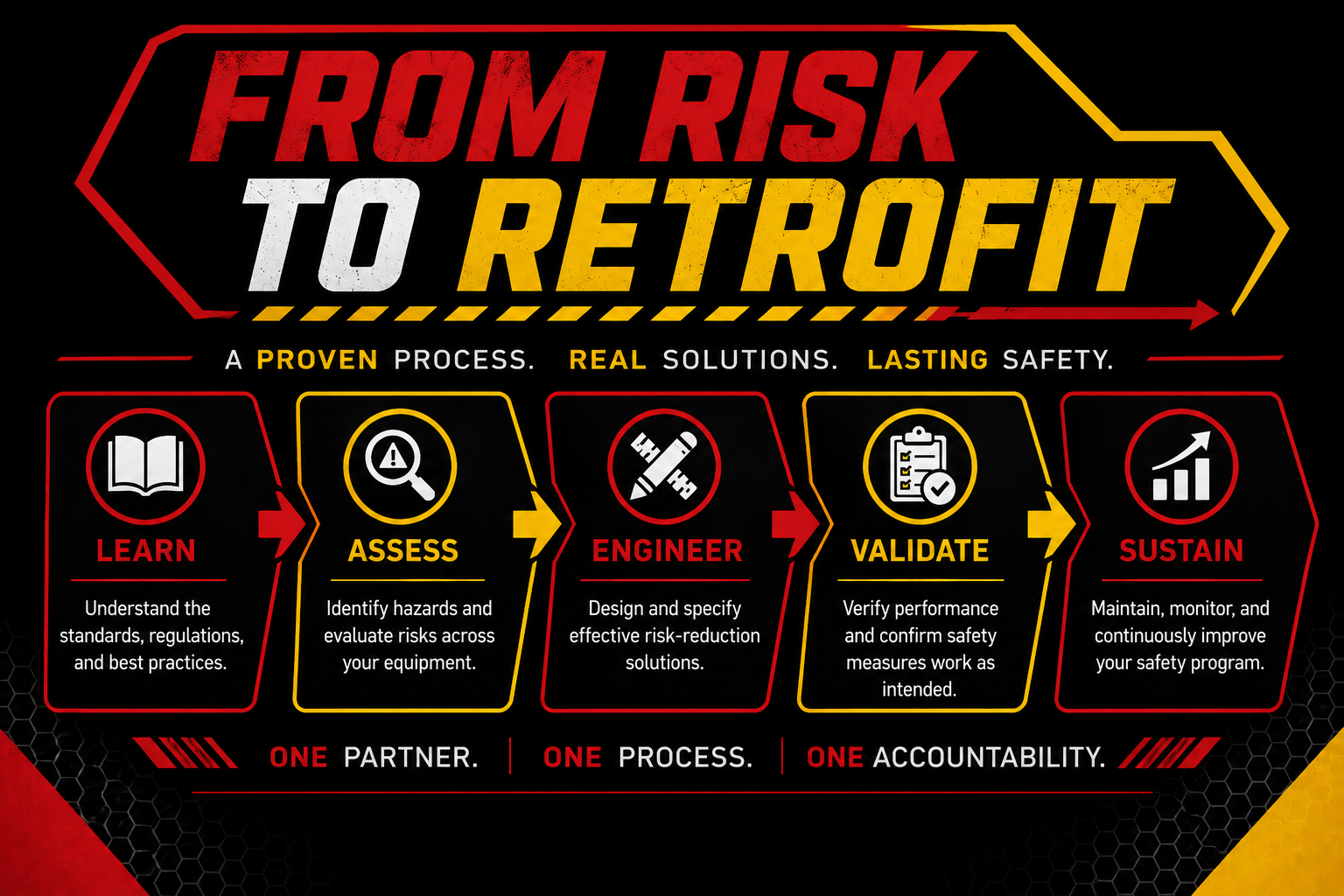
At PowerSafe Automation, we call this From Risk to Retrofit, a practical approach that helps manufacturers understand applicable standards, prioritize improvements, and implement engineered solutions that reduce risk throughout the machine safety lifecycle.
Use the resources below to explore OSHA regulations, ANSI standards, assessment tools, engineering solutions, and best practices designed to help you make informed machine safety decisions.
Remember: OSHA machine guarding violations remain among the most frequently cited issues in manufacturing, and there is no grandfather clause that exempts older equipment from providing adequate employee protection. Existing machinery should be periodically evaluated against current safety requirements and accepted engineering practices.
Schedule a meeting with a Safety Consultant
📝 Learn the Standards
ANSI Machine Safety Standards
Explore some of the most commonly referenced ANSI B11 standards for machine safeguarding and risk reduction.
- ANSI B7.1 – Grinding Wheels
- ANSI B11.0 – General Safety Requirements & Risk Assessment
- ANSI B11.1 – Mechanical Power Presses
- ANSI B11.4 – Shears
- ANSI B11.6 – Manual Lathes
- ANSI B11.8 – Milling, Drilling & Boring Machines
- ANSI B11.9 – Grinding Machines
- ANSI B11.10 – Metal Sawing Machines
- ANSI B11.12 – Roll Forming & Bending Machines
- ANSI B11.19 – Performance Requirements for Safeguarding
Continue Learning
-
Practical ANSI Translator
- Need help understanding a standard? Explore the Practical ANSI Translator, where complex ANSI machine safety requirements are explained in plain language with real manufacturing examples.
- Machine Safety Assessments
- Machine Guarding Solutions
- Complete ANSI B11 Standards (ASSP)
OSHA Machine Safety Regulations
OSHA regulations establish the legal requirements employers must follow to provide a safe workplace.
Frequently referenced machine safety regulations include:
- 1910.211 – Definitions
- 1910.212 – General Machine Guarding
- 1910.219 – Mechanical Power Transmission
- 1910.147 – Control of Hazardous Energy (Lockout/Tagout)
Learn more with this article on Top OSHA Machine Safety Violations Manufacturers Should Know
Related Resources
- Machine Safety Assessments
- Training & Workshops
- The Practical ANSI Translator
- Case study on From OSHA concerns to a standardized machine safety program
Frequently Asked Questions
- What is the difference between OSHA and ANSI?
- OSHA is a federal regulatory agency that establishes and enforces workplace safety requirements, while ANSI develops voluntary consensus standards with input from industry experts. Although ANSI standards are generally voluntary, OSHA may reference recognized industry practices when evaluating whether employers have adequately protected employees.
-
Are ANSI standards mandatory?
- ANSI standards are generally voluntary unless they are adopted by a regulatory authority, incorporated into a contract, or required by an organization. Even when not legally mandated, they are widely recognized as accepted engineering practices for machine safety and risk reduction.
-
Does OSHA require machine guarding?
- Yes. OSHA requires employers to protect employees from hazards created by moving machine parts under regulations such as 29 CFR 1910.212. The specific safeguarding method depends on the machine, the hazards present, and how employees interact with the equipment.
-
Is there a grandfather clause for older machines?
- No. There is no general grandfather clause that exempts older machinery from providing adequate employee protection. Existing equipment should be periodically evaluated to determine whether additional safeguarding or risk-reduction measures are appropriate based on current operating conditions and accepted engineering practices.
-
When is a risk assessment recommended?
- A machine safety risk assessment is recommended whenever new equipment is installed, existing machinery is modified, production changes, incidents occur, or potential hazards are identified. Periodic reassessments can also help identify new risks as equipment, processes, and standards evolve.
- How often should machines be reassessed?
- There is no single required interval for every machine. Reassessments are commonly performed after significant modifications, process changes, incidents, recurring maintenance issues, or whenever operating conditions change enough to potentially affect employee safety.
-
What is the purpose of ANSI B11.19?
- ANSI B11.19 provides performance requirements and guidance for selecting, designing, constructing, installing, operating, and maintaining safeguarding measures used to reduce machine-related risks. It helps manufacturers apply appropriate safeguarding technologies based on identified hazards and risk reduction objectives.
Why Machine Safety Matters
Proper machine safety programs help organizations:
- Protect employees
- Reduce machine-related injuries
- Improve equipment uptime
- Support regulatory compliance
- Standardize safeguarding practices
- Build a stronger safety culture
OSHA's Most Frequently Cited Standards
Machine guarding and hazardous energy control (lockout/tagout) continue to be among OSHA's frequently cited workplace safety violations. Understanding these requirements is an important step toward reducing risk and protecting employees.
🔍 Assess the Risks
Every machine presents different hazards depending on its design, operation, maintenance requirements, and employee interaction. Before selecting safeguarding measures, the hazards should be identified, evaluated, and prioritized so appropriate risk-reduction measures can be developed.
During a machine safety assessment, engineers commonly evaluate hazards such as:
Mechanical Hazards
- Pinch Points
- Crushing Hazards
- Shear Points
- Rotating Parts
- Entanglement Hazards
- In-running Nip Points
- Cutting & Severing Hazards
- Impact Hazards
Physical Hazards
- Flying Chips & Debris
- Sharp Edges
- Hot Surfaces
- Noise Exposure
- Vibration
- Slips & Trips
- Fire Hazards
Energy & Control Hazards
- Unexpected Start-Up
- Stored Energy
- Electrical Hazards
- Functional Safety Issues
- Automation Hazards
Safeguarding Concerns
- Missing Guards
- Bypassed Safety Devices
- Damaged Guards
- Improper Guard Openings
- Inadequate Safety Distances
- Poor Access Control
- Insufficient Warning Indication
🛠 Engineer Solutions
Once hazards have been identified and risk has been evaluated, the next step is designing and implementing practical risk-reduction measures. Effective machine safety combines physical guarding, safety controls, and system integration into one engineered solution that supports safe operation throughout the equipment lifecycle.
PowerSafe Automation delivers turnkey machine safety solutions—from engineering through validation.
Engineered Machine Guarding
Protect employees from hazardous motion using safeguarding systems designed specifically for your equipment.
Related Resources
Safety Controls & Integration
Modern safeguarding often combines physical barriers with safety-rated control systems that monitor protective devices, safely stop hazardous motion, and coordinate machine operation.
Related Resources
Safety Technologies
Select the appropriate safeguarding technology based on the application and identified hazards.
Examples include:
- Light Curtains
- Safety Scanners
- Interlock Switches
- Safety Mats
- 3D Safety Radars
- Trapped Key Interlock Safety Systems
Turnkey Project Delivery
Unlike companies that only assess risk or supply components, PowerSafe delivers complete machine safety projects from concept through installation.
Typical project phases include:
- Engineering & Design
- Manufacturing & Assembly
- Controls Integration
- Nationwide Installation
- Startup & Validation
Supporting Resources
Machine safety is most effective when every safeguarding component functions as part of a coordinated system rather than as isolated devices. Integrating physical guards, safety controls, risk assessment findings, and validation into one engineered solution helps create a more consistent and maintainable machine safety program.
✅ Validate Performance
Installing a safeguarding solution is not the final step. Before returning equipment to production, the completed system should be verified to confirm that safety devices, controls, and engineered safeguards function as intended and support the identified risk-reduction objectives.
Validation confirms that engineered safeguards, safety controls, and integrated systems perform as intended before equipment returns to production.
Validation & Commissioning
Validation may include activities such as:
- Verifying safeguarding functions
- Confirming safety device operation
- Testing safety-related control functions
- Reviewing machine operating modes
- Confirming documentation and drawings
- Final acceptance walkthroughs
Documentation & Traceability
A successful project should leave the customer with documentation that supports future maintenance, modifications, and continuous improvement.
Examples include:
- Validation Reports
- Updated Drawings
- Device Documentation
- Recommended Corrective Actions
- Project Closeout Documentation
Ongoing Support
Machine safety doesn't end after commissioning.
PowerSafe continues to support customers through:
- Preventive Maintenance
- Safety Inspections
- Machine Modifications
- Additional Risk Assessments
- Future Retrofit Projects
📈 Sustain Improvements
Machine safety is an ongoing process, not a one-time project. Equipment changes, production evolves, standards are updated, and new risks emerge over time. Sustaining improvements requires periodic evaluation, consistent engineering practices, and a long-term approach to risk reduction.
Whether you're maintaining a single machine or standardizing safety across multiple facilities, continuous improvement helps protect employees, support operational reliability, and build a stronger machine safety culture.
Standardize Across Your Organization
For organizations managing multiple facilities or planning long-term machine safety initiatives, explore the Machine Safety Alignment Initiative (MSAI) to develop consistent standards, governance, roadmaps, and engineering practices across your operations.
Ready to reduce risk?
Whether you're evaluating one machine or developing a corporate machine safety strategy, PowerSafe Automation provides turnkey machine safety solutions from assessment through engineering, manufacturing, installation, and validation.