
Press Safety, Controls & Safeguarding
Adjustable Hairpin Guarding
Configurable Point-of-Operation Guarding for Mechanical Presses
Adjustable Hairpin Guarding
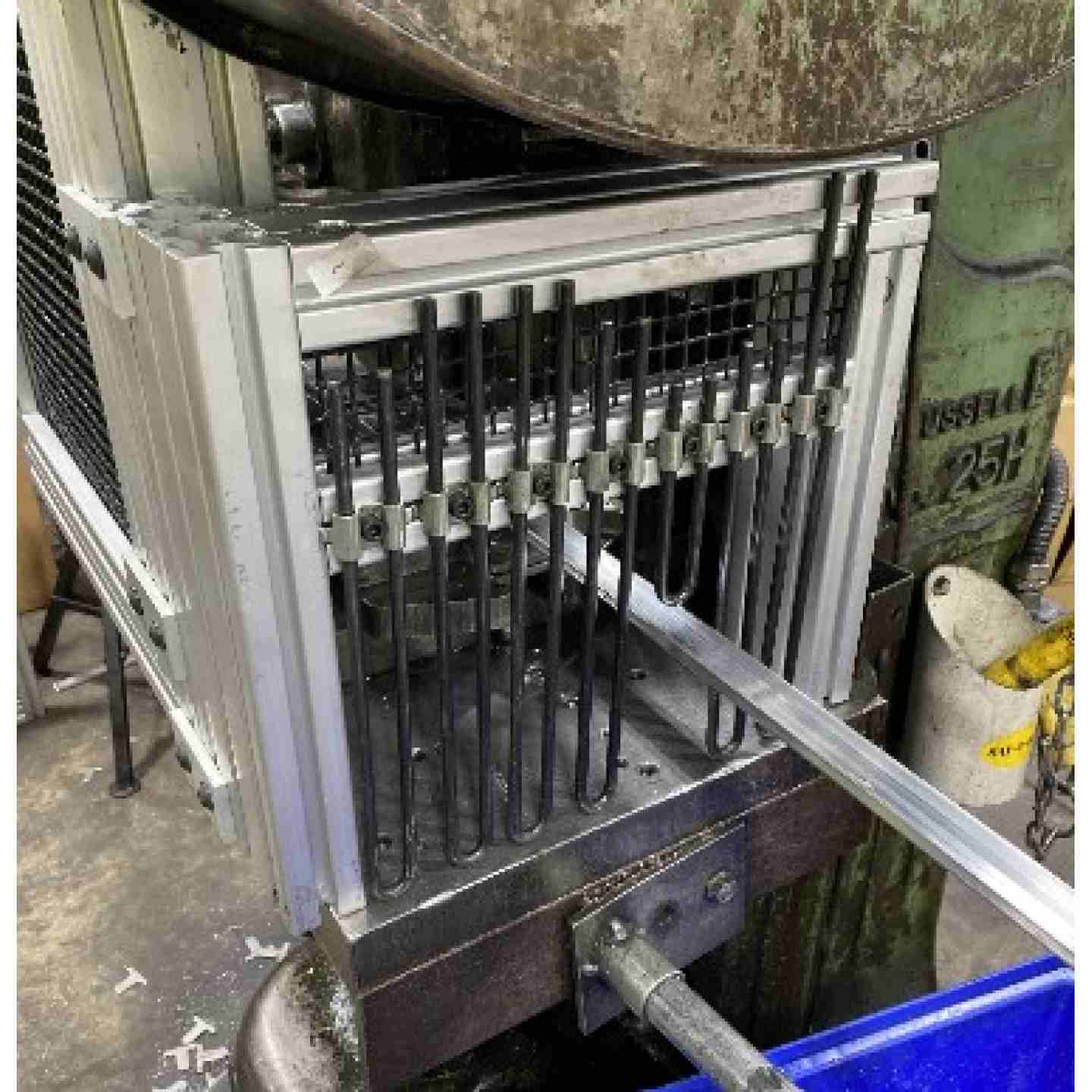
Mechanical presses handling different material shapes, profiles, and customer-specific forming requirements often need a more adaptable point-of-operation guarding solution. PowerSafe designs and fabricates Adjustable Hairpin Guarding with individually positioned steel rods that accommodate varying material configurations while maintaining engineered access restrictions. Unlike fixed horizontal barriers intended for flat-sheet applications, adjustable hairpin systems provide greater flexibility for irregular workpieces and frequent production changeovers. Guarding configurations are developed around the press, tooling, material flow, and required safety distances to help reduce exposure to hazardous areas without unnecessarily limiting production.
Key Features
Engineered press guarding – Adjustable physical safeguarding designed around the mechanical press, tooling, material profiles, operator interaction, and production requirements.
Individually adjustable hairpin rods – Vertical steel rods can be positioned to accommodate different material shapes, formed profiles, and tooling configurations.
Customizable material openings – Adjustable rod arrangements provide flexibility for varying customer orders while maintaining defined safeguarding boundaries.
Safe-distance-based design – Rod spacing, adjustment limits, and barrier placement are engineered around applicable reach-distance and opening-size requirements.
Point-of-operation access control – Helps restrict access to hazardous press areas while allowing the material clearance necessary for approved production configurations.
Controlled rod positioning – Mechanical retention, guides, and locking arrangements help maintain approved rod positions during press operation.
Custom fabricated construction – Durable steel hairpins, mounting assemblies, and support frames designed for industrial press environments.
Frequent production changeovers – Configurable guarding arrangements can accommodate different material profiles without requiring complete replacement of the guarding assembly, provided each configuration maintains required protection.
Fixed and perimeter guarding integration – Adjustable hairpins can be combined with side, rear, and perimeter barriers to help prevent access around the point-of-operation guard.
Supplemental safeguarding integration – Systems can incorporate safety light curtains with appropriate floating blanking capabilities, safety laser scanners, interlocked access points, and additional protective devices where suitable for the press and application.
Press safety control upgrades – Guarding can be integrated with upgraded safety relays, controllers, emergency stops, and other press control improvements to support a coordinated safeguarding solution.
Die setup and maintenance protection – Additional provisions can include die safety blocks, lockable power disconnects, and engineered mechanical wedges or restraints for applicable servicing and maintenance activities.
Retrofit-friendly design – Custom mounting and adjustment assemblies can be engineered for existing mechanical presses without requiring extensive machine modifications.
Operator and material-flow accommodation – Guarding configurations account for manual feeding, part removal, tooling clearance, die changes, and production access requirements.
Part of a complete press-safety system – Can be engineered alongside fixed guarding, presence-sensing devices, stop-time measurement, safety-distance verification, and control system upgrades as part of a coordinated mechanical press retrofit.
Adjustable Hairpin Guarding
Configurable Point-of-Operation Guarding for Mechanical Presses
Adjustable Hairpin Guarding
Mechanical presses handling different material shapes, profiles, and customer-specific forming requirements often need a more adaptable point-of-operation guarding solution. PowerSafe designs and fabricates Adjustable Hairpin Guarding with individually positioned steel rods that accommodate varying material configurations while maintaining engineered access restrictions. Unlike fixed horizontal barriers intended for flat-sheet applications, adjustable hairpin systems provide greater flexibility for irregular workpieces and frequent production changeovers. Guarding configurations are developed around the press, tooling, material flow, and required safety distances to help reduce exposure to hazardous areas without unnecessarily limiting production.
Key Features
Engineered press guarding – Adjustable physical safeguarding designed around the mechanical press, tooling, material profiles, operator interaction, and production requirements.
Individually adjustable hairpin rods – Vertical steel rods can be positioned to accommodate different material shapes, formed profiles, and tooling configurations.
Customizable material openings – Adjustable rod arrangements provide flexibility for varying customer orders while maintaining defined safeguarding boundaries.
Safe-distance-based design – Rod spacing, adjustment limits, and barrier placement are engineered around applicable reach-distance and opening-size requirements.
Point-of-operation access control – Helps restrict access to hazardous press areas while allowing the material clearance necessary for approved production configurations.
Controlled rod positioning – Mechanical retention, guides, and locking arrangements help maintain approved rod positions during press operation.
Custom fabricated construction – Durable steel hairpins, mounting assemblies, and support frames designed for industrial press environments.
Frequent production changeovers – Configurable guarding arrangements can accommodate different material profiles without requiring complete replacement of the guarding assembly, provided each configuration maintains required protection.
Fixed and perimeter guarding integration – Adjustable hairpins can be combined with side, rear, and perimeter barriers to help prevent access around the point-of-operation guard.
Supplemental safeguarding integration – Systems can incorporate safety light curtains with appropriate floating blanking capabilities, safety laser scanners, interlocked access points, and additional protective devices where suitable for the press and application.
Press safety control upgrades – Guarding can be integrated with upgraded safety relays, controllers, emergency stops, and other press control improvements to support a coordinated safeguarding solution.
Die setup and maintenance protection – Additional provisions can include die safety blocks, lockable power disconnects, and engineered mechanical wedges or restraints for applicable servicing and maintenance activities.
Retrofit-friendly design – Custom mounting and adjustment assemblies can be engineered for existing mechanical presses without requiring extensive machine modifications.
Operator and material-flow accommodation – Guarding configurations account for manual feeding, part removal, tooling clearance, die changes, and production access requirements.
Part of a complete press-safety system – Can be engineered alongside fixed guarding, presence-sensing devices, stop-time measurement, safety-distance verification, and control system upgrades as part of a coordinated mechanical press retrofit.
Adjustable Hairpin Guarding
Customizable Point-of-Operation Hard Guarding for Mechanical Presses
Adjustable Hairpin Guarding provides a configurable physical barrier for mechanical presses handling varying material shapes, sizes, and formed profiles.
Designed for applications where fixed guarding openings may restrict material handling, individually adjustable steel hairpins allow operators to accommodate different workpiece configurations while maintaining engineered access restrictions to the point of operation.
PowerSafe Automation designs and fabricates these systems with application-specific rod spacing, adjustment limits, and safeguarding distances based on the press, tooling, material geometry, and applicable safety requirements.
Typical Guarding Components
Depending on the press and application, an adjustable hairpin guarding system can include:
Individually adjustable steel hairpin rods
Fabricated rod mounting and retention assemblies
Custom rod spacing and adjustment ranges
Fixed side and rear guarding
Machine-specific mounting brackets
Steel or aluminum support framing
Adjustable material clearance openings
Mechanical stops or locking mechanisms
Integration with existing press tables and material supports
Supplemental fixed barriers to restrict reach-around access
Adjustable Hairpin Configuration
Adjustable Hairpin Guarding is designed for mechanical press applications where material shapes and profiles frequently change between production orders.
Typical configurations can include:
Independently adjustable vertical hairpin rods
Configurable openings for irregular material profiles
Custom fabricated rod widths and lengths
Application-specific minimum rod spacing
Engineered reach-distance and opening-size limitations
Positive retention to maintain rod positioning
Machine-width custom sizing
Integration with existing press frames or work surfaces
Combination with fixed side and rear guarding
Configurations supporting repeatable production changeovers
Rod positioning and adjustment limits must maintain the required safeguarding distance and prevent access to the point of operation. Material clearance alone does not establish a safe opening.
Guarding Materials & Construction
Hairpin guarding assemblies are fabricated for durability, repeated adjustments, and the operating environment of the press.
Options can include:
Formed steel hairpin rods
Fabricated steel mounting frames
T-slot aluminum support framing
Mechanical rod guides and retention blocks
Adjustable locking mechanisms
Machine-specific mounting plates and brackets
Fixed steel barrier panels
Supplemental wire mesh or polycarbonate guarding
Removable maintenance sections where appropriate
Material Flow & Operator Access
Adjustable Hairpin Guarding is particularly suited to press applications requiring flexibility for different customer orders and formed material configurations.
Layout considerations can include:
Irregular or changing material profiles
Custom-formed parts
Multiple product shapes and sizes
Manual material loading and unloading
Frequent tooling or die changes
Operator positioning and feeding methods
Material support and alignment
Part removal and scrap handling
Die setup and maintenance access
Repeatable and controlled rod adjustments
The goal is to provide production flexibility while maintaining effective point-of-operation protection for each approved operating configuration.
Supplemental Safeguarding Integration
Adjustable Hairpin Guarding can be combined with additional safeguarding technologies when required by the press risk assessment.
Options can include:
Safety light curtains with application-appropriate floating blanking capabilities
Safety laser scanners for supplemental area or access protection
Fixed side and rear guarding
Interlocked access doors and panels
Press safety control system upgrades
Safety relays and safety controllers
Emergency stop devices
Two-hand control systems where appropriate
Stop-time measurement and safety-distance verification
Die safety blocks
Lockable electrical power disconnects
Mechanical wedges or other engineered means of preventing hazardous movement
Protective devices must be selected and integrated based on the press stopping characteristics, operating modes, control reliability, and applicable requirements. Floating blanking and other detection-field adjustments require specific evaluation because they can affect required safety distances and access protection.
Die blocks, power isolation, and mechanical restraints provide additional protection during applicable servicing, setup, or maintenance activities and are not substitutes for operating point-of-operation safeguarding.
Engineered for the Press
Adjustable Hairpin Guarding is application-specific. PowerSafe Automation evaluates the mechanical press, tooling, material profiles, operator interaction, adjustment requirements, and potential access to hazardous areas before developing the guarding concept.
Guarding configurations are evaluated against applicable requirements, including OSHA 29 CFR 1910.217 and relevant ANSI B11 standards, with consideration for safe opening dimensions, reach distances, guard integrity, and press operation.
The finished solution can combine adjustable hairpin barriers, fabricated mounting assemblies, fixed guarding, presence-sensing devices, press safety controls, and installation and integration as part of a complete mechanical press-safety retrofit.
Flexible material handling. Engineered access protection. One integrated safeguarding solution.