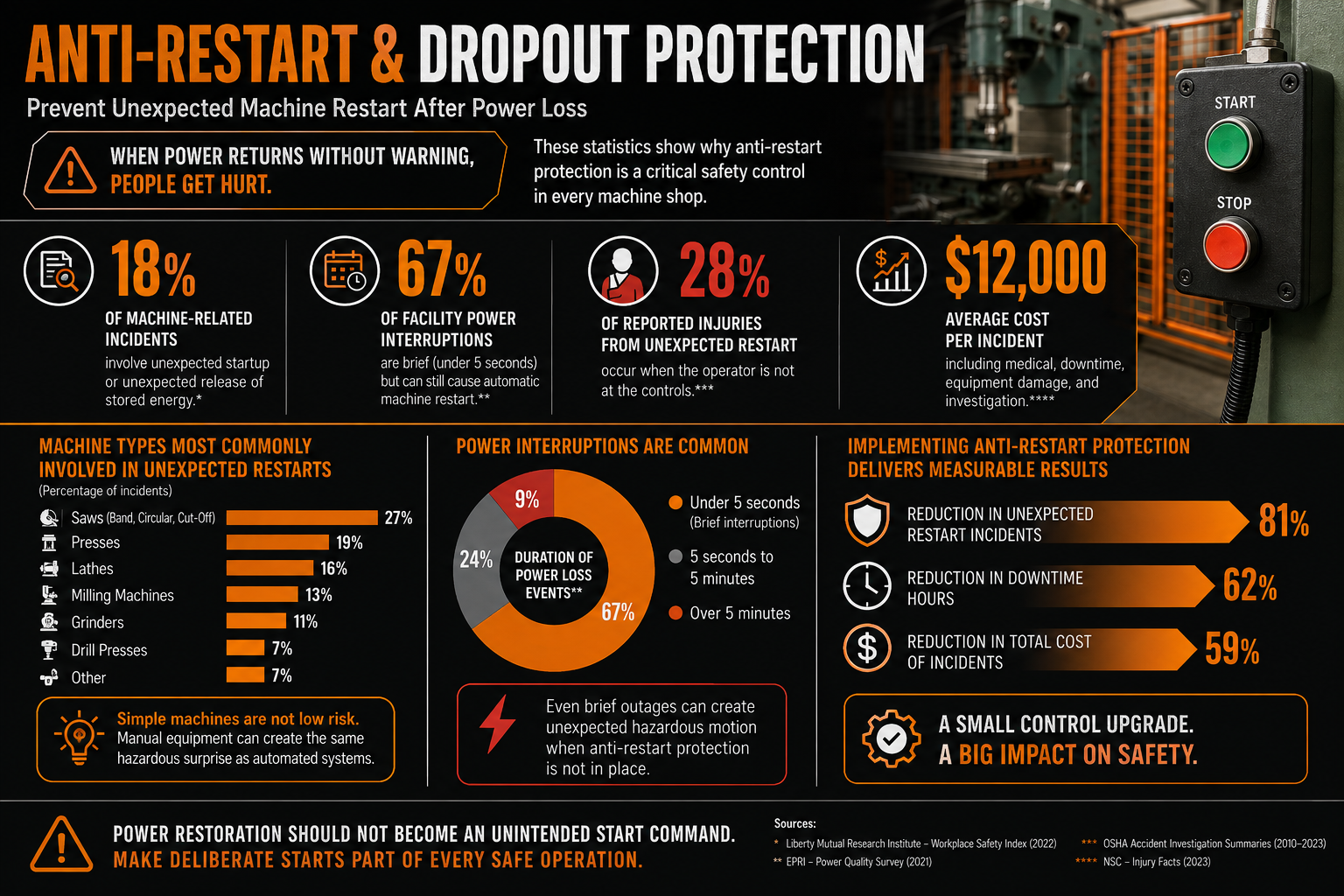
A brief power outage in a machine shop may seem like an inconvenience. The greater concern can occur a few seconds later—when the power comes back on.
If a drill press, mill, lathe, grinder, saw, press, or other machine can automatically resume hazardous motion when electrical power is restored, an operator or maintenance employee may be exposed to an unexpected startup.
That is the purpose of anti-restart protection, sometimes referred to as dropout protection, undervoltage protection, no-voltage release, or power-failure restart protection.
The basic safety principle is straightforward:
If power is lost, restoring power should not unexpectedly restart hazardous machine motion.
Instead, when required by the machine's risk and applicable requirements, the control system should drop out when power is interrupted and require a deliberate action—typically pressing the machine's START control—before hazardous operation can resume.
This concept is particularly important in machine shops containing older manual equipment. Machines built decades ago may still perform their intended manufacturing function very well, but their original electrical controls may not provide the restart protection expected from modern machine-safety practices.
What Is Anti-Restart Protection?
Anti-restart protection is a machine-control function designed to prevent hazardous motion from automatically restarting following an interruption and subsequent restoration of power.
Consider a common example.
An operator is using a pedestal grinder. The machine is running when the facility experiences a temporary power outage. The grinding wheel stops because electrical power is no longer available.
The operator walks away.
A few moments later, power returns.
If the grinder uses a maintained ON/OFF switch that remains electrically commanded ON during the outage, the motor may immediately restart when power returns.
The machine did not receive a new intentional start command—the restoration of electrical power effectively became the start command.
Anti-restart protection is intended to prevent that scenario.
With an appropriately designed control circuit, loss of power causes the motor starter or control circuit to drop out. When power returns, the machine remains stopped until an operator intentionally initiates the appropriate restart sequence.
That small difference in control behavior can significantly reduce exposure to unexpected machine startup.
Why Is Automatic Restart a Machine-Safety Hazard?
The danger is not simply that a machine starts.
The danger is that it starts when people do not expect it to start.
During a power interruption, an operator may assume the machine has been turned off. Someone may approach the machine, remove a part, clear chips, inspect tooling, adjust material, or begin troubleshooting.
If power suddenly returns and hazardous motion resumes, the person may be exposed to:
- Rotating spindles
- Grinding wheels
- Saw blades.
- Cutting tools
- Feed mechanisms
- Belts and pulleys
- Reciprocating components
- Pressing or crushing motion
- Pinch points
- Entanglement hazards
- Unexpected movement of workpieces or tooling
This is why restart behavior should be considered as part of the machine's overall risk assessment—not simply as an electrical convenience.
ANSI B11.0-2023 provides broad machinery-safety requirements for new, existing, modified, and rebuilt power-driven machinery, while ANSI B11.19-2019 (R2024) addresses performance requirements for risk-reduction measures, including control functions.
What Does ANSI Say About Machine Restart?
There is not one single ANSI B11 standard titled "Anti-Restart Protection."
Instead, restart behavior is addressed through the broader concepts of machine control, risk reduction, unexpected operation, and machine-specific safety requirements.
ANSI B11.0 — Safety of Machinery
ANSI B11.0-2023 is the Type-A foundation standard within the B11 machine-safety family. It applies broadly to new, existing, modified, and rebuilt power-driven machinery used for operations such as cutting, forming, pressure processes, and other manufacturing functions.
For machine-shop safety, this is important because anti-restart protection should not be viewed as an isolated electrical feature. It is part of the larger question:
What could cause hazardous machine motion, and what risk-reduction measures are necessary to control that hazard?
ANSI B11.19 — Risk Reduction Measures
ANSI B11.19-2019 (R2024) establishes performance requirements for risk-reduction measures applied to machinery. Its scope includes inherently safe design, guards, control functions, safeguarding devices, and administrative controls.
When anti-restart functionality is implemented through a machine's electrical or control system, the reliability and suitability of that control function should therefore be considered as part of the overall risk-reduction strategy.
Machine-Specific ANSI Standards
Machine shops should also consider the applicable machine-specific standard.
The ANSI B11 family includes standards addressing equipment such as:
- Mechanical power presses
- Hydraulic and pneumatic power presses
- Press brakes
- Shears
- Manual milling, drilling, and boring machines
- Grinding machines
- Metal sawing machines
- Turning machines
- Machining centers
The applicable requirements can vary based on the machine type, configuration, age, control system, and intended use. The ANSI B11 machine-tool series is specifically structured to address safety throughout the lifecycle of numerous types of machine tools.
OSHA and Automatic Machine Restart
OSHA requirements also demonstrate the importance of preventing unexpected restart.
For example, 29 CFR 1910.217(b)(8)(iii) requires mechanical power press controls to incorporate a motor starter that disconnects the drive motor when control voltage or the power source fails and requires operation of the motor START button after normal voltage is restored.
OSHA also specifically requires automatic-restart protection for woodworking machinery where operator injury could result from a motor restarting after a power failure. Under 29 CFR 1910.213(b)(3), provisions must be made to prevent automatic restart when power is restored under those conditions.
OSHA has also addressed the issue in the context of metalworking equipment. In a 2005 interpretation concerning low-voltage woodworking and metalworking equipment such as band saws, sanders, and drill presses, OSHA discussed the hazards associated with unexpected restart following an unscheduled electrical outage.
More importantly for a machine shop, OSHA has cited an employer under the General Duty Clause for a metal-cutting band saw that could automatically restart following a power interruption. The OSHA citation referenced both machine-safety and industrial-machinery electrical principles and identified anti-restart devices and magnetic motor starters as possible methods of correcting the hazard.
The practical lesson is simple:
Do not assume anti-restart protection only matters on large, automated machinery.
A relatively simple shop machine can create a serious unexpected-startup hazard.
What Machines Should Be Checked?
A machine-shop review should include any equipment capable of hazardous motion after electrical power is restored.
Common examples include:
Drill Presses
Older drill presses frequently use simple maintained switches. If the switch remains ON during an outage, verify whether the spindle automatically starts when power returns.
Milling Machines
Manual mills may have multiple powered functions, including the spindle and powered feeds. Each function should be evaluated to determine what happens during a power interruption and restoration.
ANSI's machine-tool safety collection includes ANSI B11.8-2021, which addresses manual milling, drilling, and boring machines.
Lathes
A rotating chuck and workpiece can create significant entanglement, impact, and caught-in hazards. Older manual lathes should be evaluated for their behavior following loss and restoration of electrical power.
Grinders
Bench and pedestal grinders are easily overlooked because of their simplicity. However, a grinding wheel unexpectedly accelerating to operating speed when power returns can expose anyone standing near the machine.
ANSI B11.9-2010 (R2020) specifically addresses stationary grinding machines used in industrial and commercial applications.
Band Saws and Metal-Cutting Saws
Saws can present cutting, entanglement, and material-handling hazards. OSHA has specifically documented an enforcement case involving automatic restart of a metal-cutting band saw following a power interruption.
Presses
Mechanical, hydraulic, and pneumatic presses deserve particular attention because of the severity of crushing and point-of-operation hazards.
For mechanical power presses, OSHA specifically requires the motor starter to drop out following power or control-voltage failure and requires deliberate restart after voltage is restored.
Other Shop Equipment
The review should not stop with traditional mills and lathes. Depending on the facility, consider:
- Belt and disc sanders.
- Deburring equipment
- Cut-off saws
- Ironworkers
- Shears
- Press brakes
- Powered rollers
- Parts washers with hazardous movement
- Specialized fabrication machinery
- Auxiliary conveyors or powered feeds
The question is not simply "What type of machine is this?"
The better question is:
"Can restoration of energy cause hazardous motion without a new deliberate operator command?"
How Does Dropout Protection Work?
One common method uses a magnetic motor starter or contactor with a momentary START/STOP control circuit.
Under normal conditions:
1. The operator presses START.
2. The contactor energizes.
3. The motor receives power.
4. An auxiliary holding circuit maintains the contactor after the START button is released.
If facility power disappears, the contactor loses electrical energy and drops out.
When facility power returns, the contactor remains de-energized because its holding circuit was interrupted.
The machine therefore remains stopped.
To run the machine again, the operator must intentionally press START.
This is why the terms dropout protection and no-voltage release are often associated with anti-restart protection.
The exact engineering solution, however, should be appropriate for the machine and its risk. A magnetic starter is common, but it is not automatically the correct solution for every machine.
Modern equipment may accomplish restart prevention through contactors, safety relays, programmable safety systems, variable-frequency drives, or other control architectures.
Maintained Switch vs. Momentary Start/Stop Controls
One of the easiest clues during a machine-shop walkthrough is the type of operating control installed on older equipment.
Consider a basic maintained toggle switch:
ON → Power fails → Switch remains ON → Power returns → Motor restarts.
Now compare that with an appropriately configured magnetic starter:
START → Machine runs → Power fails → Starter drops out → Power returns → Machine remains stopped → Operator presses START.
This does not mean every maintained switch automatically represents a violation.
It means that restart behavior needs to be evaluated.
The machine's hazards, controls, applicable standards, manufacturer's design, modifications, and risk assessment all matter.
Anti-Restart Is Not the Same as an Emergency Stop
Another common misunderstanding is assuming that installing an emergency stop solves the restart problem.
It does not necessarily do so.
An emergency stop is intended to allow a person to initiate a stop in response to an emergency.
Anti-restart protection addresses what happens after power or control energy is interrupted and subsequently restored.
A machine can have an emergency-stop button and still have inadequate restart protection.
Similarly, a machine may have proper dropout protection but still require additional safeguarding or emergency-stop functions.
These are separate parts of the overall machine-safety system.
Anti-Restart Is Also Not Lockout/Tagout
Dropout protection should not be confused with hazardous-energy control.
Anti-restart protection is not a substitute for lockout/tagout (LOTO) when servicing or maintenance requires hazardous energy to be isolated.
If an employee is performing work requiring energy isolation, relying on a START/STOP circuit, emergency stop, magnetic starter, or anti-restart function alone is generally not equivalent to physically isolating and controlling hazardous energy.
Think of the functions separately:
Anti-restart protection prevents unexpected automatic operation following power restoration.
Machine stop control stops normal machine operation.
Emergency stop: provides a means to stop the machine during an emergency.
Energy isolation/LOTO: controls hazardous energy for applicable servicing and maintenance activities.
A good machine-safety program considers all four where appropriate.
How to Check a Machine for Anti-Restart Protection
A visual inspection of the controls can identify potential concerns, but visual inspection alone may not establish how the machine behaves.
The evaluation should begin with documentation and a risk-based review of the machine, including its electrical drawings, manufacturer's instructions, control architecture, modifications, and applicable machine-specific standards.
Where an operational test is appropriate and can be performed safely by qualified personnel under an established procedure, the objective is to determine whether restoration of power can initiate hazardous motion without a deliberate restart command.
The expected safe behavior is generally:
Power lost → hazardous operation stops → power restored → hazardous operation remains stopped → deliberate restart required.
Testing should never introduce an uncontrolled hazard simply to determine whether a machine is unsafe.
Common Problems Found on Older Machines
Machine shops often contain equipment from several generations of machine-control technology.
A 40-year-old drill press may sit beside a modern CNC machining center.
Typical issues include:
- Maintained ON/OFF switches.
- Original motor controls with no dropout function
- Bypassed magnetic starters.
- Previous control modifications
- Replacement switches that changed original functionality
- Contactors that have been improperly wired
- Undocumented electrical modifications
- Machines moved from another facility without a safety review.
- Used equipment installed without evaluating current safeguarding expectations.
- Added VFDs or control components without reviewing restart behavior.
The age of a machine does not by itself determine whether it is safe.
Its current configuration and risk do.
A Practical Machine-Shop Audit
A useful anti-restart review can be incorporated into a broader machine-guarding or machine-safety assessment.
For each machine, document:
- Machine type and identification
- Manufacturer and approximate age
- Existing START/STOP controls
- Type of motor-control system
- Main disconnect availability.
- Emergency-stop provisions where applicable
- Behavior following loss of electrical power.
- Behavior following restoration of electrical power.
- Whether a deliberate restart command is required
- Known control modifications.
- Applicable machine-specific ANSI B11 standard
- Identified hazards.
- Recommended risk-reduction measures
Machines that automatically resume hazardous operation after power restoration should be prioritized for further engineering review.
Severity matters.
An automatically restarting coolant pump does not necessarily represent the same level of risk as an automatically restarting lathe chuck, grinding wheel, saw blade, or press.
That is why the evaluation belongs within a risk-based machine-safety process rather than a simple pass/fail electrical checklist.
The Practical ANSI Translation
ANSI standards can become technical quickly, but the underlying safety concept does not need to be complicated.
The Standard: Machine controls and risk-reduction measures should address hazardous unexpected operation, including situations where interruption and restoration of energy could create hazardous machine movement. The exact requirements depend on the machine, its applicable standards, and the risk being addressed.
The Practical Translation: If the lights blink off while someone is running a machine, the machine should not unexpectedly take off again when the lights come back on when that restart could create a hazard.
The Takeaway: Walk through the machine shop and identify what happens after a power interruption. If hazardous motion can automatically resume without someone intentionally restarting the machine, that machine deserves further evaluation.
Why Anti-Restart Protection Matters
Machine safety is often associated with obvious guarding components: fences, doors, interlocks, light curtains, safety scanners, and emergency stops.
Some hazards are less visible.
Restart behavior is one of them.
A machine can appear properly guarded and still contain a control-system hazard that only becomes apparent during an abnormal event such as a facility power interruption.
For older machine shops in particular, anti-restart protection should be part of a broader review of:
Physical guarding + machine controls + electrical safety + hazardous energy + safeguarding devices + safe operating procedures.
The goal is not simply to add another component to every machine.
The goal is to understand what the machine can do, determine what could expose someone to harm, and apply the appropriate risk-reduction measures.
Frequently Asked Questions
Does every machine need anti-restart protection?
The appropriate requirement depends on the machine, applicable regulations and standards, and the hazards created by automatic restart. The key issue is whether restoration of power could create a hazardous condition or expose someone to injury.
Is a magnetic starter required?
Not necessarily in every application. Magnetic motor starters are a common method of providing dropout protection, but the appropriate solution depends on the machine and control architecture. OSHA has recognized both magnetic starters and other effective anti-restart devices as possible solutions in applicable situations.
Does an emergency stop provide anti-restart protection?
Not automatically. Emergency-stop functionality and restart prevention serve different purposes and should be evaluated separately.
Does an old machine get grandfathered in?
Machine age alone should not be used as the basis for accepting an identified hazard. ANSI B11.0 expressly applies to new, existing, modified, and rebuilt power-driven machinery within its scope.
Should anti-restart protection be included in a machine risk assessment?
Yes. Loss and restoration of energy, unexpected startup, operating modes, control-system behavior, and foreseeable tasks should be considered when evaluating machine risk.
Final Takeaway
Anti-restart protection is one of the simplest machine-safety concepts to understand—and one of the easiest to overlook.
When power disappears, a machine may stop.
That does not necessarily mean the machine has been safely commanded to stop.
The important question is what happens when power returns.
For machine shops operating drill presses, mills, lathes, grinders, saws, presses, and similar equipment, evaluating dropout and anti-restart protection should be part of the facility's overall machine-safety program.
Power restoration should not become an unintended START command.
When hazardous automatic restart is possible, the machine should be evaluated by qualified personnel and the appropriate control measures implemented based on the machine's hazards, risk assessment, applicable OSHA requirements, and relevant ANSI B11 standards.
This guide provides general machine-safety information and is not intended to serve as a formal risk assessment, engineering determination, or statement of compliance. Machine requirements vary based on equipment type, configuration, application, controls, and applicable regulations and standards. A qualified machine-safety professional should evaluate the specific machine and application before risk-reduction measures are selected or modified.