Amber Stack Lights for Safety Bypass
Machine safeguarding is designed to prevent people from being exposed to hazardous machine motion. In some situations, however, authorized personnel may need limited access to a machine while certain safety functions are intentionally bypassed for specific tasks such as troubleshooting, setup, testing, or maintenance. When this occurs, it is critical that everyone in the area clearly understands the machine is operating under a special condition.
One of the most recognized methods of communicating this condition is the use of an amber stack light as a visual indication that a safeguard bypass is active.
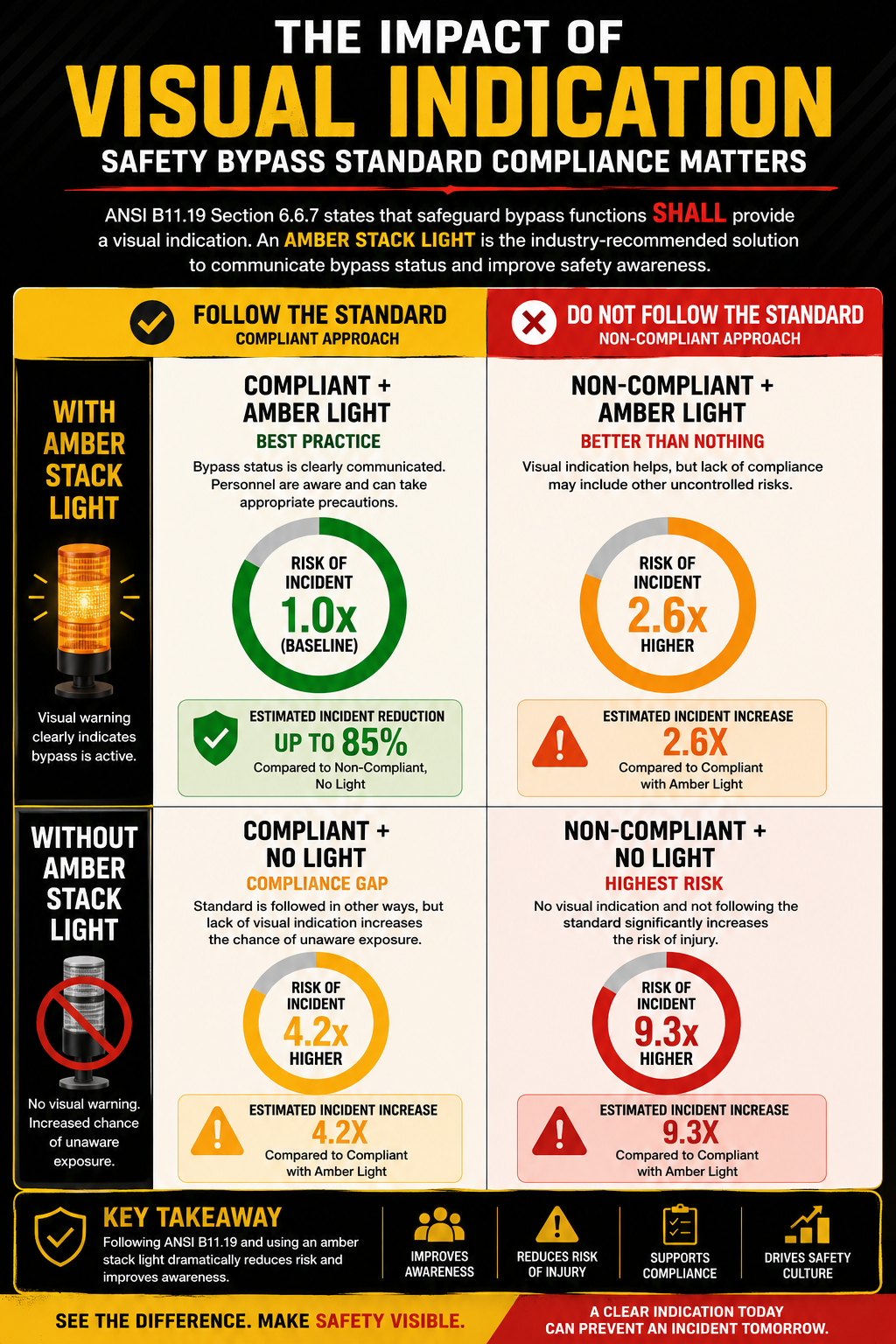
While an amber light by itself does not make a machine safe, it serves as an important layer of risk reduction by providing a clear visual warning to operators, maintenance personnel, supervisors, and anyone nearby that the machine is not operating in its normal safeguarded mode.
Understanding why this visual indication exists, when it should be used, and how it fits into an overall machine safety strategy can help manufacturers improve safety awareness while supporting efficient maintenance and troubleshooting activities.
What Is a Safeguard Bypass?
A safeguard bypass is a controlled method of temporarily overriding selected safeguarding functions so authorized personnel can perform specific machine tasks that cannot reasonably be completed while the machine remains fully safeguarded.
Typical examples include:
- Machine setup
- Teaching positions
- Troubleshooting automation
- Sensor adjustment
- Process verification
- Maintenance diagnostics
- Functional testing
- Recovery after machine faults
These activities often require observing machine motion while remaining close to the equipment.
A bypass should never be considered normal production operation.
Instead, it should only be available under carefully controlled conditions using documented procedures, trained personnel, and engineered safety controls that minimize the resulting risk.
Why Does a Visual Indication Exist?
When a safeguard is bypassed, the machine may appear normal from the outside.
Without an obvious indication, another employee could unknowingly approach the machine believing all safeguarding remains active.
This creates unnecessary confusion and increases risk.
A visual indication immediately communicates that the machine is operating differently than normal.
The purpose is simple:
- Increase awareness
- Alert nearby personnel
- Support safe decision making
- Reduce unexpected exposure
- Reinforce controlled operating procedures
Visual indication is intended to supplement—not replace—proper engineering controls, safe operating procedures, employee training, and risk assessment.
ANSI Guidance for Visual Indication
ANSI machine safety guidance recognizes that when safeguard bypass functions are used, personnel should receive a clear indication that the bypass condition exists.
Section 6.6.7 discusses the use of a visual indication associated with safeguard bypass functions. A common implementation is an amber stack light, which provides a highly visible indication that the machine is operating under a bypass condition.
Although specific machine designs and risk assessments determine the appropriate implementation, the intent remains consistent:
Personnel should be able to quickly recognize that safeguarding has been intentionally modified for an authorized purpose.
Why Amber?
Color selection plays an important role in industrial communication.
Amber has long been associated with caution.
Unlike a green light, which typically communicates normal operation, or a red light, which commonly indicates an emergency stop, alarm, or fault condition, amber communicates that special attention is required.
When illuminated during an active safeguard bypass, an amber stack light helps communicate:
- Normal safeguarding may not be active.
- Authorized operation is occurring.
- Increased awareness is required.
- Only trained personnel should be involved.
Because amber is widely recognized throughout manufacturing facilities, personnel can quickly identify the condition even without reading labels or documentation.
Common Situations Where Amber Stack Lights Are Used
Safeguard bypass functions may be incorporated into many types of industrial equipment.
Examples include:
Robotic Cells
Maintenance personnel may need to observe robot movement while adjusting tooling or verifying programmed paths.
Packaging Equipment
Technicians often troubleshoot sensors, conveyors, and timing mechanisms during machine setup.
Automated Assembly Systems
Servo positioning and indexing operations sometimes require controlled motion while protective devices are temporarily bypassed.
Material Handling Systems
Conveyor transitions, palletizing systems, and transfer stations may require diagnostic movement.
Press Automation
Feed systems, transfer mechanisms, or auxiliary equipment may require controlled testing.
CNC Automation
Automatic loading systems, bar feeders, and robotic tending applications often require maintenance diagnostics.
Custom Manufacturing Equipment
Many one-of-a-kind machines include maintenance modes that benefit from controlled bypass functionality combined with visual indication.
Visual Indication Is Only One Layer of Safety
An amber stack light should never be viewed as the primary protective measure.
Instead, it becomes one component within an engineered safety system.
Depending on the machine and risk assessment, additional protective measures may include:
- Mode selection switches
- Key-operated selector switches
- Password-protected access
- Reduced speed operation
- Hold-to-run controls
- Three-position enabling devices
- Safety-rated monitored stop functions
- Safety PLC programming
- RFID interlocked access doors
- Trapped key systems
- Safety scanners
- Light curtains
- Emergency stop circuits
- Safety relays
- Safety controllers
Each application should be evaluated individually to determine which combination of protective measures provides an appropriate level of risk reduction.
Factors Engineers Consider
Designing a safeguard bypass involves much more than installing an indicator light.
Machine safety engineers evaluate numerous factors, including:
- Type of machine
- Hazard severity
- Required maintenance activities
- Frequency of bypass use
- Access locations
- Operator interaction
- Existing safety devices
- Functional safety architecture
- Control reliability
- Applicable standards
- Production requirements
- Human factors
The goal is to balance productivity, maintainability, and worker protection without introducing unnecessary complexity.
Integration Into Modern Safety Controls
Modern safety systems allow visual indication to become an integrated function rather than a standalone device.
For example, the amber stack light may automatically illuminate whenever:
- Maintenance mode is selected.
- A bypass key switch is activated.
- A safety function is intentionally overridden.
- Setup mode is entered.
- Reduced-speed operation is enabled.
- Special operating modes are active.
Programming the indication directly into the machine's safety control architecture helps ensure consistent operation and reduces the possibility of human error.
Benefits of an Amber Stack Light
Although relatively simple, an amber indication provides several operational benefits.
Improved Awareness
Personnel immediately recognize the machine is operating differently than normal.
Better Communication
The visual signal communicates machine status without requiring verbal instruction.
Supports Maintenance
Technicians receive confirmation that bypass mode has been intentionally activated.
Increased Consistency
Facilities can standardize bypass indication across multiple machines.
Supports Safety Culture
Visible communication reinforces safe work practices and encourages employees to remain aware of changing machine conditions.
What an Amber Stack Light Does Not Do
It is equally important to understand what the indicator does not accomplish.
An amber stack light does not:
- Prevent access to hazards.
- Stop hazardous motion.
- Replace interlocked guarding.
- Replace lockout/tagout procedures.
- Replace risk assessments.
- Replace functional safety design.
- Replace operator training.
- Eliminate hazards.
Instead, it communicates information that supports safe decision making.
Human Factors Matter
Industrial environments are busy.
Operators may supervise multiple machines simultaneously.
Maintenance personnel often work under time pressure.
Supervisors may walk through production areas without detailed knowledge of each machine's operating condition.
Because people naturally rely on visual cues, an illuminated amber stack light becomes an effective method for quickly communicating that something about the machine has changed.
This reduces uncertainty and helps personnel recognize when additional caution is appropriate.
Developing a Standardized Approach
Many manufacturers choose to standardize the use of visual indications throughout their facilities.
Benefits of standardization include:
- Consistent operator expectations
- Easier employee training
- Reduced confusion between departments
- Simplified maintenance
- Better documentation
- Improved troubleshooting
- More consistent machine upgrades
Standardization also supports future equipment purchases by establishing clear internal expectations for machine builders and system integrators.
Engineering the Right Solution
No two manufacturing facilities are identical.
A robotic welding cell has different operational needs than a packaging line.
A stamping press differs from a CNC machining center.
A converting line differs from an automated assembly system.
For this reason, safeguard bypass functions should always be evaluated within the context of the specific machine, hazards, production process, and maintenance requirements.
An experienced machine safety team can help determine:
- Whether a bypass function is appropriate.
- Which operating modes are needed.
- How visual indication should be implemented.
- What additional safeguards should be incorporated.
- How the system integrates with existing controls.
- How documentation and operator training should support the design.
Frequently Asked Questions
Is an amber stack light required on every machine?
No. The need for visual indication depends on the machine's design, operating modes, applicable standards, and results of the machine risk assessment.
Does an amber light make a bypass safe?
No. It communicates that a bypass condition exists but does not reduce hazards by itself.
Can bypass functions be used during production?
Bypass functions should only be used for authorized purposes defined by the machine design, operating procedures, and facility safety program—not as a way to avoid proper safeguarding during routine production.
Should every machine use the same stack light colors?
Many facilities establish internal standards for stack light colors to improve consistency and operator recognition across equipment.
Who should design safeguard bypass systems?
Machine safety engineers and qualified control system designers should evaluate the application to ensure bypass functions are implemented appropriately and integrated into the overall safety strategy.
How PowerSafe Automation Can Help
Designing safeguard bypass functions requires more than selecting a stack light. It requires understanding machine hazards, operating modes, applicable safety standards, and how people interact with equipment during setup, maintenance, troubleshooting, and production.
PowerSafe Automation specializes in turnkey machine safety solutions that integrate risk assessments, engineered safeguarding, safety controls, functional safety concepts, machine guarding, and validation into a complete solution. Whether you're upgrading a legacy machine or designing a new production cell, our team can incorporate visual indication strategies—such as amber stack lights for safeguard bypass conditions—into a properly engineered safety system tailored to your application.
From initial machine safety assessments through control system design, guard fabrication, installation, integration, and final validation, PowerSafe Automation helps manufacturers develop practical machine safety solutions that support both worker protection and operational efficiency.
If you're planning a machine guarding retrofit, safety control upgrade, or complete machine safety modernization, contact PowerSafe Automation to discuss how engineered safeguard bypass functions and integrated visual indication can become part of your overall risk reduction strategy.
Final Thoughts
An amber stack light may seem like a small component, but its role in communicating safeguard bypass conditions can significantly improve situational awareness within a manufacturing environment. When combined with properly engineered safety controls, documented procedures, employee training, and comprehensive risk assessments, visual indication helps create a clearer understanding of machine operating conditions for everyone working around the equipment.
Rather than serving as a standalone safety device, the amber stack light functions as an important communication tool within a layered machine safety strategy. By integrating these visual indicators into modern safety control systems, manufacturers can improve consistency, support maintenance activities, and reinforce a proactive safety culture while aligning with recognized industry guidance.