The Challenge
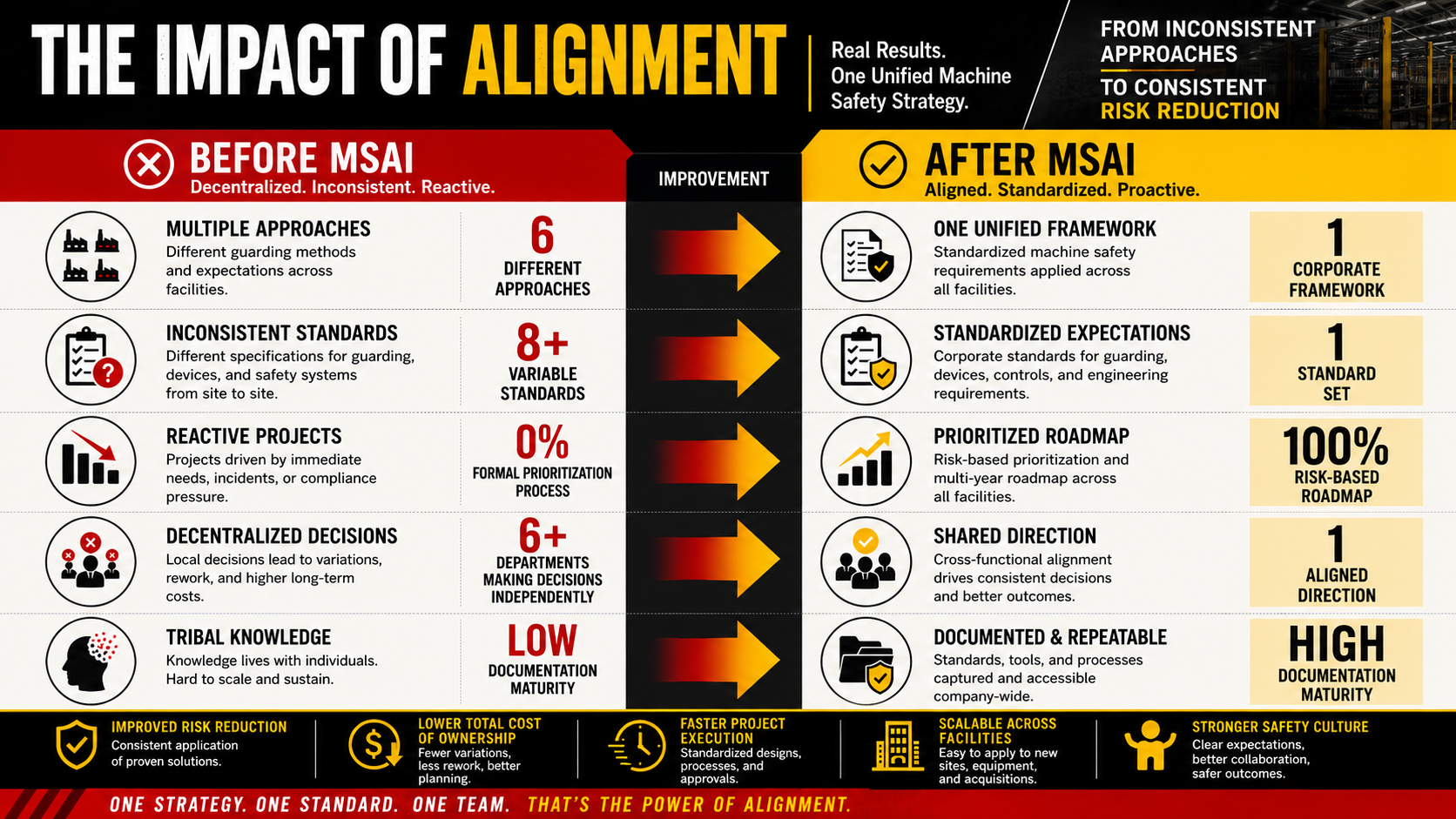
A multi-site consumer goods manufacturer had been addressing machine safety for years, but each facility was largely doing it its own way.
Individual plants had different equipment, different levels of machine age and automation, and different approaches to safeguarding. Risk reduction projects were being completed, but decisions surrounding guarding construction, safety devices, controls, access, and implementation were not always consistent from one facility to another.
The company was not necessarily looking for another machine guarding project.
They were looking for a way to create consistency across the organization.
Questions began to shift from:
"How should we guard this machine?"
to:
"How should our company approach machine safety?"
The Approach
At the time, PowerSafe Automation did not have a formal program called the Machine Safety Alignment Initiative (MSAI).
Instead, we collaborated quietly with the customer's safety and engineering teams to help organize what was already being learned through individual projects.
Together, we began establishing a more consistent framework around:
- Machine safeguarding expectations
- Preferred guarding methods and construction.
- Safety device applications
- Electrical and controls considerations
- Risk reduction priorities.
- Engineering and project expectations
- Documentation and validation
- Consistency between facilities
The objective was not to make every machine identical.
It was to give different facilities and project teams a common starting point for making machine safety decisions.
From Individual Projects to a System
As the framework developed, something important became clear.
The value was not only in the guarding systems being installed.
The greater value came from creating an infrastructure around machine safety.
Instead of repeatedly starting from zero when a new machine, facility, project, or hazard was identified, the organization could reference previously established expectations and use them to guide the next decision.
That helped create a more repeatable path:
Identify Risk → Prioritize → Apply Standards → Engineer Risk Reduction → Implement → Validate → Improve.
Machine safety began functioning less like a collection of individual projects and more like an ongoing organizational system.
What We Learned
Working through this process showed PowerSafe something we believed other manufacturers were likely experiencing as well:
Many companies do not have a machine safety problem because they are not doing anything. They have a consistency problem because they are doing many things independently.
A corporate safety leader may establish one expectation.
A plant engineer may use another.
An OEM may provide something different.
A machine guarding integrator may introduce another solution.
And the next facility may start the process all over again.
Even when everyone is trying to reduce risk, the organization can gradually accumulate different technologies, designs, expectations, and approaches.
The Result
The customer gained a more structured approach for managing machine safety across facilities while still allowing individual sites to address the realities of their equipment and operations.
For PowerSafe, the project became something else.
It became a proving ground.
We saw how much value could be created when assessment, standards, engineering, risk reduction, validation, documentation, and long-term planning were treated as parts of the same machine safety lifecycle.
We had effectively built the early version of a service we had not formally named yet.
From a Quiet Customer Initiative to MSAI
After seeing the framework work in practice, PowerSafe Automation decided to formalize the methodology and make it available to other manufacturers.
That became the Machine Safety Alignment Initiative (MSAI).
MSAI is designed to help multi-facility manufacturers move beyond isolated guarding projects and establish a common machine safety strategy that can be applied across plants, equipment, engineering teams, and future projects.
The goal is not to create another binder of requirements.
It is to create an operating framework that helps an organization answer a much more important question:
"How do we want machine safety managed throughout our company?"
Today, MSAI can include:
Corporate machine safety strategy and standards, assessment structure, risk-reduction road mapping, practical tools and resources, engineering expectations, validation practices, and ongoing program reviews—all built around the manufacturer's operations, equipment, and existing safety culture.
Customer confidentiality: Certain identifying information, facility details, equipment information, and project specifics have been intentionally generalized to protect customer confidentiality. This case study represents an actual PowerSafe Automation customer engagement and the lessons that contributed to the development of the Machine Safety Alignment Initiative.