Grinding, sanding, polishing, buffing, and deburring are everyday operations in manufacturing, and all of them can generate airborne dust and particulate directly in an employee's work area. The solution isn't as simple as placing a dust collector somewhere nearby.
OSHA requirements and ANSI industrial ventilation principles focus on something more specific: controlling contaminants at or near the point where they're generated and keeping them out of the employee's breathing zone. For machine shops, that typically means properly designed dust collection hoods, local exhaust ventilation, downdraft tables, or a combination of controls.
The OSHA Standard: 29 CFR 1910.94(b)
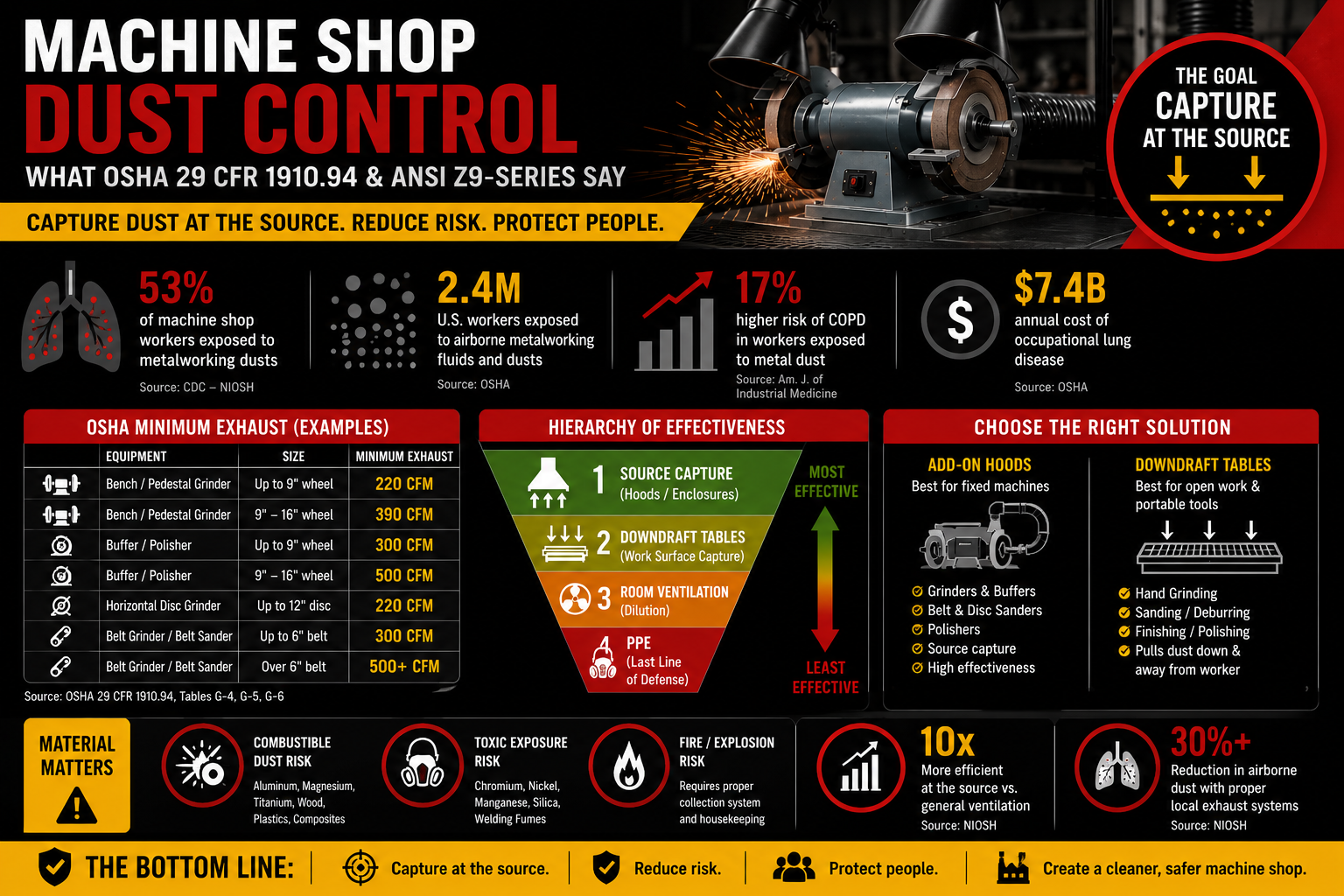
OSHA addresses ventilation for grinding, polishing, and buffing operations under 29 CFR 1910.94(b). The regulation applies to dry grinding, polishing, and buffing where employee exposure exceeds applicable permissible exposure limits, and in those situations, OSHA requires local exhaust ventilation to keep exposure within the prescribed limits.
But OSHA goes further than simply requiring “dust collection” — the standard addresses how the contaminant should be captured. Exhaust hoods must be designed and positioned so dust and particles are projected or drawn toward the hood and in the direction of airflow, not into the operator's breathing zone. That distinction matters: a dust collector may be running, but if the hood or collection point is poorly positioned, the operator can still be exposed before the dust ever reaches the collection system.
OSHA 1910.94 provides exhaust requirements for several common machine types, including bench and pedestal grinders, abrasive cutoff wheels, buffing and polishing wheels, scratch-brush wheels, disc and belt grinders, belt sanders and polishing belts, swing-frame grinders, and portable grinding operations. Minimum exhaust volumes are established for many of these based on wheel, disc, or belt size — for example, a bench or pedestal grinder with a wheel up to nine inches in diameter has a listed minimum exhaust volume of 220 CFM, and buffing or polishing wheels up to nine inches have a listed minimum of 300 CFM, with larger wheels and wider belts requiring progressively greater volumes. Dust collection needs to be matched to the specific machine and application, not applied as a one-size-fits-all fix.
Where ANSI Z9 Fits In
The ANSI/ASSP Z9 series addresses industrial ventilation and airborne contaminant control. OSHA 1910.94 specifically references the historical ANSI Z9.2, Fundamentals Governing the Design and Operation of Local Exhaust Systems, for the design and testing of exhaust systems used for grinding, polishing, and buffing. The underlying engineering principle remains highly relevant: capture the contaminant as close to its source as practical. Once dust disperses throughout the room, controlling employee exposure becomes much more difficult.
That's why local exhaust ventilation is fundamentally different from general building ventilation. General ventilation dilutes contaminated air; local exhaust ventilation captures the contaminant before it reaches the employee.
Add-On Hoods vs. Downdraft Tables
There isn't one dust-control solution that fits every machine.
For a fixed bench grinder, pedestal grinder, buffer, or belt sander, an appropriately designed add-on collection hood can often capture particles very close to where they're generated. OSHA specifically addresses hoods for this type of equipment and calls for them to be located as close as possible to the operation — a typical configuration looks like bench grinder → collection hood → duct → dust collector. The hood needs to complement the machine's existing guarding rather than compromise it.
A downdraft table approaches the problem differently: instead of capturing particulate through a hood immediately adjacent to a wheel or belt, airflow is drawn downward through the work surface, pulling material away from the employee as the workpiece is positioned over the collection area. This can make downdraft solutions particularly useful for hand grinding, portable grinding, deburring, sanding, finishing, and small-part cleanup.
Simply placing a bench grinder on top of a downdraft table doesn't automatically satisfy OSHA's ventilation requirements, though. Direction and velocity of the material leaving the machine, airflow, capture distance, hood configuration, the material being processed, and employee position all factor in. For some fixed machines, source capture through an add-on hood may be more appropriate than downdraft alone; for other applications, a combination makes sense.
Don't Forget the Material Being Collected
The machine is only half of the equation — you also need to understand what material is being processed. Grinding carbon steel isn't the same dust-control application as grinding stainless steel, aluminum, magnesium, titanium, plastics, composites, or wood products. Certain materials raise additional exposure concerns, and some metal and non-metal dust can present combustible dust or fire hazards, which can significantly change the appropriate collection method.
A conventional dry dust collector shouldn't automatically be applied to every grinding or sanding operation. The material, dust characteristics, potential ignition sources, collector design, ductwork, location, and applicable fire and explosion requirements should all be evaluated as part of the application.
Integrate Dust Control With Machine Safety
There's another issue that can get overlooked during dust-control retrofits: the collection system shouldn't create a new machine hazard. Adding a hood to a grinder or sander can affect machine guarding, operator access, workpiece handling, visibility, maintenance access, electrical controls, emergency stopping, machine restart, and existing safeguarding.
A better approach is to evaluate the dust-control system as part of the machine rather than as separate equipment — machine → guarding → dust capture → collection → controls — with the control system verifying that the collection system is operating before allowing the machine to run.
A Practical Risk-Reduction Approach
When evaluating grinding, buffing, polishing, sanding, or deburring operations, start with a few basic questions:
- What is being generated? Identify the dust, particulate, fumes, and material characteristics.
- Where is it being generated? Determine the actual point of generation.
- Where does it travel? Consider wheel rotation, belt direction, particle trajectory, and the operator's breathing zone.
- Can it be captured at the source? An add-on hood or partial enclosure may be the most effective approach.
- Would a downdraft solution be more practical? Portable grinding, sanding, deburring, and finishing applications may lend themselves well to downdraft collection.
- Does the material create additional hazards? Combustible dust and material-specific exposure hazards may require specialized equipment and engineering.
- Does the solution integrate safely with the machine? Dust collection shouldn't interfere with guarding or introduce additional operating hazards.
OSHA and ANSI don't simply say “install a downdraft table.” The objective is to reduce employee exposure by capturing airborne contaminants as close to their source as practical — whether that's add-on collection hoods for grinders, buffers, and sanders, downdraft tables for grinding, sanding, deburring, and finishing, integrated dust collection for machines producing significant particulate, or specialized engineering where combustible or hazardous materials are involved.
The right question isn't “do I need a downdraft table?” It's “where is the hazard being generated, and what's the most effective way to capture it before it reaches the employee?”
This article provides general educational information regarding machine safety and industrial ventilation. The appropriate solution depends on the machine, process, material, employee exposure, dust characteristics, and applicable regulatory and consensus-standard requirements. A qualified assessment should be performed before selecting or modifying a dust-control system.
If your machine shop needs a dust-control system engineered alongside your existing guarding rather than bolted on after the fact, contact PowerSafe Automation to talk through a solution that meets OSHA and ANSI requirements without compromising safeguarding.