If every manufacturing facility within your organization approaches machine safety differently, you're likely carrying more operational risk than you realize.
It's common for multi-site manufacturers to grow through acquisitions, expansions, new product lines, or decades of independent plant management. Over time, each facility develops its own methods, preferred suppliers, guarding philosophies, documentation, and maintenance practices. While each location may believe it's operating safely, the organization as a whole often lacks consistency.
The result isn't just inconsistent guarding—it creates inconsistent risk.
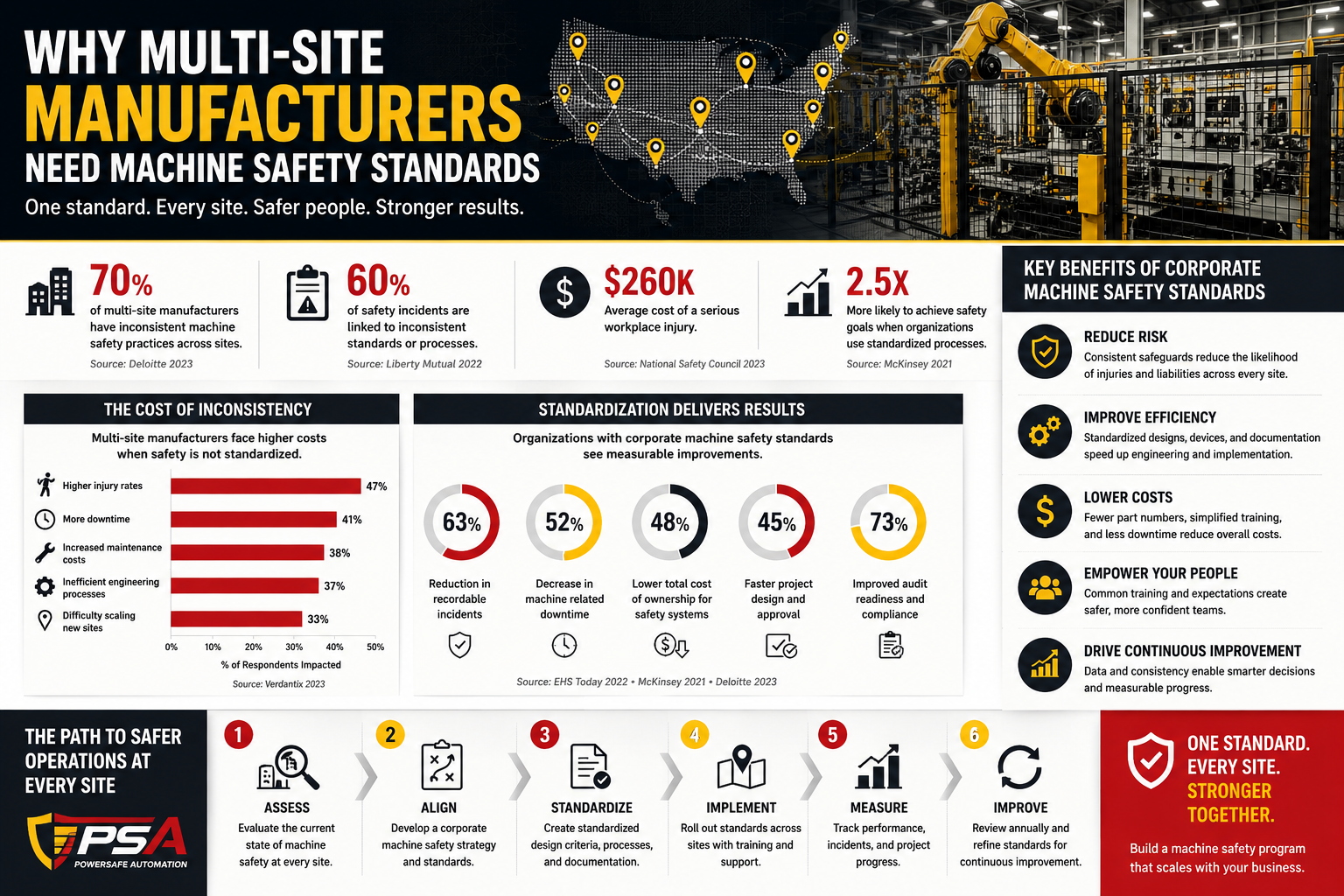
One plant may use modern interlocked guarding and documented safety validation. Another may rely on older safeguarding methods installed years ago. A third facility may interpret standards differently altogether. Maintenance teams, engineers, and operators moving between locations encounter different expectations, different hardware, and different procedures.
As these differences accumulate, they increase project costs, complicate maintenance, slow engineering decisions, and make it difficult for corporate leadership to understand the true state of machine safety across the organization.
Developing corporate machine safety standards helps solve this problem.
Instead of every facility making independent decisions, organizations establish one practical framework for evaluating hazards, selecting safeguarding methods, documenting projects, and improving machines consistently across every location.
At PowerSafe Automation, this philosophy forms the foundation of our Machine Safety Assessment Initiative (MSAI)—a structured program that helps manufacturers align strategy, standardize safeguarding practices, and build a long-term machine safety roadmap that scales with the business.
The Challenge of Multi-Site Manufacturing
Few manufacturers start with ten facilities.
Most organizations grow over time.
New plants are built.
Companies are acquired.
Production lines are relocated.
Equipment is transferred between facilities.
Engineering teams change.
Corporate leadership evolves.
Each of these changes introduces variation into machine safety practices.
Without corporate standards, every facility naturally develops its own way of doing things.
That often leads to:
- Different guarding designs for similar machines
- Different brands of safety devices
- Different lockout procedures
- Different engineering documentation
- Different risk assessment methods
- Different training expectations
- Different maintenance practices
- Different interpretations of ANSI and OSHA requirements
None of these differences may appear significant individually.
Collectively, however, they create complexity that affects every future machine safety project.
Consistency Reduces Risk
Machine safety isn't simply about installing guards.
It's about creating repeatable engineering decisions.
When facilities use consistent standards:
- Similar hazards receive similar safeguarding solutions.
- Engineering teams know what is expected.
- Maintenance personnel understand how systems operate.
- Spare parts become easier to manage.
- Documentation follows one format.
- New projects move faster.
- Validation becomes more efficient.
- Employees transferring between facilities encounter familiar safety systems.
Consistency doesn't mean every machine receives identical guarding.
Every machine presents unique hazards.
Instead, consistency means every engineering decision follows the same philosophy.
Acquisitions Create Hidden Safety Challenges
Corporate acquisitions often introduce significant machine safety variation.
One facility may have:
- Modern safety PLCs
- RFID safety switches
- Interlocked access
- Current documentation
Another acquired facility may contain:
- Legacy relay systems
- Homemade guarding
- Missing documentation
- Bypassed safety devices
- Obsolete components
Without a corporate strategy, these differences remain for years.
Eventually engineering must support dozens of different guarding approaches, making every upgrade more difficult and expensive.
Corporate standards create a roadmap for gradually bringing facilities into alignment rather than attempting large-scale replacements all at once.
Engineering Efficiency Improves Dramatically
Engineering teams spend considerable time making decisions that have already been solved elsewhere.
Questions such as:
Should this guard use mesh or polycarbonate?
Should we specify RFID or tongue interlocks?
What gate hardware should we use?
How should E-Stops be arranged?
How should access zones be documented?
Without standards, every project begins from scratch.
With standards:
Engineering templates already exist.
Preferred components are identified.
Design criteria are documented.
Risk reduction expectations are understood.
Review cycles become shorter.
Projects become more predictable.
Maintenance Benefits from Standardization
Maintenance departments often inherit decades of inconsistent equipment.
Different safety relays.
Different switch technologies.
Different reset methods.
Different emergency stop circuits.
Different replacement parts.
This creates unnecessary downtime.
Standardization allows maintenance personnel to become experts on a smaller number of approved technologies.
Benefits include:
- Faster troubleshooting
- Reduced spare parts inventory
- Simplified training
- Improved diagnostics
- Better documentation
- Reduced machine downtime
Procurement Also Wins
Corporate standards don't only help engineers.
Purchasing departments benefit significantly.
Preferred suppliers can be established.
Approved product families reduce purchasing complexity.
Volume purchasing opportunities improve.
Replacement parts become easier to source.
Lead times become more predictable.
Inventory costs often decrease because fewer unique components are required.
Corporate Leadership Gains Visibility
One of the largest challenges facing Corporate Safety Directors is understanding where risk actually exists.
Without standardized assessments, every facility reports information differently.
One plant may classify hazards one way.
Another may prioritize projects differently.
Corporate leadership struggles to compare facilities objectively.
Standardized machine safety assessments allow leadership to evaluate:
- Overall machine risk
- Project priorities
- Budget requirements
- Completion progress
- Corporate trends
- Investment planning
Instead of reacting to individual requests, leadership can prioritize improvements strategically.
Machine Safety Becomes a Business Strategy
Many organizations approach safeguarding one machine at a time.
A complaint occurs.
A customer requests improvements.
An incident happens.
An inspection identifies deficiencies.
A project gets approved.
The machine is upgraded.
The cycle repeats.
While this solves individual problems, it rarely creates organizational improvement.
Corporate standards shift the conversation.
Instead of reacting, organizations begin managing machine safety like any other strategic initiative.
Projects become prioritized.
Budgets become planned.
Engineering becomes proactive.
Leadership gains measurable progress.
Training Improves Across Every Facility
Employees frequently transfer between facilities.
Without standards, every plant operates differently.
Different reset procedures.
Different guarding expectations.
Different documentation.
Different maintenance practices.
Corporate standards create consistency that improves training for:
- Operators
- Maintenance technicians
- Engineers
- Electricians
- Supervisors
- Safety professionals
Training materials become reusable across multiple facilities instead of being recreated repeatedly.
Documentation Becomes More Valuable
Many organizations possess thousands of pages of machine safety documentation.
Unfortunately, much of it lacks consistency.
Different formats.
Different terminology.
Different risk ranking methods.
Different engineering drawings.
Corporate standards establish common documentation practices including:
- Risk assessment methodology
- Guarding specifications
- Safety validation
- Electrical documentation
- Inspection procedures
- Maintenance expectations
- Project closeout requirements
This consistency saves countless hours during future upgrades.
Standards Support Continuous Improvement
Machine safety should never be considered complete.
Production changes.
Equipment ages.
Processes evolve.
Technology improves.
Corporate standards provide a framework for continuous improvement rather than one-time compliance projects.
Annual reviews allow organizations to evaluate:
- Completed projects
- Emerging risks
- New technologies
- Updated standards
- Lessons learned
- Future priorities
This keeps programs current without requiring complete reinvention.
Avoiding the "Every Plant Does Its Own Thing" Problem
One of the most common statements heard during multi-site assessments is:
"That's just how this facility has always done it."
Unfortunately, another facility within the same company may say something completely different.
Neither location is intentionally wrong.
They simply evolved independently.
Corporate standards provide shared direction while still allowing engineering flexibility where appropriate.
The goal isn't eliminating local expertise.
It's ensuring every decision supports the organization's overall machine safety philosophy.
Machine Safety Standards Support Long-Term Growth
As organizations expand, consistency becomes increasingly important.
Imagine adding three new manufacturing facilities.
Without standards:
Each facility develops independently.
With standards:
Every new location begins with the same engineering expectations.
Guarding philosophy.
Preferred hardware.
Documentation.
Training.
Assessment methods.
Validation.
Growth becomes easier because the framework already exists.
Common Elements of Corporate Machine Safety Standards
While every organization is different, effective corporate standards often address topics such as:
- Machine risk assessment methodology
- Guarding design philosophy
- Safety device selection
- Safety control architecture
- Lockout/tagout expectations
- Electrical safety integration
- Documentation requirements
- Validation procedures
- Training requirements
- Preferred manufacturers
- Inspection frequency
- Project approval workflow
- Change management
- Contractor expectations
- Continuous improvement reviews
Rather than dictating every engineering decision, these standards establish a consistent decision-making framework.
The Role of ANSI Standards
Consensus standards such as ANSI provide valuable guidance for machine safeguarding, risk assessment, safeguarding design, and control reliability.
However, organizations still need internal standards that define how those principles will be applied consistently across their own facilities.
Corporate machine safety standards bridge the gap between broad industry guidance and day-to-day engineering decisions.
This creates greater consistency while allowing engineering teams to address the unique hazards presented by individual machines.
How the Machine Safety Assessment Initiative (MSAI) Helps
Developing corporate machine safety standards requires more than collecting existing procedures into a binder.
Successful programs begin by understanding where the organization stands today.
The Machine Safety Assessment Initiative (MSAI) is designed to help manufacturers build a scalable machine safety operating framework that supports both immediate improvements and long-term consistency.
The process typically includes:
- Executive strategy workshops
- Review of existing machine safety practices
- Evaluation of current safeguarding methods
- Assessment of engineering documentation
- Development of corporate machine safety standards
- Creation of standardized design criteria
- Machine safety toolkit development
- Multi-year implementation roadmap
- Annual program reviews
Rather than focusing on a single project, MSAI establishes the structure needed to improve machine safety across every facility in a consistent, measurable way.
One Corporate Strategy Instead of Many
Organizations often spend years solving the same machine safety challenges multiple times because each facility works independently.
Corporate standards change that.
One strategy.
One set of engineering expectations.
One documentation system.
One safeguarding philosophy.
One roadmap.
One framework for future growth.
The result is greater consistency, improved engineering efficiency, better visibility for leadership, and a more scalable approach to machine safety.
Final Thoughts
Machine safety is no longer just a plant-level responsibility.
For organizations operating multiple facilities, it has become a corporate initiative that directly influences productivity, maintenance, engineering efficiency, capital planning, and operational consistency.
Without corporate standards, facilities naturally drift in different directions over time. Different guarding methods, documentation practices, preferred components, and engineering philosophies make future projects more difficult and create unnecessary complexity.
Establishing corporate machine safety standards doesn't mean every machine looks the same. It means every decision follows the same principles, every facility works from the same playbook, and every improvement contributes to a larger strategy.
Manufacturers that invest in standardized machine safety programs position themselves to scale more effectively, reduce engineering duplication, improve maintenance efficiency, and create a more consistent approach to risk reduction across every location.
For organizations looking to move beyond isolated machine guarding projects, developing a corporate machine safety framework is often the first step toward building a safer, more efficient, and more sustainable manufacturing operation.