Most manufacturers would say safety matters. The harder question is what happens when safety competes with production — that's where workplace safety culture becomes visible.
It shows up when a guard makes a task less convenient, when an operator feels a safety device slows things down, when maintenance struggles to troubleshoot equipment, when management has to fund a safeguarding project, or when an employee raises a concern about a machine everyone else has run for years. Machine safety isn't shaped by standards alone — it's shaped by the attitudes of the people interacting with the equipment every day, and those attitudes look different depending on where you're standing.
Perspective #1: “Production Comes First”
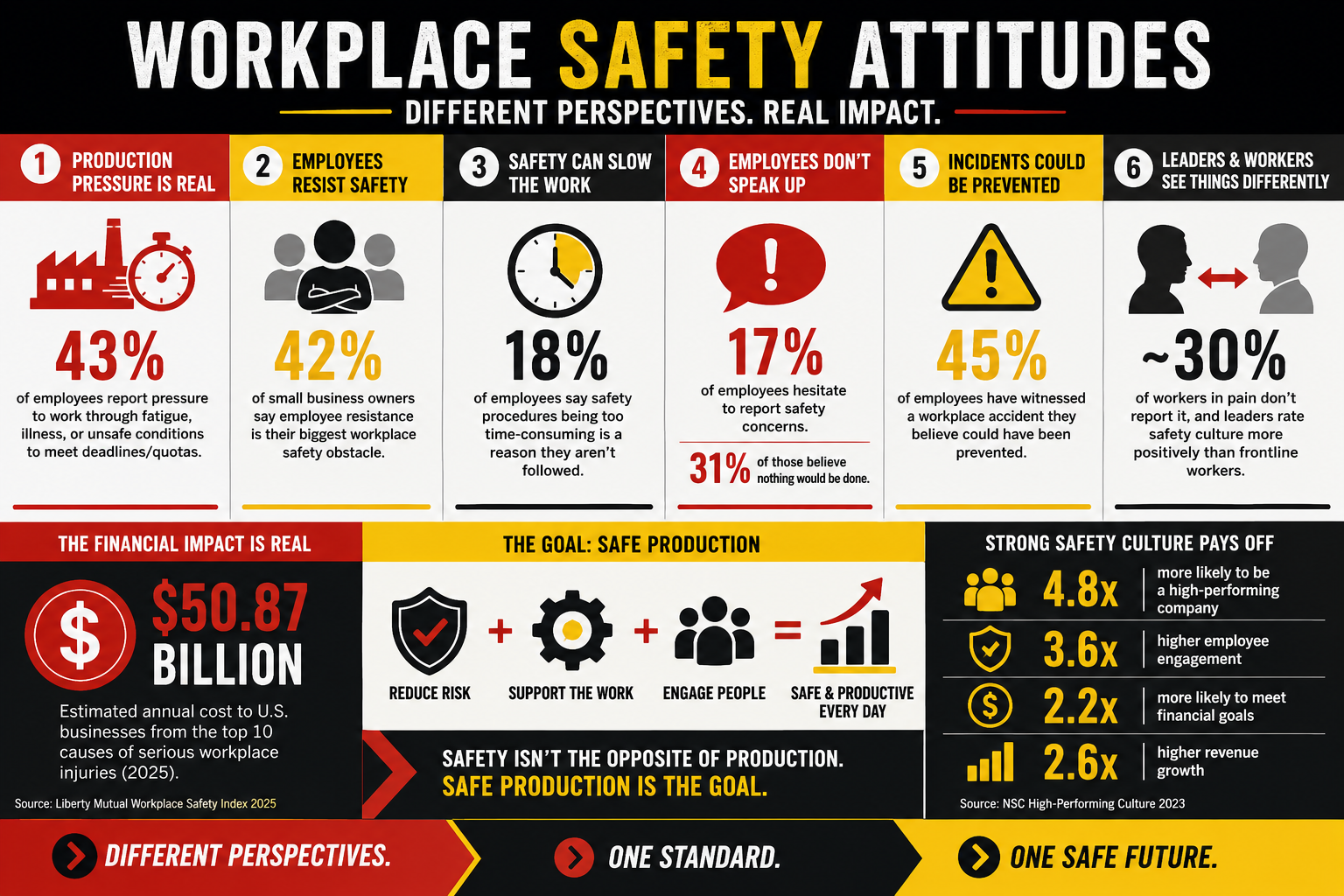
Production pressure is real. Manufacturers juggle schedules, customer commitments, labor costs, downtime, and quality requirements, and that pressure can gradually make production the unwritten priority. The message rarely comes as “ignore safety and keep running.” It's usually more subtle: “we need this order out today,” “can maintenance get it running for now,” “we'll fix the guard during the next shutdown,” or “we've run it this way for years.” Individually, these statements sound reasonable. Collectively, they can let temporary workarounds slowly become normal operating conditions.
The problem isn't wanting production — production is the purpose of the equipment. The challenge is designing safety into production rather than treating the two as competing objectives.
Perspective #2: “Safety First - No Matter What”
At the opposite end is the belief that any potential hazard should immediately stop production until it's eliminated. The motivation is understandable, nobody wants someone injured. But effective machine safety isn't simply about adding more guards, switches, procedures, or restrictions. The objective is practical risk reduction.
A safeguarding solution that makes a machine extremely difficult to operate, maintain, clean, load, or troubleshoot creates its own problem: people start looking for ways around it. Operators bypass switches, guards get removed, safety devices get defeated, and maintenance teams develop unofficial workarounds. The safest-looking machine on paper isn't necessarily the safest machine in actual operation. Good safeguarding has to account for both risk reduction and how people actually interact with the machine.
Perspective #3: The Employee Who Wants More Safety
Sometimes the strongest advocate for machine safety isn't management — it's the person standing at the machine every day. An operator may notice something engineering doesn't. A maintenance technician may know exactly where someone reaches during a jam. An employee may recognize that a task puts their hands closer to a hazard than anyone realized when the machine was originally evaluated.
When that employee says, “I don't feel comfortable doing this,” it shouldn't automatically mean the machine is unsafe — but it shouldn't be dismissed either. Frontline employees provide valuable input during a machine risk assessment because they understand the real-world interaction between the person and the equipment. The machine documentation tells you how the machine was intended to operate; the operator can tell you how it actually operates. Both matter.
Perspective #4: “It's Safe Enough”
Other employees have the opposite reaction. Add a light curtain, interlocked door, scanner, guard, or reset sequence, and you'll hear “why are we doing this” or “this is going to slow me down” - often followed by one of the most common arguments in workplace safety: “nobody has ever gotten hurt on this machine.”
That can feel like compelling evidence, but it isn't proof the risk doesn't exist. A person can cross the street hundreds of times without being hit by a vehicle; that doesn't eliminate the traffic hazard. The same principle applies to machinery — years without an incident may reflect good operating practices, limited exposure, experienced operators, or simply luck. Risk isn't determined solely by injury history. It should also weigh hazard, exposure, likelihood, severity, and the ability to avoid or limit harm.
Perspective #5: “They Should Know Better”
Another common attitude places safety responsibility primarily on the employee: “they shouldn't put their hand there,” “they're trained not to do that,” “the warning label tells them not to reach inside.” Training, procedures, and employee responsibility absolutely matter, but machine safety also has to account for foreseeable human behavior.
People make mistakes. They react instinctively. Parts jam, material falls, tools get dropped, production conditions change, and employees get distracted. Machine safety shouldn't depend exclusively on perfect human behavior. Where practical, engineering controls and safeguarding reduce the dependence on the operator making the right decision every single time.
Perspective #6: “Management Won't Spend the Money”
Now consider the employee who sees a hazard but doesn't believe anything will be done about it. Guarding has been requested repeatedly, equipment has known deficiencies, and every proposed improvement gets treated primarily as an expense. Eventually, employees may conclude that production matters more than whether they go home safely - and whether management intended to send that message becomes almost irrelevant, because that's how the workforce interprets it.
Safety culture isn't created by posters that say “Safety First.” It's created by what happens when someone raises a legitimate concern: does management investigate it, is the risk evaluated, is there a process for prioritizing improvements, and does corrective action actually get completed? Those actions communicate an organization's real safety priorities far more effectively than a slogan.
Safety and Production Don't Have to Be Opponents
The biggest mistake is framing the conversation as production versus safety. A better objective is safe production - safeguarding that supports the work instead of unnecessarily interfering with it. That means understanding the hazard (what can hurt someone), the task (how the employee interacts with the equipment), the exposure (when and how often someone can encounter the hazard), the behavior (what operators and maintenance personnel will realistically do), the risk reduction (what safeguarding can practically reduce that risk), and the production impact (can the solution keep the machine productive and usable).
Sometimes the answer is physical guarding. Sometimes it's an interlocked access door, a light curtain, a scanner, or a combination of measures. And sometimes the first step is simply conducting a proper risk assessment, so everyone stops arguing from opinion and starts working from the same information.
Moving From Safety Opinions to Risk-Based Decisions
Walk through almost any manufacturing facility and you'll find different attitudes toward the same machine. One person thinks it's dangerous; another has run it for 20 years without a problem. Engineering sees a technical challenge, operations sees potential downtime, maintenance sees an accessibility problem, management sees capital spending, and safety sees organizational risk. They're all looking at the same machine from different perspectives — which is exactly why machine safety shouldn't depend entirely on anyone's opinion.
A structured risk-reduction process creates a common language. Instead of asking “do you think this machine is safe,” the conversation becomes: what are the hazards, who is exposed, what tasks create that exposure, what is the level of risk, what safeguards already exist, where are the gaps, and what additional risk reduction is necessary? That's a far more productive conversation.
The Goal Isn't “Safety First.” It's Safety Built Into the Work.
“Safety First” is a powerful message, but in a manufacturing environment, safety shouldn't have to repeatedly fight for first place. The stronger long-term goal is making safety part of how equipment is designed, operated, maintained, modified, and improved. When that happens, operators don't have to choose between working safely and hitting production goals, engineering doesn't treat safeguarding as something bolted on after the machine is finished, management has a method for prioritizing investments instead of reacting to the loudest concern, and employees understand why the safeguards exist instead of seeing them as obstacles.
The best safety culture isn't created when everyone says “Safety First.” It's created when safe production becomes the normal way the work gets done.
A structured risk assessment is the starting point for replacing opinion with data. Contact PowerSafe Automation to talk through a guarding assessment or risk-reduction prioritization program for your facility.