One of the most common misconceptions in manufacturing is believing that a machine risk assessment and machine risk reduction are the same thing.
They are not.
In fact, confusing these two concepts often leads to delayed projects, unrealistic expectations, budgeting challenges, and missed opportunities to improve workplace safety.
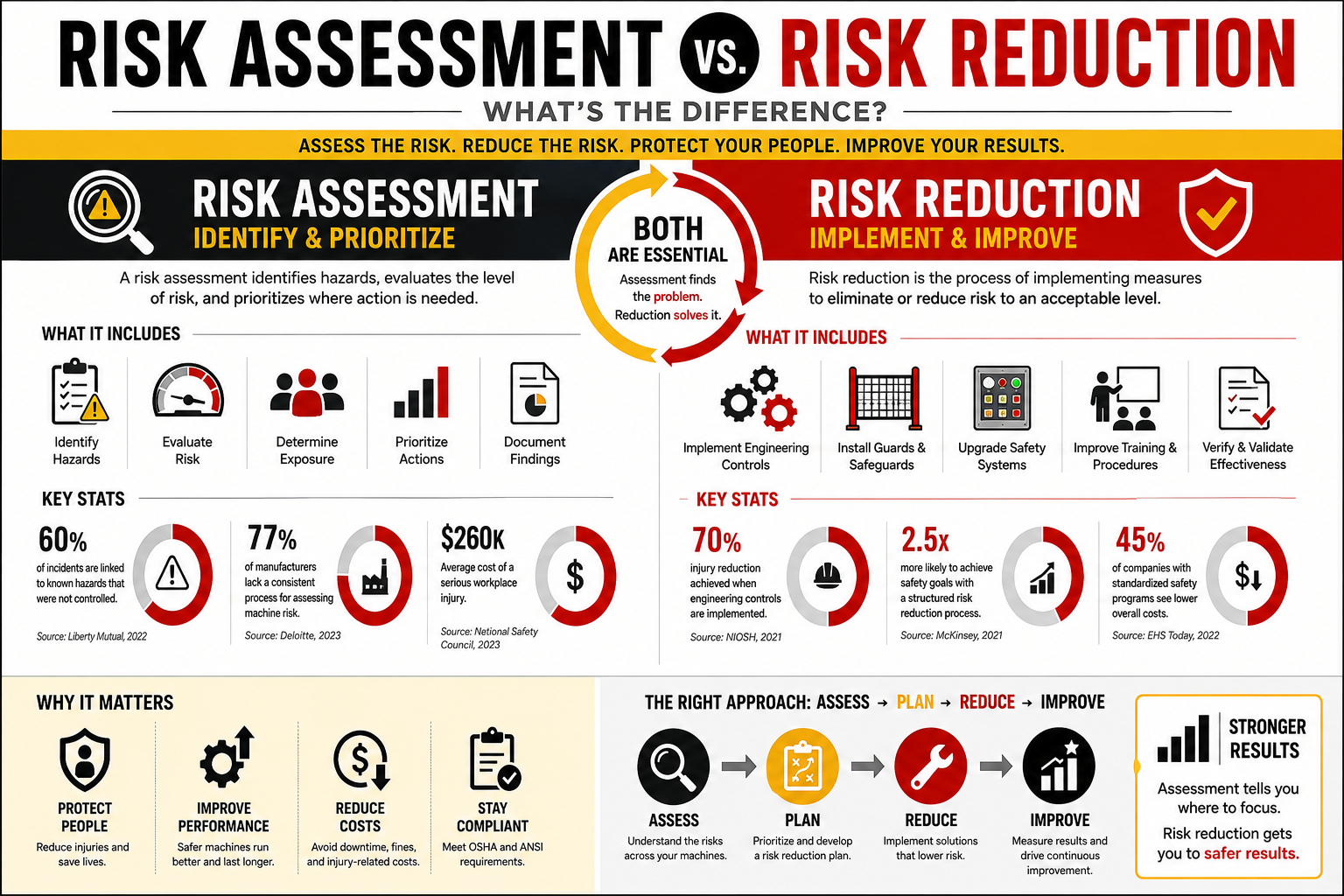
A risk assessment identifies hazards and evaluates risk. Risk reduction is the process of implementing practical measures to reduce those risks to an acceptable level.
One identifies the problem.
The other solves it.
Understanding the distinction is essential for Corporate Safety Directors, Plant Managers, Maintenance Leaders, Engineers, and Operations teams responsible for machine safety across one facility—or dozens.
At PowerSafe Automation, this distinction is at the heart of our Machine Safety Assessment Initiative (MSAI). Organizations do not simply need a list of machine hazards. They need a strategy for reducing risk consistently across every facility.
Let us explore what separates assessment from action—and why both are essential to building a successful machine safety program.
What Is a Machine Risk Assessment?
A machine risk assessment is a structured evaluation of the hazards associated with operating, maintaining, setting up, cleaning, troubleshooting, or servicing a machine.
Its purpose is to answer questions such as:
- What hazards exist?
- Who is exposed?
- How could someone be injured?
- How severe could the injury be?
- How often are employees exposed?
- How likely is the hazard to occur?
- What safeguards currently exist?
- Are additional protective measures needed?
The assessment does not modify the machine.
It gathers information.
Think of it as creating a detailed map before beginning a construction project.
Without understanding where hazards exist, it becomes difficult to determine the best path forward.
Common Hazards Identified During Assessments
Risk assessments frequently identify hazards such as:
- Point-of-operation hazards.
- Crushing hazards
- Pinch points
- Shear points
- Rotating shafts
- Nip points
- Entanglement hazards
- Flying debris
- Unexpected machine motion
- Stored energy
- Electrical hazards
- Robot movement
- Conveyor hazards
- Thermal hazards
- Ergonomic concerns
Some machines contain only a handful of hazards.
Others may have dozens requiring evaluation.
The goal is to understand every foreseeable interaction between employees and hazardous machine motion.
What a Risk Assessment Produces
A quality machine risk assessment generally includes:
- Hazard identification
- Risk evaluation
- Existing safeguards
- Recommended improvements
- Prioritized actions
- Documentation supporting future decisions.
Notice something important.
The assessment itself does not reduce risk.
It identifies where risk exists.
That is a critical distinction.
What Is Risk Reduction?
Risk reduction begins after the assessment.
Once hazards are identified, organizations determine how to lower the level of risk through engineering, safeguarding, administrative controls, or changes in work practices.
Examples include:
- Installing machine guards
- Adding interlocked access doors
- Integrating safety light curtains
- Using safety laser scanners
- Installing safety mats
- Upgrading safety controls
- Adding emergency stop devices.
- Improving electrical safety systems
- Updating procedures
- Enhancing training
- Improving lockout/tagout practices
Unlike an assessment, risk reduction changes the machine or the way people interact with it.
It is where planning becomes implementation.
Risk Assessment Answers "What?"
Risk Reduction Answers "How?"
One simple way to remember the difference is this:
Risk assessment asks:
"What hazards exist?"
Risk reduction asks:
"How do we reduce those hazards?"
Organizations need both.
Skipping the assessment often leads to unnecessary spending.
Skipping risk reduction leaves known hazards unresolved.
Neither delivers the complete solution on its own.
Why the Difference Matters
Many organizations request a "machine safety assessment" expecting the consultant to automatically redesign every machine.
Others believe completing an assessment alone satisfies their safety objectives.
Neither assumption is correct.
An assessment provides information.
Risk reduction requires engineering, budgeting, project management, fabrication, installation, controls integration, validation, and training.
These are separate phases of the overall machine safety journey.
Recognizing this distinction helps organizations develop realistic expectations, timelines, and budgets.
Why Risk Assessments Are Still Essential
If risk reduction is the ultimate goal, why not skip the assessment?
Because effective solutions begin with understanding the problem.
Without a structured assessment, organizations often:
- Solve the wrong problem.
- Overspend on guarding.
- Miss hidden hazards.
- Create new operational issues.
- Install inconsistent safeguards.
- Increase maintenance challenges.
Good engineering begins with good information.
Risk assessments provide that foundation.
Risk Reduction Is More Than Installing Guards
Many people equate machine safety with physical guarding.
Guarding is important—but it is only one part of reducing risk.
Depending on the application, risk reduction may include:
Engineering controls
Administrative controls
Safety-rated control systems
Operator training
Machine redesign
Automation improvements
Reduced exposure
Safe maintenance access
Improved diagnostics
Enhanced visibility
Every machine presents unique challenges.
The best solution is not always the biggest guard.
It is the one that effectively reduces risk while supporting productivity, maintenance, and operator usability.
The Hierarchy of Risk Reduction
Successful machine safety programs generally follow a logical order when reducing risk.
Organizations first look for opportunities to eliminate hazards through design whenever practical.
If hazards cannot be eliminated, they consider engineering safeguards that physically prevent access to hazardous motion.
Administrative measures, procedures, and training provide additional layers of protection but should not replace engineered safeguarding when engineering controls are feasible.
This structured approach helps organizations make consistent decisions while balancing safety, productivity, maintenance, and operational needs.
Why Prioritization Matters
Few manufacturers can upgrade every machine simultaneously.
Most facilities have:
Hundreds of machines.
Limited budgets.
Competing capital projects.
Engineering resource constraints.
Operational demands.
That is why prioritization is critical.
After assessments are completed, organizations should determine:
Which machines present the highest risk?
Which improvements provide the greatest benefit?
Which projects can be completed quickly?
Which require larger capital investments?
Which facilities should be addressed first?
Without prioritization, organizations often tackle projects based on urgency rather than actual risk.
The Cost of Stopping at the Assessment
Many companies invest significant resources completing assessments but never implement recommendations.
Years later:
The reports remain on shelves.
Hazards remain unchanged.
Machines continue operating the same way.
Employees continue facing the same exposure.
An assessment only creates value when it leads to action.
That is why implementation planning should begin before the assessment is even completed.
Risk Reduction Requires Multiple Disciplines
Reducing machine risk often involves collaboration between:
Safety professionals
Mechanical engineers
Controls engineers
Electrical designers
Maintenance personnel
Operations leaders
Production supervisors
Purchasing
Outside machine safety specialists
Successful projects rarely rely on one department alone.
Machine safety is a cross-functional initiative requiring shared ownership.
Why Standardization Improves Risk Reduction
Organizations operating multiple facilities frequently discover that similar machines have completely different safeguarding methods.
Different plants.
Different guarding.
Different documentation.
Different safety devices.
Different engineering philosophies.
Corporate standards reduce this inconsistency.
Instead of solving the same problem ten different ways, organizations establish preferred design criteria, documentation methods, component selections, and implementation practices.
This consistency reduces engineering time, simplifies maintenance, and supports long-term scalability.
Measuring Success
How do organizations know if risk reduction efforts are working?
Success is not measured by the number of guards installed.
It can be evaluated through broader operational improvements such as:
- Completion of prioritized projects
- Reduced exposure to machine hazards
- Improved consistency across facilities
- Better documentation
- Simplified maintenance
- Faster engineering decisions
- Improved employee confidence
- More predictable project planning
- Stronger management visibility
These indicators demonstrate that machine safety is becoming part of the organization's operating system rather than a collection of isolated projects.
Common Misconceptions
Several misconceptions frequently delay machine safety improvements.
"The assessment makes us compliant."
An assessment identifies opportunities. Risk reduction implements improvements.
"We only need guarding."
Effective risk reduction may involve controls, procedures, training, or process improvements in addition to physical guarding.
"Every machine needs the same solution."
Every machine should be evaluated individually, even when following common corporate standards.
"We'll fix hazards as we find them."
Reactive improvements often cost more than structured planning.
Building a Machine Safety Roadmap
One of the biggest advantages of completing assessments is the ability to develop a long-term roadmap.
Instead of reacting to isolated requests, organizations can create a phased implementation plan that aligns with production schedules, maintenance shutdowns, capital budgets, and staffing resources.
A roadmap helps answer questions like:
- Which machines should be upgraded first?
- What projects fit into this year's budget?
- Which improvements can wait?
- How should work be phased across multiple facilities?
- What engineering resources are required?
This approach turns machine safety from a reactive expense into a strategic investment.
The Role of MSAI
PowerSafe Automation developed the Machine Safety Assessment Initiative (MSAI) because many organizations needed more than individual assessments.
They needed a complete machine safety framework.
MSAI begins by understanding your current state through structured assessments and leadership discussions.
From there, the initiative helps organizations:
- Align executive strategy.
- Develop corporate machine safety standards.
- Prioritize machine upgrades.
- Standardize engineering practices.
- Build implementation roadmaps.
- Create machine safety toolkits.
- Establish documentation standards.
- Support continuous annual reviews.
Rather than viewing assessments as the finish line, MSAI treats them as the starting point for a scalable machine safety program.
Turning Information Into Action
Information alone does not improve safety.
Action does.
Risk assessments provide valuable insight into where hazards exist and how they should be prioritized.
Risk reduction transforms that information into engineered solutions that protect employees, improve consistency, and support operational performance.
The most successful manufacturers recognize that these two activities are inseparable.
One without the other leaves the job unfinished.
Final Thoughts
Machine safety is not achieved by completing a report.
Nor is it achieved by installing random safeguards without understanding the underlying hazards.
Effective machine safety requires both careful evaluation and disciplined implementation.
Risk assessment identifies where risk exists.
Risk reduction systematically lowers that risk through practical engineering, standardized processes, and thoughtful planning.
For organizations operating multiple facilities, the greatest opportunity lies in connecting these two activities through a long-term strategy rather than treating them as isolated projects.
The Machine Safety Assessment Initiative (MSAI) was developed with that objective in mind—helping manufacturers move beyond simply identifying hazards and toward building a consistent, scalable machine safety program that supports every facility, every project, and every employee.
When organizations understand the difference between assessment and reduction, they stop asking, "Have we completed the assessment?"
Instead, they begin asking the more important question:
"How are we reducing risk across our entire organization?"
That shift in perspective is where meaningful, sustainable machine safety improvements begin.