Margin of Safety in Machine Guarding: What Manufacturing Leaders Need to Know
When engineers hear the phrase "margin of safety," they often think about structural calculations, design loads, or mechanical components. Financial professionals may recognize it as an investment principle made famous by Benjamin Graham. In manufacturing, however, the concept takes on an even more practical meaning.
Every day, operators, maintenance technicians, supervisors, and engineers rely on machines that contain hazards capable of causing serious injury. Rotating shafts, in-running nip points, point-of-operation hazards, stored energy, robotic motion, and automated material handling systems all present risks that must be managed. The goal is not simply to comply with regulations—it is to create enough separation between people and hazards that normal production, maintenance, setup, and troubleshooting can be performed safely.
That protective separation is the real-world margin of safety.
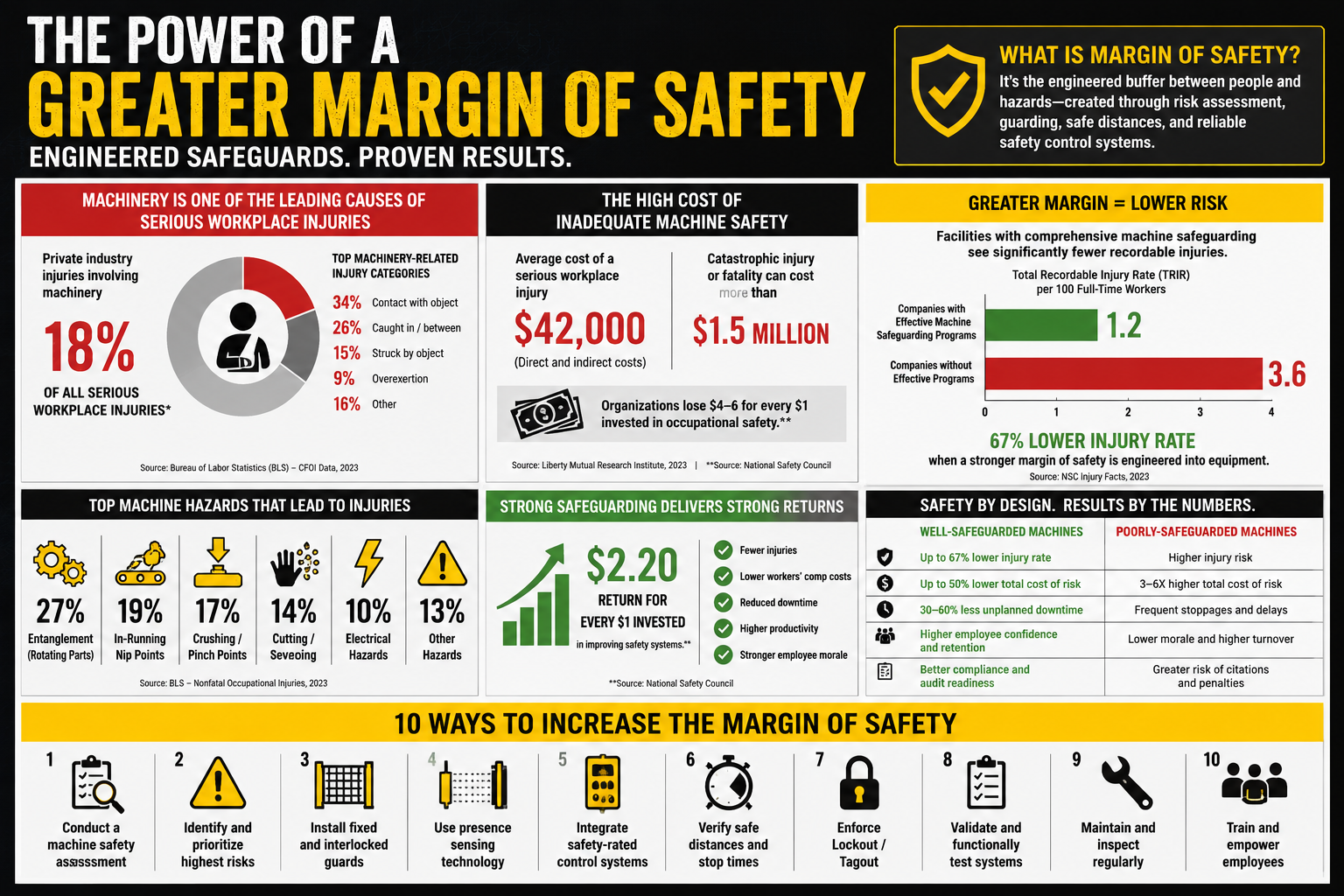
Although the phrase is not specifically defined within OSHA regulations or ANSI B11 machine safety standards, the principle is embedded throughout modern safeguarding practices. Risk assessments, engineering controls, protective devices, safe distances, interlocking systems, and validated safety functions all work together to increase the margin between hazardous motion and the people who interact with machinery.
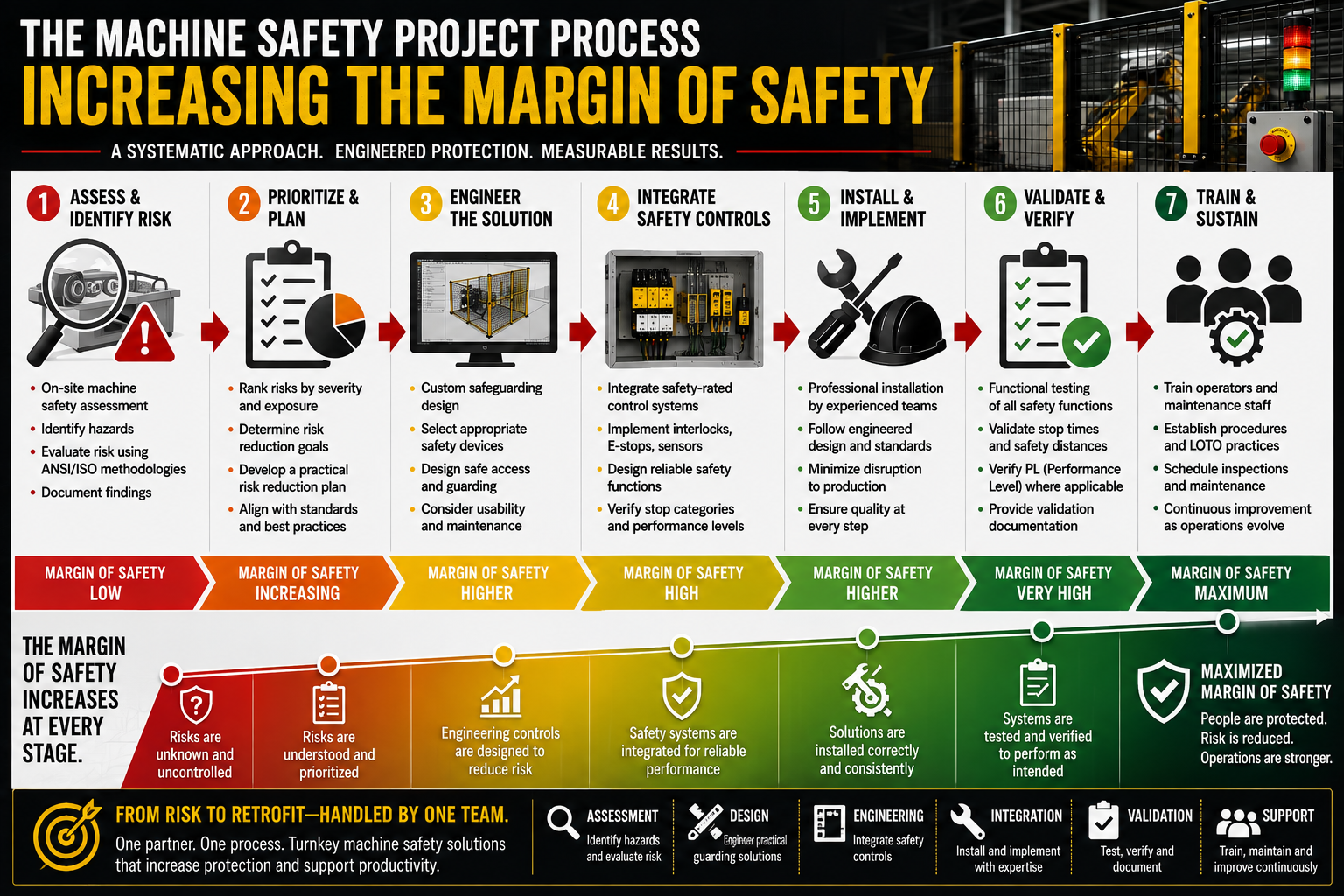
Understanding this concept helps manufacturers move beyond minimum compliance toward sustainable risk reduction that protects employees while supporting productivity.
What Does Margin of Safety Mean?
Generally, a margin of safety is the difference between where failure begins and where normal operation occurs.
In machine safety, that difference can be viewed as the protective buffer created through engineering.
Examples include:
- Distance between an operator and hazardous motion.
- Time required for hazardous motion to stop before access is possible.
- Physical barriers preventing accidental contact.
- Safety-rated control systems preventing unexpected startup.
- Safe maintenance procedures controlling stored energy.
The greater this engineered buffer, the greater the margin of safety.
Rather than depending on perfect employee behavior, organizations rely on engineered systems designed to reduce the likelihood and severity of injuries.
Why Margin of Safety Matters in Manufacturing
Modern manufacturing demands speed, flexibility, and efficiency. Equipment is expected to operate continuously while producing high-quality products with minimal downtime.
Unfortunately, increased automation often increases machine complexity.
Facilities commonly operate:
- Packaging equipment
- Conveyors
- Hydraulic presses
- Mechanical presses
- Roll forming lines.
- Slitters
- Palletizers
- CNC machining centers
- Robotic cells
- Assembly automation
- Material handling systems
- Metal fabrication equipment
Each introduces hazards that require thoughtful safeguarding.
Without sufficient protection, workers may be exposed to:
- Crushing hazards
- Shearing hazards
- Cutting hazards
- Entanglement hazards
- Pinch points
- In-running nip points
- Unexpected machine motion
- Flying debris
- Stored energy
- Electrical hazards
A properly engineered safeguarding system increases the margin of safety by preventing or limiting exposure to these hazards.
Engineering Controls Create the Largest Margin of Safety
The hierarchy of controls consistently recognizes engineering controls as one of the most effective methods of reducing workplace risk.
Examples include:
Fixed Guards
Physical barriers permanently prevent access to hazardous areas.
Examples include:
- Perimeter fencing
- Polycarbonate enclosures
- Wire mesh guarding
- Sheet metal guards
These create a physical separation that significantly increases the margin of safety.
Interlocked Access Doors
Many machines require operator access.
Instead of removing guarding, interlocked doors stop hazardous motion whenever access is attempted.
Examples include:
- RFID safety switches
- Safety interlock switches
- Guard locking systems.
- Trapped key systems.
These systems prevent hazardous access until safe conditions exist.
Presence Sensing Devices
Some applications require open access while maintaining protection.
Common devices include:
- Safety light curtains
- Safety laser scanners
- Safety mats
- Three-dimensional radar systems
These detect personnel before hazardous motion can create injury.
Safety Control Systems
Protective devices must function reliably.
Safety-rated relays and safety PLCs monitor:
- Emergency stop circuits.
- Guard switches
- Light curtains
- Two-hand controls
- Safety scanners
- Safety mats
These systems provide diagnostic capability while maintaining designed safety performance.
Safe Distance Is Part of the Margin
One of the simplest methods of increasing safety is increasing distance.
ANSI standards include calculations for determining:
- Guard openings
- Reach distances.
- Safety distances
- Light curtain positioning
- Scanner placement
A guard located too close to the hazard reduces the available margin.
Likewise, an improperly positioned light curtain may allow someone to reach the hazard before the machine stops.
Engineering calculations ensure sufficient separation exists.
Stopping Time Matters
Many manufacturers assume stopping the machine is enough.
However, stopping must occur before a person can reach the hazard.
Stopping performance depends on:
- Brake condition
- Load
- Machine inertia
- Response time
- Safety controller reaction
- Device response time
Periodic stopping time measurements help confirm the designed margin of safety continues throughout the equipment's life.
Risk Assessments Help Identify Needed Safety Margins
Every machine is different.
A formal machine risk assessment evaluates:
- Machine tasks
- Hazards
- Exposure frequency
- Severity
- Possibility of avoidance
The assessment determines where additional engineering controls are required.
Rather than applying the same solution everywhere, safeguards are matched to the actual risk.
Compliance Alone Does Not Equal Safety
Many organizations ask:
"Is this OSHA compliant?"
Compliance is important, but it should not be the finish line.
Machines can technically meet minimum requirements while still presenting unnecessary risk.
High-performing manufacturers focus on:
- Risk reduction
- Reliability
- Maintainability
- Employee confidence
- Production efficiency
Their goal is sustainable safety rather than passing an inspection.
Common Ways the Margin of Safety Is Reduced
Even well-designed systems can deteriorate over time.
Common issues include:
- Missing guards
- Defeated interlocks.
- Bypassed safety devices
- Damaged fencing
- Poor maintenance
- Incorrect replacement parts
- Unauthorized modifications
- Worn brakes.
- Sensor misalignment
Regular inspections help identify these issues before they become serious hazards.
Human Factors Matter
Employees often interact with machines during:
- Setup
- Changeovers
- Cleaning
- Troubleshooting
- Maintenance
- Product adjustments
- Material loading
- Material unloading
Safeguarding should support these tasks rather than encouraging bypassing.
If production requires defeating safeguards, the true margin of safety has already been compromised.
Validation Confirms the Margin Exists
Installing safeguards is only part of the process.
Validation confirms:
- Devices function correctly.
- Interlocks stop hazardous motion.
- Safety circuits operate properly.
- Stop times meet design assumptions.
- Documentation matches installation
Validation provides confidence that engineered safety measures perform as intended.
Continuous Improvement
Machine safety is never completely finished.
Facilities evolve through:
- Equipment upgrades
- Production changes
- New products
- Staffing changes
- Automation improvements
Periodic reviews help ensure safeguarding continues meeting operational needs while maintaining acceptable levels of risk.
Building a Stronger Safety Culture
Organizations with mature safety cultures recognize that safeguarding supports productivity rather than competing against it.
Employees become more willing to report hazards.
Maintenance teams receive better documentation.
Engineering gains standardized design practices.
Leadership gains improved visibility into risk.
This creates an environment where safety improvements become part of continuous operational excellence.
How PowerSafe Automation Helps
Effective safeguarding requires more than installing guards.
Successful projects typically begin with understanding how employees actually interact with equipment before selecting the most appropriate engineering solution.
PowerSafe Automation partners with manufacturers to evaluate existing machinery, identify hazards, prioritize risk reduction opportunities, and design safeguarding systems that support both employee protection and production goals.
Services include:
- Machine safety assessments
- Risk reduction planning.
- Guarding system design
- Custom machine guarding
- Safety controls integration
- Safety device selection
- Installation support
- Validation and functional testing
- Legacy machine safeguarding
- Corporate machine safety standard development
Rather than offering a single product, PowerSafe Automation provides a turnkey approach that helps manufacturers move from identifying risk to implementing practical safeguarding solutions.
Final Thoughts
Margin of safety is more than an engineering expression—it represents the protective space intentionally created between people and hazardous machine motion.
Whether achieved through fixed guards, interlocked doors, safety-rated controls, presence-sensing devices, validated stopping times, or comprehensive risk assessments, every improvement that reduces exposure contributes to a safer workplace.
Manufacturers that view machine safety as an ongoing engineering process rather than a one-time compliance exercise often realize benefits beyond injury prevention. Standardized safeguarding, improved reliability, reduced downtime, easier maintenance, and increased employee confidence all contribute to stronger operational performance.
For organizations evaluating legacy equipment, expanding automation, or developing corporate machine safety standards, focusing on the margin of safety provides a practical framework for making informed risk reduction decisions. When engineering, operations, and safety teams work together to increase that margin, they create manufacturing environments that are not only safer but also more productive, reliable, and sustainable for years to come.