
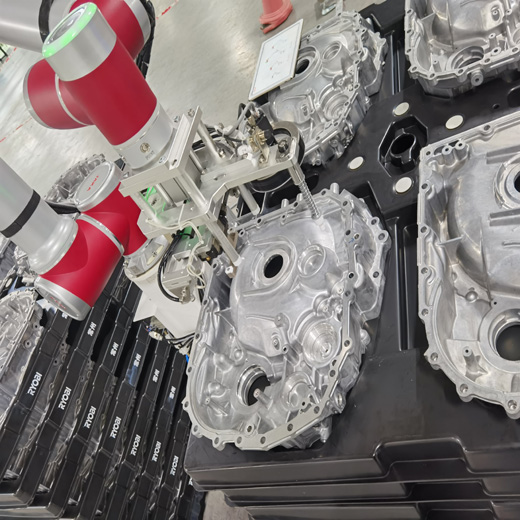
Cobot Pick & Place Applications: What, why, How, and When to Use Them in Modern Manufacturing
If you are evaluating automation for your facility, collaborative robots (cobots) are likely already on your radar especially for pick and place tasks. These applications are often the fastest, lowest-risk entry point into automation, but many teams still struggle with one question:
“Is this actually the right move for our operation?”
This guide breaks down the what, why, how, and when of cobot pick and place applications so you can make a confident, engineering-driven decision.
What Is a Cobot Pick & Place Application?
At its core, a pick and place application involve a robot:
- Picking a part from a known location (bin, conveyor, fixture)
- Moving it through space
- Placing it in another defined location
With cobots, this process happens in a shared workspace with humans, often without full traditional guarding (depending on risk assessment).
Common Pick & Place Use Cases:
- Machine tending (loading/unloading CNCs or presses)
- Conveyor sorting and part transfer
- Packaging and case packing
- Kitting and assembly staging
- Light palletizing and depalletizing
These applications are ideal because they are:
- Repetitive
- Predictable
- Low variability (or manageable with vision systems)
Why Use a Cobot for Pick & Place?
1. Solve Labor Gaps Without Overhauling Your Line
Pick and place tasks are often:
- Hard to staff
- High turnover
- Low engagement roles
Cobots allow you to redeploy skilled workers while maintaining throughput.
2. Improve Ergonomics (and Reduce Injury Risk)
Repetitive motion + awkward lifting = long-term injury risk.
Cobots eliminate:
- Repetitive reaching
- Twisting
- Lifting from poor heights
This directly supports safety initiatives and OSHA compliance goals.
3. Fast ROI Compared to Traditional Automation
Unlike large industrial robots, cobots:
- Require less infrastructure.
- Have smaller footprints.
- Integrate faster.
Typical ROI range: 6–18 months depending on cycle time and labor savings.
4. Flexibility for High-Mix Environments
Modern manufacturing is not always high-volume.
Cobots can be:
- Reprogrammed quickly.
- Moved between stations.
- Adapted with different end effectors.
How to Implement a Cobot Pick & Place Application
This is where most projects either succeed—or stall.
Step 1: Define the Process (Not the Robot)
Start with:
- Part size, weight, and geometry
- Pick location consistency.
- Required cycle time.
- Placement accuracy
If the process is unstable, the robot will not fix it—it will expose it.
Step 2: Select the Right End Effector
Your gripper is just as important as the robot.
Options include:
- Vacuum grippers (flat, lightweight parts)
- Mechanical grippers (irregular or rigid parts)
- Magnetic grippers (metal components)
Step 3: Determine the Need for Vision
Ask:
- Are parts always in the same location?
- Do orientations vary?
If yes → Vision system required
If no → Hard tooling may be simpler and more reliable
Step 4: Integrate Safety the Right Way
This is where your operation can stand out.
Even though cobots are “collaborative,” many applications still require:
- Risk assessments (ANSI / ISO standards)
- Safety scanners or area monitoring
- Interlocked access points
- Defined safe speeds and zones.
A cobot is not automatically safe—it must be engineered that way.
Step 5: Build a Right-Sized Cell
Avoid overengineering.
A strong cobot cell often includes:
- T-slotted aluminum framing
- Modular guarding (where required)
- Ergonomic part presentation
- Clean cable management
This keeps the system:
- Scalable
- Maintainable
- Visually organized for operators
When Does a Cobot Pick & Place Make Sense?
Best Fit Scenarios:
- Repetitive tasks with consistent cycle times
- Parts under ~20–25 kg (depending on cobot model)
- Manual processes causing ergonomic strain.
- Lines with labor instability
- Operations needing flexibility.
Proceed with Caution:
- Highly variable, random part presentation without vision
- Ultra-high-speed requirements (traditional robots may win)
- Poor upstream process consistency
- Applications requiring tight tolerances without fixturing.
Not Ideal:
- Tasks requiring extreme force or rigidity.
- Environments with high contamination (unless properly rated)
- Processes better solved with simple mechanical automation.
Key Mistakes to Avoid
1. Starting with the Robot Instead of the Problem
Always define:
“What problem are we solving?”
Not:
“Where can we put a robot?”
2. Ignoring Safety Early
Delaying safety integration leads to:
- Redesign costs
- Delays
- Compliance issues
3. Overcomplicating the First Application
Your first cobot project should be:
- Simple
- High confidence
- High visibility internally
Build momentum before scaling.
How Pick & Place Leads to Bigger Automation Wins
Many facilities start with one cobot… and quickly realize:
- It connects to machine safety improvements.
- It exposes workflow inefficiencies.
- It creates opportunities for lean manufacturing upgrades.
This is where a turnkey approach becomes valuable:
- Guarding
- Ergonomics
- Material flow
- Automation—all in one system
Final Thoughts: Start Practical, Scale Strategically
Cobot pick and place applications are not just about automation—they are about:
- Stabilizing operations
- Protecting your workforce
- Creating a foundation for smarter manufacturing
If done right, they become the gateway to a more engineered, safety-first facility.
Thinking About a Cobot Application?
Start with a simple internal audit:
- What tasks are repetitive and hard to staff?
- Where are ergonomic risks highest?
- Which processes are stable enough to automate today?
From there, you can build a phased roadmap—not just a one-off project.