
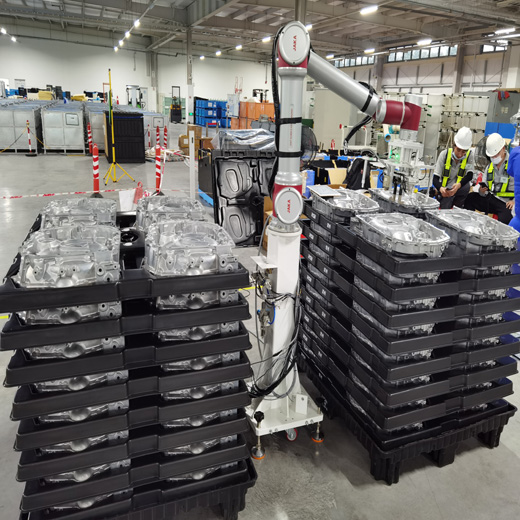
Packaging and palletizing sit at the end of the production line, but they directly affect efficiency, product quality, and customer experience. If upstream production is optimized but packaging is slow, inconsistent, or fully manual, that gap shows up as lost throughput and margin.
Key Takeaways
Manual palletizing is one of the highest-risk ergonomic tasks in a facility. Automation candidates are typically high-volume, consistent-format operations; highly variable or low-volume operations are poor fits. Success depends on box consistency, pallet pattern design, correct end-of-arm tooling, and matching throughput to upstream production.
What Is Packaging and Palletizing?
Packaging
Packaging prepares products for shipment or storage, protects them from damage, and presents them to customers. It typically includes boxing, wrapping, labeling, and sealing.
Palletizing
Palletizing is the process of stacking packaged goods onto pallets in stable, repeatable patterns so they're ready for transport.
Both processes typically occur at end-of-line production, during distribution preparation, and in warehouse operations.
Why Packaging and Palletizing Matter
Protecting Product Quality
Poor packaging leads to shipping damage, returns and claims, and customer dissatisfaction.
Maximizing Throughput
End-of-line bottlenecks often form because packaging can't keep pace with production, or because palletizing is labor-intensive and slow to scale.
Improving Ergonomics and Safety
Manual palletizing involves heavy lifting, repetitive motion, and awkward stacking positions, making it one of the highest-risk ergonomic areas in a facility.
Standardizing Output
Automation delivers consistent packaging quality, repeatable pallet patterns, and predictable load stability.
How Packaging and Palletizing Are Done
Facilities generally fall into one of four approaches, depending on volume and variability:
| Approach | How It Works | Best For |
| Manual packaging & palletizing | Operators pack products into boxes, tape or seal cartons, and stack boxes onto pallets by hand. | Low volume, high variability |
| Semi-automated systems | Case erectors, tape/sealing machines, and conveyor-fed systems handle repetitive steps. | Medium volume, improved consistency |
| Robotic & cobot palletizing | Cobots pick boxes with vacuum or mechanical grippers, stack them in defined patterns, and adjust for different SKUs. | Repetitive palletizing tasks, ergonomic improvement, flexible production |
| Integrated end-of-line systems | Vision systems handle box orientation, with automatic labeling, stretch wrapping, and load securing built in. | High-volume, fully automated lines |
When Should You Automate Packaging?
| Fit for Automation | Conditions |
| Strong candidate | High-volume production, repetitive box sizes and weights, labor shortages or high turnover, ergonomic risk from lifting |
| Proceed with caution | Highly variable packaging formats, frequent product changeovers without planning, inconsistent upstream flow |
| Not ideal | Very low-volume operations, constantly changing packaging requirements |
Key Factors That Determine Success
Product and Box Consistency
Automation depends on consistent box sizes, predictable weights, and stable packaging.
Pallet Pattern Design
A well-designed pattern ensures load stability, efficient space utilization, and reduced damage during transport.
End-of-Arm Tooling (EOAT)
Grippers must be matched to box size, weight, and surface type, such as cardboard or shrink wrap.
Throughput Matching
The packaging system must keep pace with upstream production so it doesn't become the new bottleneck.
Safety Considerations
Common risks in packaging and palletizing operations include lifting injuries, repetitive strain, falling product loads, and interaction with moving equipment.
Engineering controls that address these risks include ergonomic workstation design, guarded robotic cells where needed, presence-sensing devices such as light curtains and scanners, and stable pallet design with proper load securing.
Common Mistakes to Avoid
- Treating end-of-line as an afterthought: packaging should be designed as part of the entire process flow, not bolted on at the end.
- Ignoring ergonomics: manual palletizing is a major source of injury risk and productivity loss.
- Overcomplicating automation: start with one SKU, one pallet pattern, and one clear objective.
- Poor integration: packaging must align with both upstream production rates and downstream logistics.
Where Packaging Fits into a Bigger Strategy
Packaging and palletizing connect directly to production efficiency, warehouse operations, shipping and logistics, and customer experience. Done well, they enable faster throughput, reduced labor dependency, and scalable operations. Done poorly, they create bottlenecks, increase costs, and damage customer trust.
Questions to Ask About Your End-of-Line Process
- Where are we seeing bottlenecks at the end of the line?
- Are operators struggling with repetitive lifting?
- Is packaging consistent across shifts?
- Can automation improve both safety and throughput?