Introduction: Why Machine Safety Still Falls Short
Machine safety is one of the most discussed and most misunderstood areas in manufacturing. Many facilities have invested in guarding, safety devices, and procedures, yet still face:
- Near-misses and repeat hazards
- Inconsistent guarding across machines
- Operator workarounds and bypassed safety devices
- Uncertainty around compliance with ANSI B11.19
- Difficulty justifying budget for improvements
The issue is rarely a lack of effort. It is a lack of structure.
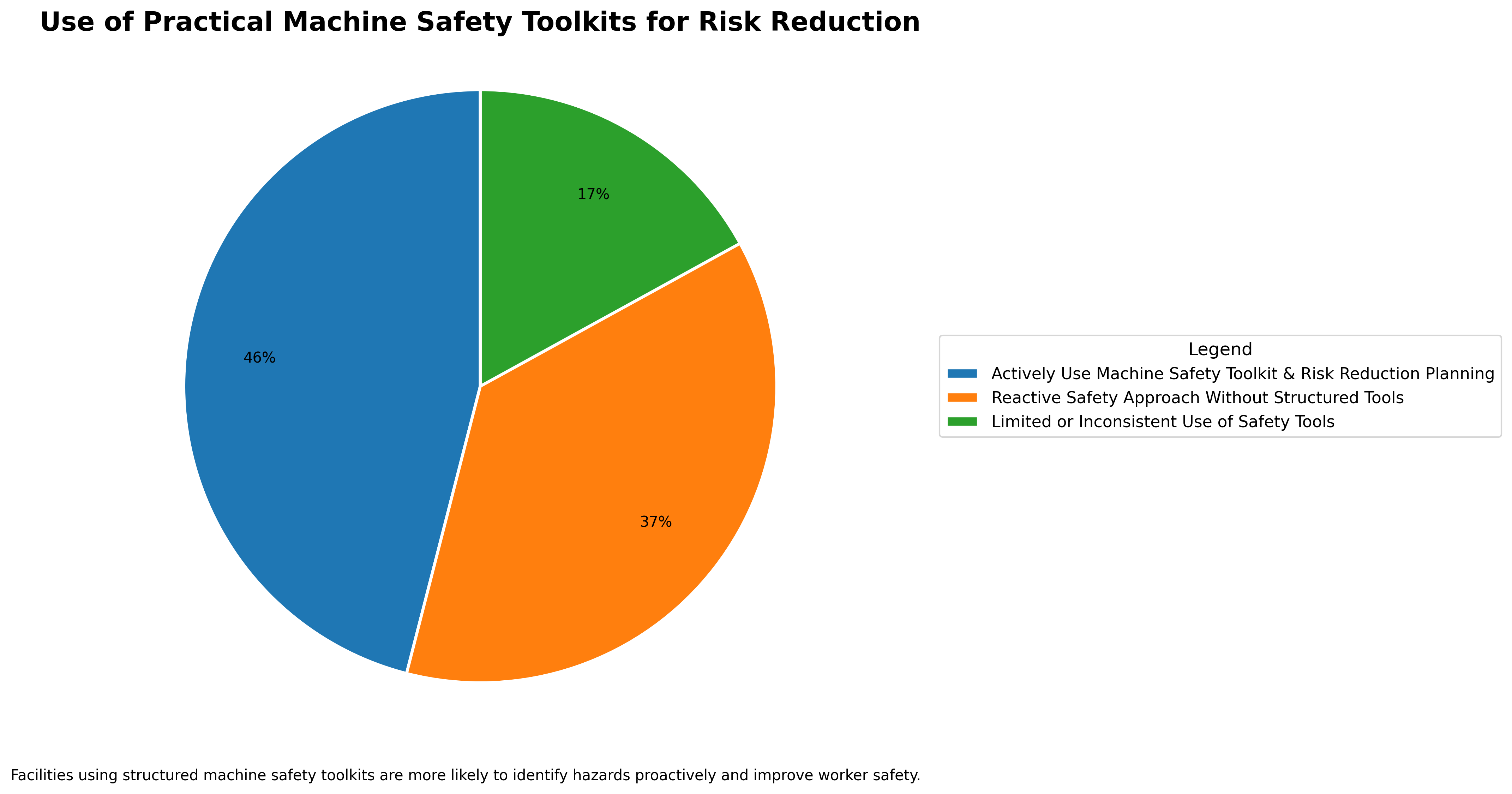
Too often, machine safety is approached reactively:
- A hazard is identified → a guard is added
- An audit occurs → gaps are addressed
- An incident happens → fixes are implemented
This approach leads to fragmented systems, inconsistent results, and ongoing risk exposure.
What is missing is a clear, repeatable framework that guides organizations from identifying risks to executing meaningful improvements.
The Machine Safety Toolkit: A Structured Approach
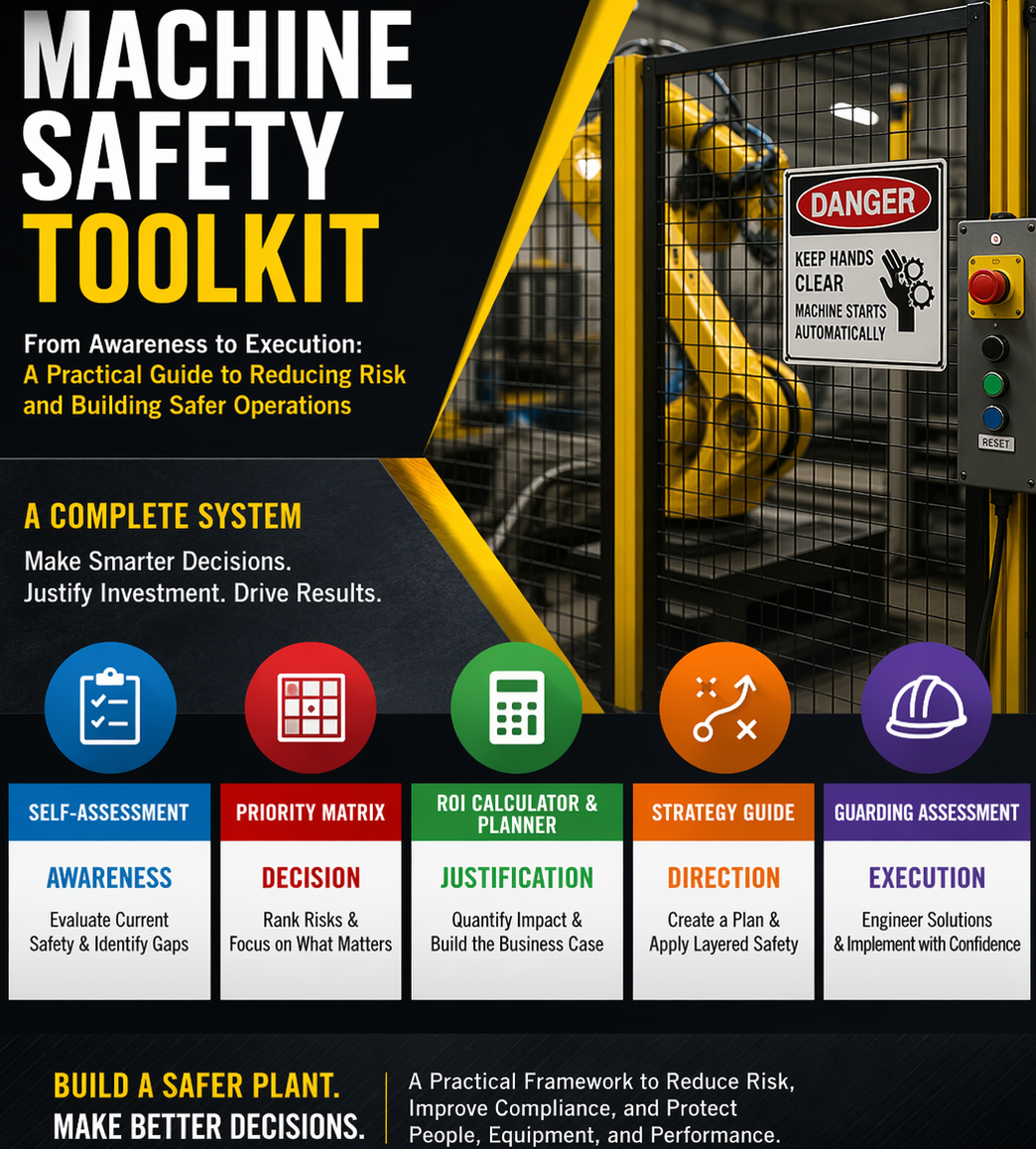
To solve this, a practical toolkit can be used to guide decision-making across five critical stages:
- Self-Assessment → Awareness
- Priority Matrix → Decision
- ROI Planner → Justification
- Strategy Guide → Direction
- Guarding Assessment → Execution
This toolkit is not theoretical. It has been built around how safety professionals work balancing compliance, operations, and budget.
1. Self-Assessment → Building Awareness
The First Step: Seeing the Gaps
Before solving machine safety challenges, you need visibility.
A machine safety self-assessment scorecard provides a quick, structured way to evaluate current conditions across:
- Physical guarding
- Interlocks and access control
- Presence-sensing devices
- Functional safety systems
- Operator interaction and behavior
- Maintenance condition
- Documentation and procedures
This step is intentionally simple.
It is not about perfect accuracy, it is about answering:
“Where are we exposed right now?”
Why Awareness Is Often Missing
In many facilities:
- Guarding exists, but may be incomplete or outdated
- Safety devices are installed, but not validated
- Procedures exist, but are not followed consistently
Without a structured overview, these gaps remain hidden until:
- An audit uncovers them
- An incident exposes them
A self-assessment creates:
- Immediate visibility
- Cross-functional alignment
- A starting point for deeper evaluation
Key Insight
Awareness is not compliance. But without awareness, compliance is impossible.
2. Priority Matrix → Making Better Decisions
The Real Challenge: What Comes First?
Once gaps are identified, the next challenge is prioritization.
Most safety teams face:
- Limited budgets
- Limited downtime
- Multiple competing risks
Everything can feel urgent.
A machine safety priority matrix introduces structure by evaluating:
- Severity of potential injury
- Frequency of exposure
- Ability to avoid the hazard
- Number of people exposed
From Emotion to Engineering Judgment
Without a prioritization method, decisions are often based on:
- The most recent issue
- The loudest concern
- The easiest fix
A priority matrix replaces this with:
- Repeatable scoring
- Transparent reasoning
- Defensible decisions
Example Outcome
Instead of saying:
“We should probably fix that machine next…”
You can say:
“This machine scores a Priority 1 due to high severity and daily exposure.”
That shift matters.
It transforms safety from:
- Subjective → Objective
- Reactive → Strategic
Key Insight
You do not need to fix everything today. You need to fix the right things first.
3. ROI Planner → Justifying Investment
The Reality: Safety Competes for Budget
Even when risks are clear, safety improvements must compete with:
- Production upgrades
- Automation investments
- Maintenance priorities
To move forward, safety must be framed as: Risk reduction + financial impact
Turning Risk Into Dollars
A risk reduction ROI planner helps quantify:
- Cost of a potential incident
- Medical expenses
- Workers’ compensation
- OSHA exposure
- Indirect costs
- Downtime
- Lost production
- Training replacement labor
- Reputation impact
It then compares:
- Current risk exposure
- Reduced risk after improvements
Why This Changes the Conversation
Instead of saying:
“We need $75,000 for guarding upgrades…”
You can say:
“This project reduces annual risk exposure by $50,000 with a 1.5-year payback.”
That is a completely different conversation.
The Hidden Opportunity
Many organizations underestimate:
- The frequency of exposure
- The true cost of incidents
When quantified properly, safety investments often:
- Pay for themselves
- Improve operational stability
- Reduce unplanned downtime
Key Insight
Safety is not just a cost. It is a risk-adjusted investment decision.
4. Strategy Guide → Creating Direction
The Missing Piece: A Plan
Even with awareness, prioritization, and ROI justification, many facilities struggle with:
“How do we actually move forward?”
A machine safety strategy provides that direction.
The 5-Step Strategy Framework
1. Identify Exposure
Focus on real operator interaction, not assumptions.
2. Assess & Prioritize
Use structured tools to rank risk.
3. Apply Layered Safety
Combine:
- Physical guarding
- Interlocks
- Presence sensing
- Functional safety
- Administrative controls
4. Validate Performance
Ensure systems work:
- Stop time
- Safety distance
- Control reliability
5. Plan & Execute
Build a realistic roadmap aligned with:
- Budget cycles
- Downtime
- Production needs
Why Layered Safety Matters
Many systems fail because they rely on a single method:
- Only guarding
- Only light curtains
- Only procedures
Effective safety systems use layers:
- Engineering controls first
- Administrative controls last
Common Mistakes to Avoid
- Treating safety as a one-time project
- Ignoring operator behavior
- Installing solutions without usability
- Assuming older machines are compliant
Key Insight
A good strategy does not eliminate all risk overnight. It creates consistent, measurable progress.
5. Guarding Assessment → Executing the Solution
Where Theory Meets Reality
At this stage, organizations move from planning to execution.
A professional guarding assessment evaluates:
- Machine-specific hazards
- Compliance with ANSI B11.19
- Effectiveness of existing safeguards
- Opportunities for engineered improvements
What Makes a Quality Assessment
Not all assessments are equal.
A strong evaluation includes:
- Real-world observation (not just paperwork)
- Practical recommendations
- Conceptual solutions
- Budgetary guidance
The Value of Turnkey Execution
Execution is where many projects fail.
Challenges include:
- Coordinating multiple vendors
- Integrating mechanical and electrical systems
- Maintaining production timelines
A turnkey approach solves this by providing:
- Design
- Manufacturing
- Assembly
- Installation
- Integration
Key Insight
Identifying risk is important. Eliminating it requires engineering and execution.
Bringing It All Together: A Complete Safety Journey
This toolkit works because each step builds on the last:
| Stage | Purpose |
| Self-Assessment | Identify gaps |
| Priority Matrix | Decide what matters most |
| ROI Planner | Justify investment |
| Strategy Guide | Create a roadmap |
| Guarding Assessment | Execute solutions |
Together, they form a complete system:
From awareness → action
Why This Approach Works
This structured methodology aligns with:
- Practical application of ANSI B11.19
- Real-world operational constraints
- Financial decision-making processes
It bridges the gap between:
- Safety requirements
- Engineering solutions
- Business priorities
Final Thought: From Uncertainty to Confidence
Most organizations do not lack commitment to safety. They lack clarity on:
- Where they stand
- What to fix
- How to justify it
- How to execute it
This toolkit provides that clarity.
PowerSafe Automation Perspective
“This toolkit helps you understand your risks. We engineer how to eliminate them.”
Next Step
If your organization is:
- Unsure where your biggest risks are
- Struggling to prioritize improvements
- Needing to justify safety investments
- Looking for engineered, turnkey solutions
A professional machine guarding assessment is the logical next step.