ANSI Safety Signs Explained: Understanding the 4-Part Structure for Machine Safety Compliance
Meta Description:
Learn how ANSI safety signs are structured, why the 4-part format matters, and how ANSI Z535 standards improve machine safety, hazard communication, and OSHA compliance in manufacturing facilities.
ANSI Safety Signs Explained: The 4-Part Structure Every Manufacturing Facility Should Understand
Walk through almost any manufacturing facility in America and you’ll see safety signs posted on machines, doors, fencing, electrical panels, conveyors, robotic cells, and workstations. Yet despite how common they are, many facilities still misunderstand what makes a safety sign truly effective — and more importantly, ANSI-compliant.
A common question among safety managers, engineers, and maintenance personnel is:
“Does ANSI require safety signs to contain four parts?”
The short answer is:
ANSI standards strongly support a structured four-part safety sign format under the ANSI Z535 series.
While not every sign requires every element, the ANSI framework establishes a standardized method for communicating hazards consistently and effectively. This structure has become a widely recognized best practice throughout manufacturing environments because it improves hazard recognition, operator understanding, and workplace safety performance.
For organizations focused on machine safety, OSHA compliance, and risk reduction, understanding the ANSI sign structure is critical.
What Is ANSI Z535?
ANSI Z535 is a family of standards developed to standardize the appearance, formatting, colors, wording, and design principles of safety signs and labels.
The goal is simple:
- Improve hazard communication
- Reduce confusion
- Increase consistency
- Help prevent injuries
- Support safer machine operation
The most commonly referenced sections related to industrial safety signage include:
- ANSI Z535.2
- ANSI Z535.4
These standards are heavily used throughout:
- Manufacturing facilities
- Machine guarding projects
- Robotic systems
- Conveyor systems
- Electrical safety programs
- Facility hazard communication systems
Although ANSI standards themselves are consensus standards rather than federal law, they are widely recognized by Occupational Safety and Health Administration as accepted industry practice.
In many machine safety evaluations, incident investigations, and liability reviews, ANSI-compliant signage is viewed as part of a comprehensive risk reduction strategy.
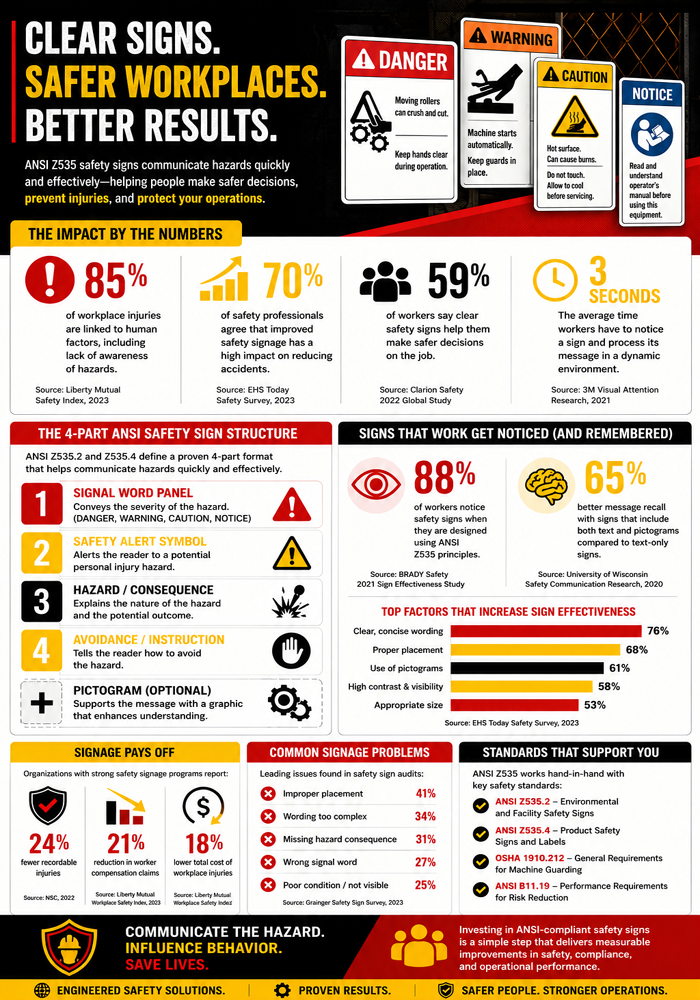
The ANSI 4-Part Safety Sign Structure
The “4-part” safety sign structure refers to the core components commonly found on ANSI-compliant hazard signs.
These components are designed to quickly communicate:
- The severity of the hazard
- The nature of the hazard
- The possible consequence
- How to avoid the hazard
Let’s break each one down.
1. Signal Word Panel
The signal word panel is typically the most visually dominant part of the sign.
It immediately communicates the severity level of the hazard.
Common ANSI signal words include:
| Signal Word | Meaning |
|---|---|
| DANGER | Immediate hazard that WILL result in serious injury or death |
| WARNING | Potential hazard that COULD result in serious injury or death |
| CAUTION | Hazard that MAY result in minor or moderate injury |
| NOTICE | Important information not directly related to injury |
| SAFETY INSTRUCTIONS | General safety-related information |
The signal word panel usually includes:
- A standardized background color
- Bold uppercase text
- A safety alert symbol when injury hazards exist
Common ANSI Colors
| Signal Word | Color |
|---|---|
| DANGER | Red |
| WARNING | Orange |
| CAUTION | Yellow |
| NOTICE | Blue |
This visual consistency allows operators to instantly recognize hazard severity before reading the rest of the sign.
2. Safety Alert Symbol
The safety alert symbol is the familiar triangle with an exclamation point inside.
⚠️
This symbol is used when:
- Personal injury hazards are present
- The hazard could impact operator safety
It is generally paired with:
- DANGER
- WARNING
- CAUTION
The symbol is not typically used for:
- Equipment-only damage
- Process information
- General notices
This small visual cue plays a major role in helping operators quickly identify safety-related warnings.
3. Hazard Description and Consequence Statement
This section explains:
- What the hazard is
- What could happen if exposed
The wording should be:
- Clear
- Specific
- Concise
- Easy to understand
Good hazard descriptions avoid vague terminology.
Weak Example
“Be careful around machine.”
Better ANSI-Style Example
“Rotating shafts can entangle clothing and cause serious injury or death.”
The second example clearly communicates:
- The hazard source
- The mechanism of injury
- The possible consequence
This matters because operators process information quickly in active manufacturing environments. Clear communication reduces assumptions and confusion.
4. Avoidance Statement
The avoidance statement tells the operator how to avoid the hazard.
This is one of the most important portions of the sign because it communicates the expected safe behavior.
Examples include:
- Keep guards in place during operation
- Lockout power before servicing
- Keep hands clear of moving rollers
- Wear required PPE
- Do not enter while machine is operating
Without an avoidance statement, the sign identifies danger but may fail to communicate actionable safety expectations.
The Optional Fifth Element: Pictograms
Although many people refer to ANSI signs as having four parts, modern safety signs frequently include a fifth element:
Pictograms or Safety Symbols
These graphics visually communicate:
- Crush hazards
- Pinch points
- Arc flash hazards
- PPE requirements
- Lockout/tagout instructions
- Entanglement hazards
Pictograms are extremely valuable because:
- They improve recognition speed
- They assist multilingual workforces
- They reduce reading dependency
- They improve comprehension during emergencies
For facilities with diverse operators or contractors, pictograms can significantly improve hazard communication effectiveness.
Example of an ANSI-Style Machine Safety Sign
DANGER
⚠️
Moving rollers can pull in hands, clothing, or loose materials and cause severe injury or death.
Keep guards in place and stay clear during operation.
This structure follows the ANSI communication flow:
- Severity
- Hazard
- Consequence
- Avoidance
Why ANSI Safety Sign Structure Matters
Many companies underestimate the importance of properly structured signage.
Poor signage can lead to:
- Operator confusion
- Unsafe shortcuts
- Increased injury risk
- Inconsistent hazard communication
- Greater liability exposure
Proper ANSI-style signage helps create:
- Consistency across facilities
- Faster hazard recognition
- Better training reinforcement
- Improved operator accountability
- Stronger safety culture
In machine guarding projects, signage should support the engineered risk reduction measures — not replace them.
ANSI Signs Are Not a Substitute for Machine Guarding
This is one of the most important concepts in machine safety.
A warning sign alone does not adequately reduce risk.
According to the hierarchy of risk reduction found in standards like:
- ANSI B11.19
- ISO 13849-1
Hazards should first be addressed through:
- Engineering controls
- Guarding
- Safety devices
- Administrative controls
- Warning signs and training
Signs are considered part of the administrative layer of protection.
For example:
- A rotating shaft should first be physically guarded
- Interlocked if required
- Safety distances validated
- Then labeled appropriately
A sign should reinforce the safe condition — not replace it.
Common Machine Safety Applications for ANSI Signs
ANSI-style signs are commonly used on:
Machine Guarding Systems
- Sliding doors
- Vertical lift guards
- Perimeter fencing
- Access gates
Conveyor Systems
- Nip points
- Rotating rollers
- Transfer hazards
Robotic Cells
- Restricted access areas
- Collaborative robot zones
- Automated motion hazards
Electrical Panels
- Arc flash warnings
- Lockout/tagout instructions
Hydraulic and Pneumatic Systems
- Stored energy hazards
- Pressure release warnings
Maintenance Access Points
- Lockout procedures
- Service hazards
In many facilities, signs also support standardized safety initiatives across multiple locations.
OSHA and ANSI: Understanding the Relationship
A common misconception is that ANSI standards are directly enforceable federal laws.
In reality:
- ANSI develops voluntary consensus standards
- OSHA develops and enforces regulations
However, OSHA frequently references ANSI standards as recognized best practices.
For example: OSHA 1910.212 requires hazards to be guarded but often does not specify exact sign formatting requirements.
ANSI fills in many of those practical implementation details.
Because of this, ANSI standards are often used during:
- Risk assessments
- Safety audits
- Incident investigations
- Legal evaluations
- Compliance improvement projects
Common Mistakes with Safety Signs
1. Too Much Text
Operators do not read paragraphs during production.
Signs should be concise and scannable.
2. Vague Language
“Use caution” is not enough.
The sign should explain:
- What the hazard is
- What can happen
- What action to take
3. Missing Consequence Statements
People respond more effectively when they understand the risk outcome.
4. Incorrect Signal Words
Using WARNING when DANGER is appropriate can dilute hazard severity.
5. Poor Placement
A perfectly designed sign is ineffective if operators cannot see it before exposure.
Best Practices for Machine Safety Signage
Standardize Across the Facility
Use consistent colors, wording, and layouts.
Use Durable Materials
Industrial environments require:
- Oil-resistant labels
- UV-resistant printing
- Washdown-compatible materials
Support Multiple Languages
Consider multilingual messaging where needed.
Pair Signs with Training
Signs reinforce training but do not replace it.
Include Signs During Guarding Design
Signage should be integrated into the engineering process — not added as an afterthought.
How ANSI Safety Signs Support a Stronger Safety Culture
One of the biggest advantages of standardized signage is cultural consistency.
When employees see:
- Consistent formatting
- Clear expectations
- Professional hazard communication
…it reinforces that safety is systematic rather than reactive.
Strong signage programs also help:
- Contractors navigate facilities
- New employees learn faster
- Visitors recognize hazards
- Multi-site organizations maintain consistency
This is especially important in facilities with:
- Legacy machinery
- High turnover
- Multiple production lines
- Frequent maintenance activities
Final Thoughts
ANSI safety sign standards provide a structured, proven method for communicating workplace hazards effectively.
While people often refer to ANSI signs as having “four required parts,” the more accurate explanation is that ANSI Z535 establishes a highly recommended framework that includes:
- Signal word
- Safety alert symbol
- Hazard/consequence statement
- Avoidance statement
Often supplemented with: 5. Pictograms or symbols
For manufacturers focused on:
- OSHA compliance
- Machine guarding
- Risk reduction
- Employee safety
- Standardization across facilities
…understanding ANSI sign structure is an important part of a comprehensive machine safety program.
Most importantly, signage should always support — not replace — engineered risk reduction measures.
When paired with proper machine guarding, functional safety controls, training, and validation, ANSI-compliant safety signs become a valuable tool for helping operators recognize hazards and work more safely every day.