Most workplace safety programs track OSHA recordables, first aid cases, and lost-time injuries. Those numbers matter, but they don't capture everything: a facility can post a low injury rate while still exposing workers to hazards that could cause a fatality or a permanently disabling injury.
SIF (Serious Injuries and Fatalities) safety addresses that gap. Instead of counting injuries after the fact, it asks a different question: if something goes wrong, how severe could the outcome be? This lets safety teams, engineers, maintenance staff, and leadership focus resources on the hazards most likely to cause catastrophic harm — before an incident occurs.
SIF risk is a growing concern for any facility running legacy equipment, automated production lines, robotics, conveyors, presses, packaging machinery, or custom-built systems.
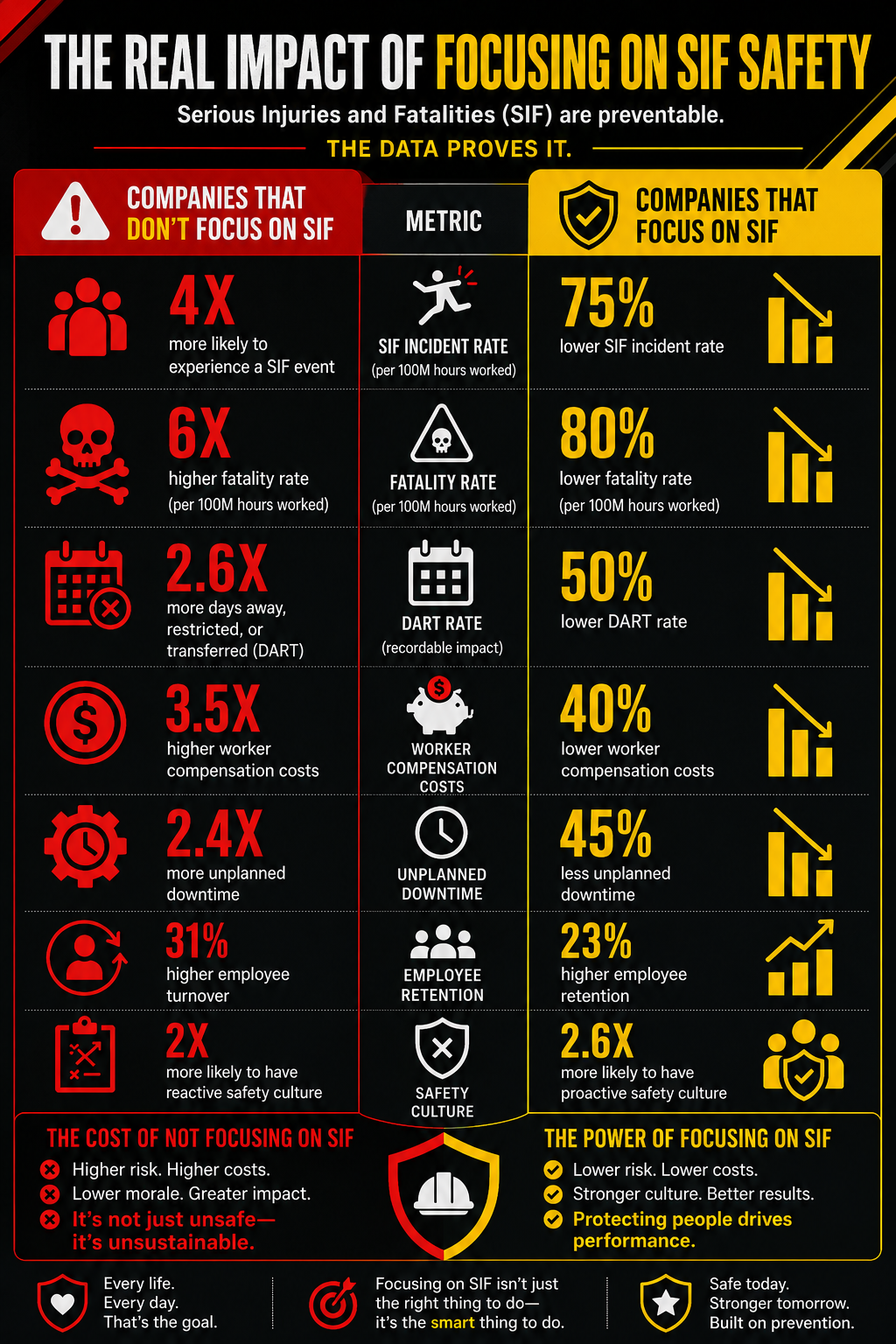
Key Takeaways
- SIF safety measures injury potential, not just injury frequency — a hazard with no injury history can still carry high SIF risk.
- Traditional metrics (TRIR, DART, lost-time incidents) only capture what has already happened, not what could happen.
- Machine hazards — nip points, unexpected startup, bypassed safeguards, incomplete lockout/tagout — are leading sources of SIF events.
- Reducing SIF exposure requires input from safety, engineering, maintenance, operations, and executive leadership, not just the safety department.
- Legacy equipment can often be brought up to modern safety standards through targeted retrofits rather than full replacement
What Is SIF Safety?
SIF stands for Serious Injuries and Fatalities: incidents that result in death, permanent disability, amputation, loss of eyesight, crushing injuries, severe burns, paralysis, traumatic brain injury, permanent loss of bodily function, or other life-altering harm.
Unlike minor injuries that heal, SIF incidents permanently change someone's life, along with their personal, professional, and financial future. This is why many organizations now evaluate injury potential alongside injury frequency: if a hazard could cause a fatality or catastrophic injury, it warrants immediate attention even if it has never caused one before.
Why Injury Rates Alone Can Be Misleading
Standard safety metrics — OSHA Recordable Rate, TRIR, DART Rate, lost-time incidents — measure what has already happened. SIF prevention focuses on what could happen.
Consider a maintenance technician who reaches through a guard to clear a jam. Nothing happens, because the machine happens to be stopped. The behavior repeats for years without incident — until the machine unexpectedly cycles, resulting in an amputation. None of the earlier near misses appeared on a safety dashboard, because no one was injured. The exposure carried SIF potential the entire time.
Why SIF Is Critical to Machine Safety
Machine hazards remain a leading source of catastrophic industrial injuries. Common sources include rotating shafts, pinch points, nip points, presses, robots, conveyors, automated assembly equipment, roll formers, packaging machinery, welding equipment, palletizers, and material handling systems.
Machine-related SIF risk is distinct because it typically involves high energy, unexpected startup, stored energy, crushing force, high-speed motion, multiple moving axes, and limited escape time. Unlike a minor slip or cut, machinery often leaves little opportunity for recovery once contact occurs — which is why machine guarding and functional safety are central to reducing SIF exposure.
Common Machine Hazards with SIF Potential
| Hazard | Why It's Dangerous |
| Unguarded nip points | Rollers, belts, chains, gears, and pulleys can pull body parts into machinery faster than human reaction time. |
| Unexpected startup | Maintenance personnel working inside hazardous areas without proper energy isolation face devastating consequences if a machine moves unexpectedly. |
| Bypassed safety devices | Light curtains, gate switches, interlocks, and safety scanners are sometimes defeated to improve productivity, which removes layers of protection and sharply increases SIF risk. |
| Inadequate lockout/tagout | Residual electrical, pneumatic, hydraulic, mechanical, or gravity energy continues to cause severe injuries across industries. |
| Poor access design | Operators climbing, reaching, or crawling into hazardous areas because equipment wasn't designed with maintenance or production access in mind. |
Who Is Responsible for SIF Prevention?
Reducing catastrophic risk requires collaboration across the entire organization, not just the safety department.
| Stakeholder | Role in SIF Prevention |
| Corporate safety leaders | Set company-wide standards and prioritize capital improvements. |
| Plant managers | Balance production demands against high-risk hazards that need attention. |
| Maintenance teams | Face the highest exposure to hazardous energy and machine access; their input is essential. |
| Engineering departments | Influence guarding, access, maintenance procedures, and control reliability from the design stage. |
| Operations leadership | Set production expectations and reinforce safe operating behavior. |
| Machine operators | Interact with equipment daily and often spot hazards before anyone else. |
| Executive leadership | Determine priorities, budgets, staffing, and overall safety culture. |
How to Identify High-Potential SIF Hazards
Evaluate operations regularly against questions like these. A "yes" to any of them warrants further review:
- Could someone contact moving machinery?
- Could unexpected startup occur?
- Could stored energy release unexpectedly?
- Could someone fall into or become trapped in a hazardous area?
- Is it easy to bypass safeguards?
- Does maintenance require entering danger zones?
- Are temporary procedures becoming permanent habits?
- Have production demands created unsafe shortcuts?
Building a SIF-Focused Safety Culture
Culture often determines whether an organization prevents an incident or experiences one. Employees need to feel comfortable reporting near misses, unsafe conditions, damaged guards, bypassed safety devices, production pressures, and equipment concerns.
What this means: organizations that punish reporting lose the chance to catch catastrophic risks early. Treating every near miss as a learning opportunity — not a compliance failure — is what allows hazards to surface before someone gets hurt.
Practical Steps to Reduce SIF Risk
Improving safety doesn't always require replacing equipment outright. Many legacy machines can be significantly improved through targeted engineering solutions:
- Perform comprehensive machine risk assessments. Evaluate equipment systematically for hazardous tasks, exposure frequency, and safeguarding gaps, and prioritize fixes based on actual exposure rather than assumptions.
- Upgrade physical guarding. Install fixed guards, movable guards, perimeter guarding, and barrier systems that account for operators, maintenance personnel, setup technicians, and cleaning activities.
- Improve functional safety. Integrate safety interlock switches, light curtains, laser scanners, two-hand controls, emergency stop systems, safety relays, safety controllers, and presence-sensing devices to complement — not replace — physical guarding.
- Evaluate lockout/tagout procedures. Review every machine for proper isolation of electrical, hydraulic, pneumatic, mechanical, gravity, thermal, and other stored energy. Effective lockout/tagout remains one of the strongest defenses against catastrophic maintenance injuries.
- Improve machine access. Add maintenance platforms, hinged guarding, quick-access panels, safe adjustment locations, ergonomic loading stations, and tooling improvements — safe access makes unsafe shortcuts less appealing.
- Validate safety systems. Test safeguarding after installation, maintenance, or modification to confirm devices function as intended.
- Investigate near misses. Treat every significant near miss like an injury that ended differently — recurring hazards often surface long before a serious event occurs.
Leadership's Role in SIF Prevention
Employees notice what leaders inspect, celebrate, and tolerate, and where budgets and priorities go. When leadership consistently prioritizes reducing catastrophic risk, employees see that protecting people is part of how the organization operates — not just a stated value.
Why Legacy Equipment Needs Special Attention
Many manufacturers run machines built decades ago that remain productive but lack modern safeguarding. Common gaps include non-interlocked guards, limited access control, minimal emergency stop coverage, poor visibility, difficult maintenance access, inconsistent documentation, and years of undocumented modifications.
Most of these systems can be upgraded without full replacement. Targeted retrofits frequently improve both safety and productivity while extending equipment life.
Creating a Risk-Based Improvement Plan
Budget constraints mean improvements should be prioritized, not addressed randomly. A phased roadmap allows continuous progress while managing resources responsibly:
| Phase | Focus |
| Immediate priorities | Hazards with high SIF potential requiring prompt attention. |
| Short-term projects | Engineering improvements planned within the next budget cycle. |
| Long-term modernization | Larger capital improvements tied to equipment replacement or automation initiatives. |
The Human Cost Behind Every SIF Event
Injury statistics don't capture the full cost of a serious incident. Behind every SIF event is a family, friends, coworkers, supervisors, customers, and a community. An employee who suffers a catastrophic injury may face years of rehabilitation, financial uncertainty, and permanent lifestyle changes. Preventing these incidents is about more than regulatory compliance — it's about making sure every employee goes home safely at the end of every shift.
Final Thoughts
SIF events are rare compared to minor injuries, but their impact is severe and permanent. Organizations that focus only on injury frequency risk overlooking hazards capable of permanently changing someone's life. Prioritizing machine guarding, functional safety, engineering controls, leadership commitment, and employee engagement reduces exposure to catastrophic events. The goal isn't just fewer injuries — it's preventing the injuries that should never happen in the first place.
At PowerSafe Automation, we help manufacturers identify high-consequence hazards and implement engineered safeguarding solutions — from upgrading legacy machinery to integrating modern safety technology into new equipment — so plants can protect their people without sacrificing operational performance. Contact our team to talk through your facility's SIF risk.