In manufacturing, machine safety projects rarely unfold on a perfect timeline. Capital approvals take time. Control system upgrades are complex. But in the meantime, operators are still exposed to real hazards every shift.
The good news: risk reduction does not have to be an all-or-nothing effort. A phased approach allows facilities to protect operators immediately with ANSI-compliant physical guarding, while developing a structured roadmap to bring the control architecture up to the required functional safety performance level.
This article breaks down what that approach looks like, technically and strategically.
Understanding the Two Zones of Machine Safety
When evaluating machine safety, it helps to separate the problem into two distinct zones. They can be addressed independently and in phases.
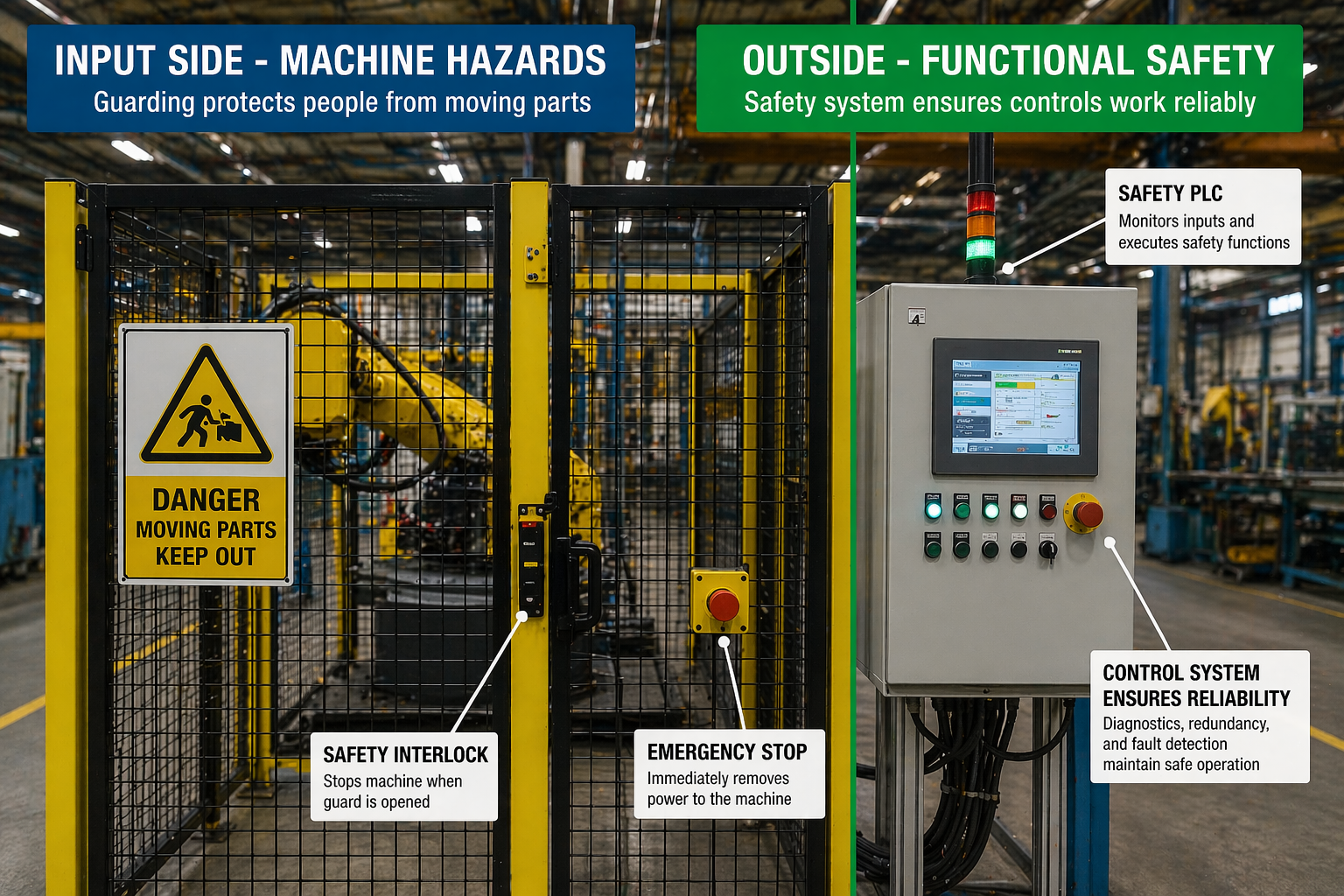
The Input Side: Where Operator Exposure Happens
This is where operators interact with the machine - loading material, making adjustments, accessing tooling, or clearing jams. It is also where the hazards exist:
- Pinch points and nip zones
- Rotating shafts and cutting surfaces
- Shear and crush hazards
- Unguarded point-of-operation access
The Output Side: Where Control Architecture Lives
This is where the safety logic is implemented - the control system that monitors interlocks, processes safety signals, and ensures the machine stops reliably when a hazard event occurs:
- Safety relays and safety PLCs
- Dual-channel circuit architecture
- Performance Level (PL) calculations (ISO 13849)
- Feedback monitoring and fault detection
- Validation and diagnostic coverage
These two zones are connected, but they do not have to be upgraded simultaneously. That distinction is the foundation of a phased safety strategy.
What Do Safety Standards Actually Require?
Standards such as ANSI B11, OSHA 1910.212, and ISO 13849 share a common principle: identify hazards, reduce risk to an acceptable level, and validate the effectiveness of your controls.
They do not require installing the most sophisticated safety control system immediately. They require that risk be reduced, and that the level of control reliability matches the severity of the hazard.
That means physical guarding is not optional. And it does not require waiting for a full control-system overhaul to implement.
Risk reduction can be staged, provided it is engineered and documented properly.
Phase 1: Immediate Risk Reduction Through ANSI-Compliant Guarding
The first phase focuses on the input side, eliminating or controlling operator exposure to hazardous energy without waiting for a controls upgrade. ANSI-compliant guarding options include:
Fixed Guards
These physically block access to hazard zones and require a tool to remove. Common configurations include:
- T-slotted aluminum framing with polycarbonate panels
- Perimeter fencing and enclosures
- Fastener-secured guards at point-of-operation
Interlocked Access Doors
These allow controlled access while preventing unsafe restart. Options include:
- Monitored safety switches
- Guard locking devices
- Dual-channel capable interlocks (selected with future architecture in mind)
Presence-Sensing Devices
These detect operator presence and stop hazardous motion automatically:
- Light curtains at entry points
- Area scanners for larger zones
- Pressure-sensitive safety mats
The key benefit: operator exposure is reduced immediately, independent of whether the control panel has been upgraded.
Why Waiting for a Full Controls Retrofit Is Itself a Risk
Control system upgrades safety PLC platforms, dual-channel architecture, panel rebuilds, networked safety systems that often require 12 to 24 months of capital planning and approval. That is a long time for operators to remain exposed.
Deferring all risk reduction until the controls project is funded is not a safety strategy. It is a liability. Physical guarding can be implemented on a much shorter timeline and at significantly lower cost reducing injury exposure, demonstrating compliance effort, and buying time for the larger controls investment.
Phase 2: Planning the Functional Safety Architecture
While Phase 1 addresses physical exposure, Phase 2 focuses on the control architecture - ensuring the system can reliably detect faults, stop hazardous motion, and meet the Performance Level required by the risk assessment.
Under ISO 13849, this involves evaluating:
- Category (B, 1, 2, 3, or 4)
- Performance Level (PLa through PLe)
- Diagnostic coverage
- Mean time to dangerous failure (MTTFd)
The critical insight: guarding hardware installed in Phase 1 should be selected with Phase 2 in mind. Specifying dual-channel capable interlocks and properly rated safety devices from the start means the guarding integrates cleanly into future PLd or PLe architecture without requiring a full replacement.
The Phased Machine Safety Strategy
| Phase | Focus | Objective |
| Phase 1 | ANSI-compliant physical guarding | Immediate operator exposure reduction |
| Phase 2 | Safety circuit review and gap analysis | Identify control architecture deficiencies |
| Phase 3 | Functional safety upgrade | Achieve the required Performance Level rating |
| Phase 4 | Validation and documentation | Close the compliance loop |
The Most Common Retrofit Mistake
The most common mistake in phased safety projects is installing guarding with no architectural foresight. When the controls upgrade eventually happens, plants find themselves rewiring interlocks, replacing devices, rebuilding panels, and absorbing unnecessary downtime. All because Phase 1 components were not selected with Phase 2 in mind.
The better approach: guard now, architect intentionally, upgrade in phases.
That means specifying guarding components with:
- Dual-channel capable interlocks
- Safety-rated devices compatible with future redundancy planning
- Clearly defined safety zones with future expansion capacity
- Wiring that supports integration into a safety PLC platform
This protects the Phase 1 investment while accelerating the path to full functional safety compliance.
The Business Case for Acting in Phases
Implementing physical guarding now:
- Reduces immediate injury risk
- Demonstrates a good-faith compliance effort to OSHA
- Improves operator confidence and morale
- Lowers liability exposure
- Creates time for capital planning on the controls side
Planning the functional safety architecture in parallel:
- Prevents expensive rework when the controls upgrade happens
- Aligns the design with ISO 13849 performance level goals
- Improves overall system reliability
- Builds a long-term safety infrastructure rather than a patchwork of fixes
Protect Now. Plan Intelligently. Build Forward.
If your input side presents clear hazards, do not delay risk reduction while waiting for a future safety PLC upgrade. The two do not have to happen simultaneously, and deferring the first until the second is funded leaves operators unprotected for no good reason.
The most effective approach:
- Implement ANSI-compliant guarding immediately to reduce operator exposure
- Select components that support future functional safety architecture
- Develop a phased roadmap for control reliability improvements
- Validate and document progress at each stage
Machine safety is not a single project. It is a lifecycle. And the most effective safety programs are phased, engineered, and built with the end goal in mind from the start.
Ready to Build a Phased Machine Safety Plan?
Whether you are evaluating ANSI compliance gaps, planning a guarding upgrade, or developing a functional safety architecture roadmap, PowerSafe Automation can help. Contact us today to start building a safer, smarter facility.