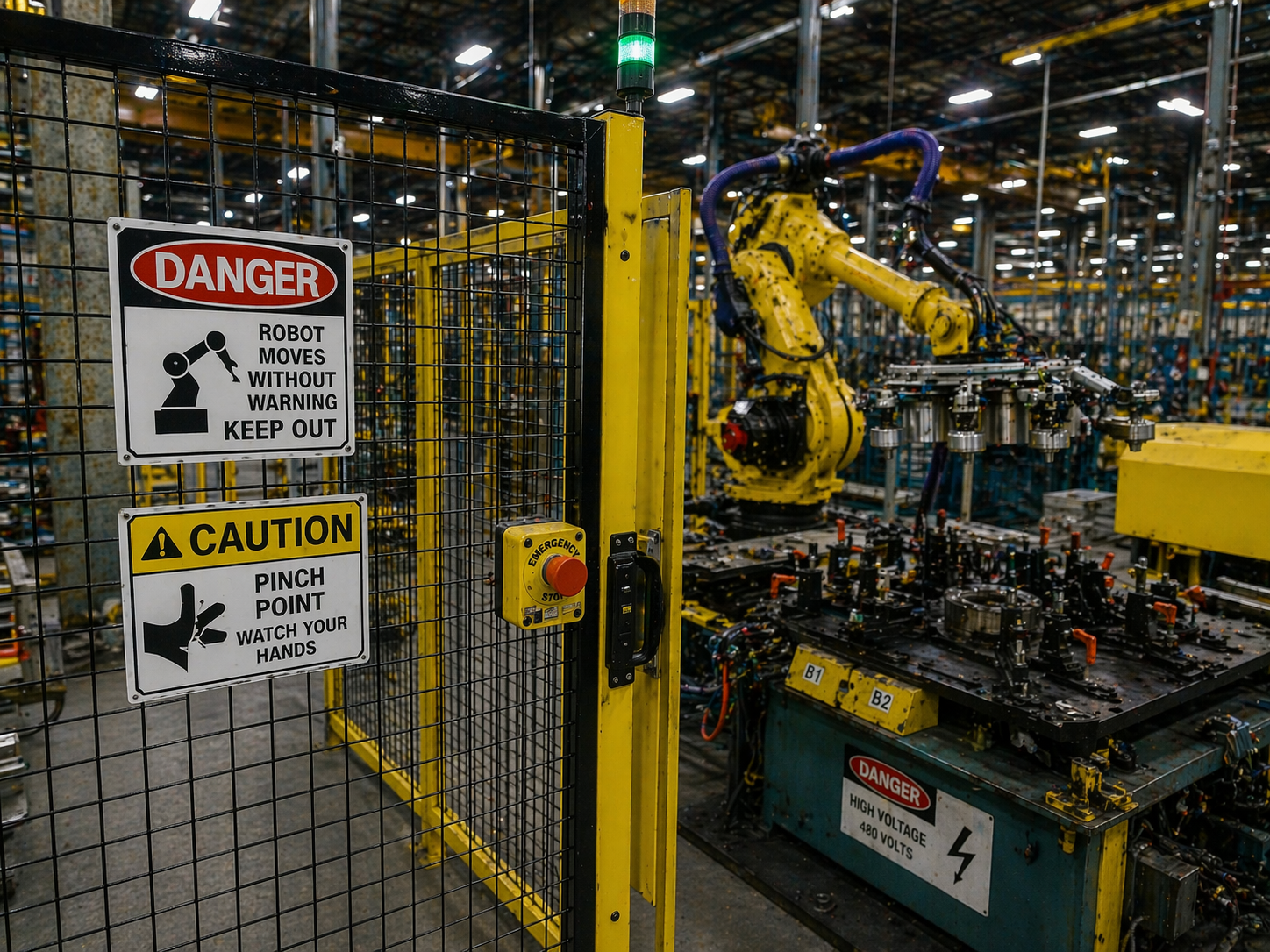
Walk through any manufacturing facility and you’ll see them: yellow caution signs, red danger placards, lockout/tagout labels, floor markings, PPE reminders. After a while, it’s easy for those signs to fade into the background.
But every operator should be asking one question: Why is there a sign posted in that area?
If there’s a sign, there’s a hazard. If there’s a hazard, there’s exposure. And if there’s exposure, someone can get hurt. This article is written for operators - the people closest to the equipment - to help you see safety signs not as decoration, but as intentional warnings worth your attention.
Safety Signs Don’t Exist Without a Reason
In regulated manufacturing environments, signage is not placed randomly. A sign is typically installed because:
- A risk assessment identified a hazard that could not be fully eliminated by engineering controls alone
- An incident or near miss occurred in that area
- A compliance requirement mandates it — such as OSHA regulations 29 CFR 1910.145 or 1910.212
- Engineering controls reduce the risk, but do not remove it entirely
When a sign reads:
- Caution – Pinch Point
- Do Not Enter – Authorized Personnel Only
- Lockout Required Before Servicing
- PPE Required in This Area
It means someone evaluated the hazard, determined the risk was real, and took action to communicate it. That is not white noise. That is a signal.
The Problem with “Safety Sign Fatigue”
Operators are exposed to the same environment every single day. Over time, the brain naturally begins to filter out repetitive visual inputs — a process called habituation.
When signs become background noise, three things start to happen:
- The warning stops being consciously processed
- Shortcuts become normalized
- Risk becomes routine
The hazard didn’t disappear. Your awareness of it did. And that’s when injuries happen.
A Sign Means the Hazard Is Being Managed — Not Eliminated
In machine safety, the Hierarchy of Controls is used to prioritize how hazards are addressed, in this order
- Elimination
- Substitution
- Engineering controls (guards, interlocks)
- Administrative controls (procedures, training, signage)
- PPE
Signs fall into the administrative control category. That means the hazard likely still exists — it’s simply being communicated rather than removed.
To put that in practical terms:
- A “Pinch Point” sign means there are moving components, guarding may limit but not eliminate exposure, and body parts can get caught.
- A “Hearing Protection Required” sign means noise levels exceed safe exposure limits and long-term damage is possible.
- A “Lockout Required” sign means there is stored energy and unexpected startup could cause serious injury.
The sign is there because the hazard cannot be ignored — and neither should you.
How to Read a Sign More Intentionally
Instead of walking past it, practice this three-question habit every time you encounter a safety sign:
- What hazard is this sign communicating? Mechanical? Electrical? Thermal? Noise? Crush point?
- Where exactly is the exposure point? A moving roller? A belt drive? A robot swing radius?
- What happens if this sign is ignored? A minor injury? A lost-time incident? A fatality?
That one habit — asking why — keeps you engaged instead of desensitized.
Signs Often Represent Someone Else’s Lesson
In many facilities, signs were installed after a near miss, a recordable injury, an OSHA inspection, a safety audit, or a machine modification. The sign you walk past every day may represent a lesson learned the hard way by someone who came before you.
Treat it with that level of respect.
When a Sign Should Trigger Immediate Action
There are moments when a sign should cause you to stop and reassess the situation entirely:
- The hazard appears worse than the sign suggests — guarding is missing, damaged, or has been bypassed
- The sign itself is faded or worn, which may signal broader complacency in that area
- The procedure doesn’t match the signage — for example, a “Lockout Required” sign with no practical way to safely isolate the energy source.
As an operator, you are the closest line of defense. Your awareness is part of the safety system.
Safety Signs Are One Piece of a Larger System
In modern manufacturing environments, signage works alongside physical machine guarding, interlocked access doors, light curtains, area scanners, safety relays, control reliability systems, and lockout/tagout procedures.
If your facility follows OSHA regulations or standards like the ANSI B11 series for machine safety, signage is one deliberate piece of a structured safety strategy. It’s there because someone evaluated the risk and determined communication was necessary — not optional.
Habits That Keep You Safer Every Day
If you want to strengthen your safety mindset on the floor, start with these four habits:
- Slow down in signed areas. Do not rush through zones marked with warnings.
- Speak up. If signage seems outdated, insufficient, or missing entirely, report it.
- Treat guards as protection, not obstacles. If guarding makes a task difficult, that is a conversation to have — not a reason to bypass.
- Stay curious. Curiosity is what prevents complacency.
A Sign Is a Conversation
Every safety sign is asking you something:
- Are you aware of this hazard?
- Are you protecting yourself?
- Are you following the safe method?
The sign is not decoration. It is not optional. It is not background noise. It is a reminder that a real risk exists in that area — and it was placed there by someone who wanted to make sure you knew.
The safest operators are not the ones who ignore familiar hazards. They’re the ones who pause, ask why the sign is there, and act accordingly.
Want to evaluate the safety systems in your facility?
PowerSafe Automation specializes in machine safety guarding, integrated safety controls, and risk assessments for manufacturing environments. Contact our team to learn how we can help you build a safer, more compliant facility.