
Integrated Machine Safety Controls
Two-Hand Controls with Anti-Tie-Down Safety Relay
Redundant two-hand control system with anti-tie-down logic, ensuring safe machine cycles.
Two hand controls with an anti tie down safety relay are operator initiated safety devices that require both hands to be intentionally and simultaneously used to start a hazardous machine cycle. PowerSafe builds these stations around Allen-Bradley 800Z Zero-Force Touch Buttons, capacitive sensing palm buttons that require no operating force and detect a hand through most industrial gloves, paired with a dedicated anti tie down safety relay sized to your system voltage (24VDC, 120VAC, or 240VAC). By requiring both buttons to be actuated within a set time window and held continuously, the system prevents operators from bypassing the controls, reaching into danger zones, or defeating the safety function with tie downs. Commonly used on presses, cutters, shears, and other high force machinery, these systems support Category 3/PLd or Category 4/PLe safety relay configurations and help facilities comply with OSHA, ANSI B11, and ISO 13851 requirements for two hand control.
Key Features
- Supports Category 3/PLd or Category 4/PLe safety relay configurations to match your machine's required performance level
- Anti tie down safety relay logic requires both buttons to be actuated within a defined time window and held continuously, preventing single hand or tied down activation
- Built on Allen-Bradley 800Z Zero-Force Touch Buttons: capacitive, zero force sensing that activates on touch, detectable through most industrial gloves
- Relay output touch buttons rated 200,000 operations (General Purpose) or 150,000 operations (Heavy Industrial), with a maximum response time of 76 ms on / 60 ms off
- Heavy Industrial version rated Type 4/13, IP66, tested to withstand 1200 psi washdown; General Purpose version rated Type 4/4X/13, IP66
- Operating temperature range of -25°C to +55°C (-13°F to 131°F), suited to most plant floor environments
- Built in diagnostic LEDs flag power up touch, excessive electrical noise, and sensing surface contamination without opening the enclosure
- UL Listed, CSA Certified, and CE Marked; complies with UL 508, CSA 22.2 No. 14, and EN/IEC 60947-5-1
- Dedicated anti tie down safety relay ordered by voltage: 440R-D23171 (24VDC), 440R-D23169 (120VAC), or 440R-D23168 (240VAC)
- Available in 22.5 mm and 30.5 mm mounting hole sizes with quick disconnect or terminal block wiring, in flush or surface mount housings
- Compatible with light curtains, safety interlocks, emergency stops, and other machine safety circuit devices for full system integration
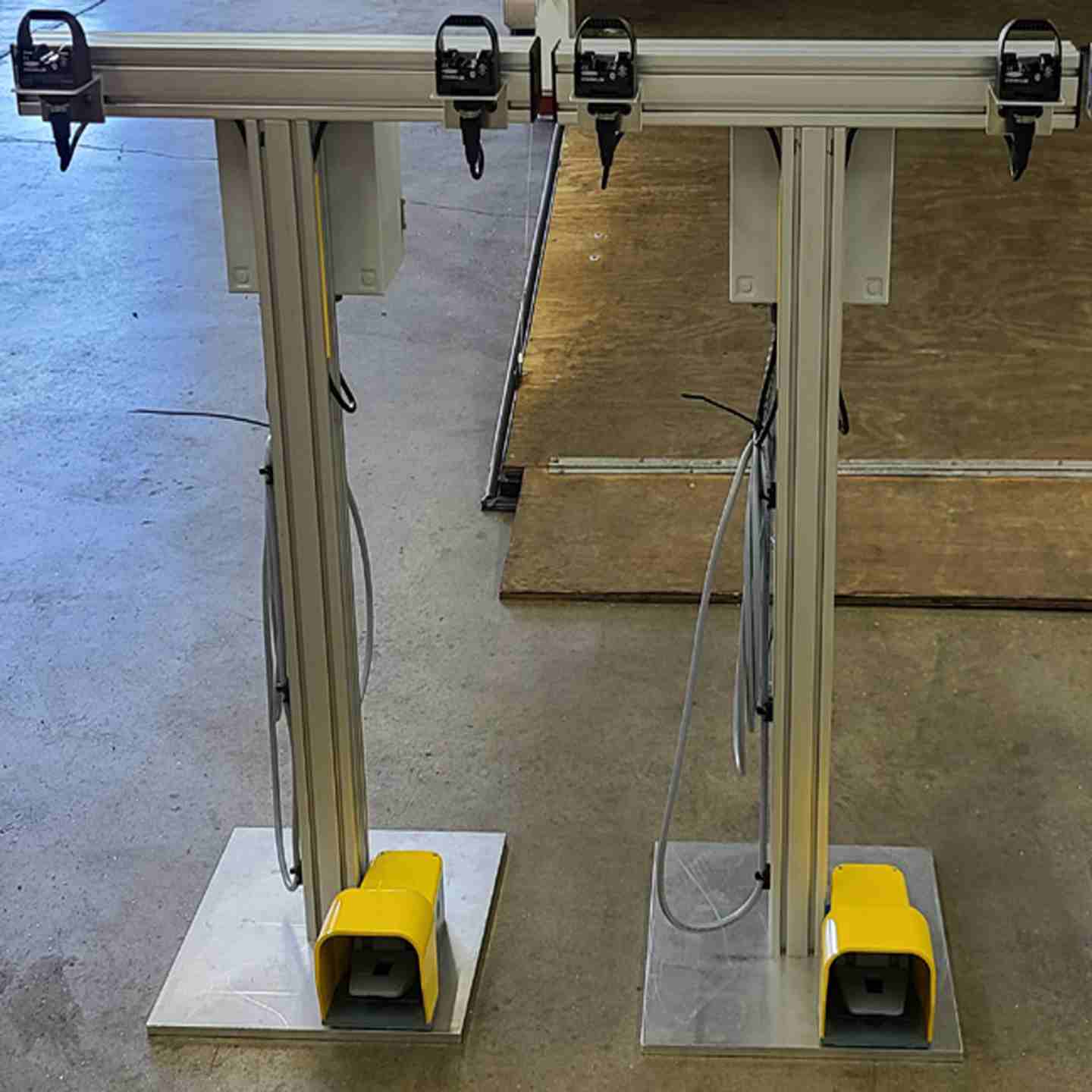
Two-Hand Controls with Anti-Tie-Down Safety Relay
Redundant two-hand control system with anti-tie-down logic, ensuring safe machine cycles.
Two hand controls with an anti tie down safety relay are operator initiated safety devices that require both hands to be intentionally and simultaneously used to start a hazardous machine cycle. PowerSafe builds these stations around Allen-Bradley 800Z Zero-Force Touch Buttons, capacitive sensing palm buttons that require no operating force and detect a hand through most industrial gloves, paired with a dedicated anti tie down safety relay sized to your system voltage (24VDC, 120VAC, or 240VAC). By requiring both buttons to be actuated within a set time window and held continuously, the system prevents operators from bypassing the controls, reaching into danger zones, or defeating the safety function with tie downs. Commonly used on presses, cutters, shears, and other high force machinery, these systems support Category 3/PLd or Category 4/PLe safety relay configurations and help facilities comply with OSHA, ANSI B11, and ISO 13851 requirements for two hand control.
Key Features
- Supports Category 3/PLd or Category 4/PLe safety relay configurations to match your machine's required performance level
- Anti tie down safety relay logic requires both buttons to be actuated within a defined time window and held continuously, preventing single hand or tied down activation
- Built on Allen-Bradley 800Z Zero-Force Touch Buttons: capacitive, zero force sensing that activates on touch, detectable through most industrial gloves
- Relay output touch buttons rated 200,000 operations (General Purpose) or 150,000 operations (Heavy Industrial), with a maximum response time of 76 ms on / 60 ms off
- Heavy Industrial version rated Type 4/13, IP66, tested to withstand 1200 psi washdown; General Purpose version rated Type 4/4X/13, IP66
- Operating temperature range of -25°C to +55°C (-13°F to 131°F), suited to most plant floor environments
- Built in diagnostic LEDs flag power up touch, excessive electrical noise, and sensing surface contamination without opening the enclosure
- UL Listed, CSA Certified, and CE Marked; complies with UL 508, CSA 22.2 No. 14, and EN/IEC 60947-5-1
- Dedicated anti tie down safety relay ordered by voltage: 440R-D23171 (24VDC), 440R-D23169 (120VAC), or 440R-D23168 (240VAC)
- Available in 22.5 mm and 30.5 mm mounting hole sizes with quick disconnect or terminal block wiring, in flush or surface mount housings
- Compatible with light curtains, safety interlocks, emergency stops, and other machine safety circuit devices for full system integration
Assembly / What's Included
- Dual palm button housing
- Matched anti tie down safety relay with redundant, force guided contacts
- A wiring diagram for your safety control voltage
- Installation, reset, and safety distance guidance documentation
- An optional pedestal stand and mounting hardware are available for floor mounted stations.
Output & Connection Options
- Relay output touch buttons, required for two hand safety applications, available in low voltage (10 to 40VDC / 20 to 30VAC) or full voltage (100 to 240VAC) input types
- Transistor/PNP output touch buttons are available for general sensing use but are not used in two hand safety configurations; the anti tie down safety relay must pair with relay output touch buttons only
- General Purpose devices connect via 4 pin or 5 pin quick disconnect, or 6 ft / 24 ft cabled options
- Heavy Industrial devices use an 8 position terminal block connection, wire range #22 to 12 AWG, 9 lb·in (1 N·m) tightening torque
- Mounting hole sizes of 22.5 mm or 30.5 mm, flush or surface mount, with an optional guard
Environmental Ratings
- Degree of Protection: Type 4/4X/13, IP66, tested to 1200 psi washdown (General Purpose); Type 4/13, IP66 (Heavy Industrial)
- Operating Temperature: -25°C to +55°C (-13°F to 131°F)
- Storage Temperature: -40°C to +85°C (-40°F to 185°F)
- Humidity: up to 95% RH from 25°C to 50°C (77°F to 122°F), full operation
- Vibration tested to 10 G with 1.52 mm displacement; mechanical shock tested to 100 G
Applicable Safety Standards
- CSA 22.2, No. 14
- EN50081-2
- EN60204-1
- EN60954-1
- EN61000-6-2
- EN/IEC 60947-5-1
- UL 508
Activation & Timing Issues
Machine won't cycle even with both hands on the buttons
- Confirm both buttons are pressed within the anti tie down relay's timing window and held continuously
- Check for a tied down or jammed button that could trigger the anti tie down fault condition
- Verify the correct safety relay (440R-D23171, 440R-D23169, or 440R-D23168) is installed for your system voltage
- Inspect wiring between the touch buttons and the safety relay for loose or damaged connections
Diagnostic LED & Status Issues
Button LED is blinking or button won't respond
- A blink pattern at power up usually means the button was touched during startup; remove your hand and wait about 10 seconds for the device to resume
- A different blink pattern means the button detected excessive electrical noise (above 20V/m); the device resumes automatically once the noise source is cleared
- A third blink pattern signals a conductive film, such as coolant or oil, building up on the sensing surface; clean the surface and the device will resume
- If the LED shows no activity at all, check incoming power at the terminal block or quick disconnect connector
Response Time & Relay Output Issues
Delay before machine starts, or machine doesn't stop as expected
- Confirm response time is within the rated 76 ms on / 60 ms off specification
- Check relay contacts for wear if the touch buttons are approaching their rated operation count (200,000 for General Purpose, 150,000 for Heavy Industrial relay output)
- Verify the safety relay's monitored reset and redundant outputs are functioning
- Test for welded or shorted contacts per the safety relay's fault detection routine
Wiring & Connection Issues
Intermittent operation or no output signal
- Recheck wire range and terminations; Heavy Industrial units use an 8 position terminal block, General Purpose units use 4 pin or 5 pin quick disconnect connectors
- Confirm tightening torque on terminal connections is correct
- Inspect cabled versions for cuts, pinches, or strain at the connector
- Verify common wiring is correct if isolated commons are required
Environmental & Contamination Issues
Degraded or inconsistent performance over time
- Clean the sensing surface regularly, especially in washdown or high oil/coolant environments
- Confirm the enclosure rating (Type 4/4X/13, IP66) matches the actual operating environment
- Check gasket condition on Heavy Industrial units for signs of wear
- Verify ambient temperature and humidity remain within rated limits
Mechanical & Housing Issues
Physical damage, guard problems, or mounting issues
- Inspect the optional guard for damage that could block or interfere with the touch surface
- Confirm mounting hardware is tight and the pedestal stand, if used, hasn't shifted
- Check housing material for cracks or wear from vibration or shock
- Verify the button surface still conforms properly and shows no visible sensor damage
Safety Compliance & Selection
System design concerns or audit findings
- Confirm the safety relay's rated category (Category 3/PLd or Category 4/PLe) matches your machine's required performance level
- Ensure hand spacing and button placement meet ISO 13851 safe distance requirements
- Verify relay output touch buttons, not transistor/PNP output, are used for the two hand safety function
- Confirm periodic function testing is documented per your safety program
Preventive Maintenance
To avoid recurring issues:
- Clean touch button surfaces on a regular schedule, especially in washdown environments
- Inspect wiring, terminal connections, and cable strain relief periodically
- Track relay output operation counts against rated life (200,000 or 150,000 operations)
- Confirm anti tie down timing and safety distance settings haven't drifted from commissioning
Fault Tracking & Continuous Improvement
- Log every fault or trip, including which diagnostic LED pattern was shown and the operating conditions at the time
- Look for patterns, such as repeated noise faults tied to a specific piece of nearby equipment
- Use fault history to plan relay and button replacement before reaching rated operation limits