
Integrated Machine Safety Controls
Intrinsic Safety Control Systems
Guard interlocking for hazardous locations with electrical ignition risks
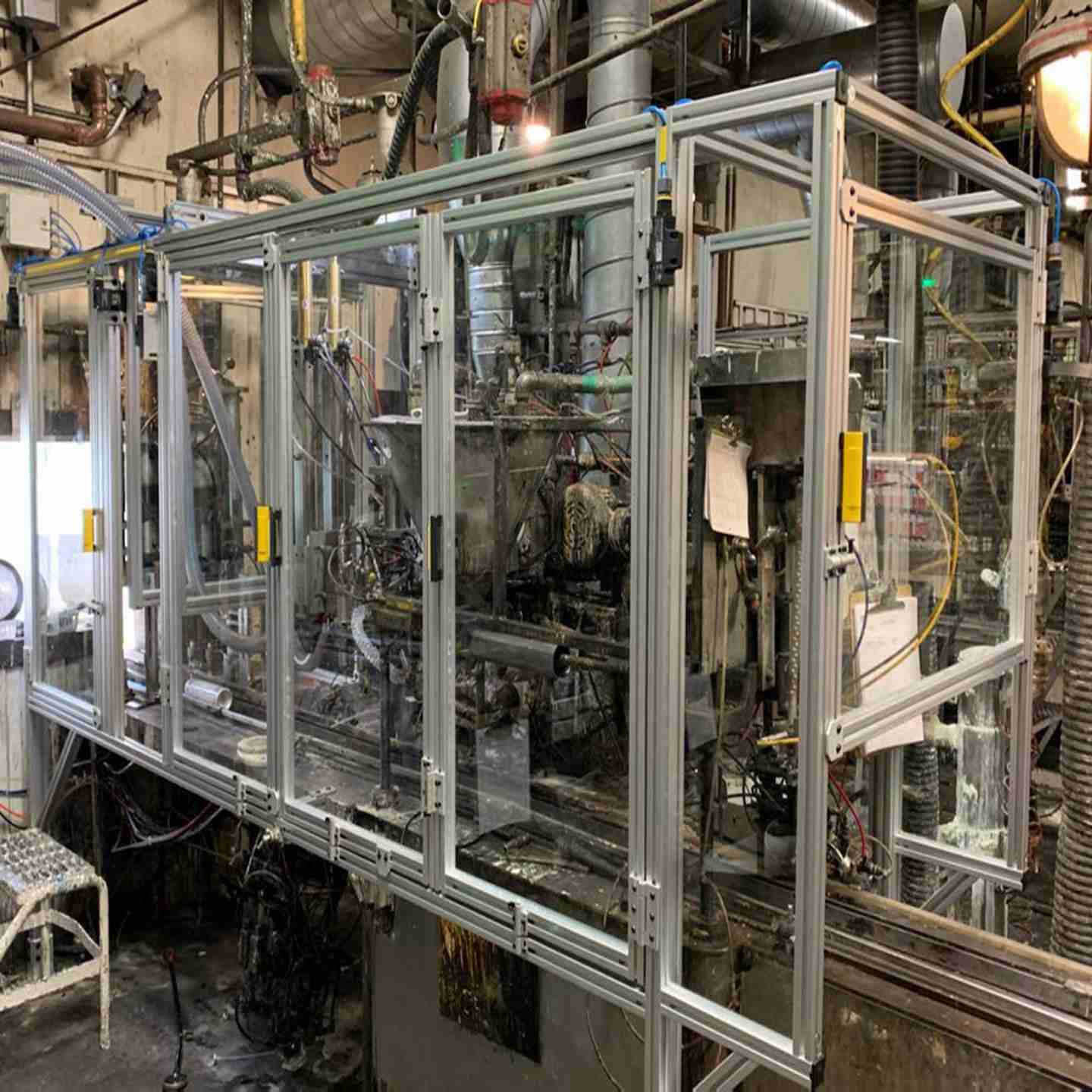
Intrinsic Safety Control Systems let you interlock guard doors and gates inside classified hazardous areas without an ignition source. The barrier caps the energy reaching the field circuit at 10.5V, 17.1 mA and 45 mW, well below what can ignite a flammable gas, vapor, or combustible dust. The result is a machine guarding circuit that stops hazardous motion on guard opening and meets the electrical requirements of a Class I / II / III, Division 1 & 2 area.
Key Features
- 937T isolated barrier certified [Ex ia Ga] IIC, [Ex ia Da] IIIC and [Ex ia Ma] I, rated up to SIL 2 per IEC 61508
- Intrinsically safe output parameters of Uo 10.5V / Io 17.1 mA / Po 45 mW (linear characteristic) for the hazardous-area circuit
- Dual-channel barrier supports the 440K Trojan 5's two direct-opening N.C. safety contacts on a single 12.5 mm DIN-rail module
- Line fault detection on each channel flags an open (≤0.1 mA) or shorted (>6.5 mA) field circuit before it becomes a silent failure
- 440K Trojan 5 interlock rated B10d > 2 × 10⁶ operations, MTTFd > 385 years, PFHd > 3 × 10⁻⁷ — usable in PLd or PLe / Cat. 3 or Cat. 4 architectures depending on the application
- Self-ejecting, tamper-resistant stainless steel actuator prevents defeat with a spare key; rotatable head gives four actuator entry positions
- Interlock switch sealed to IP67 with a -20…+80 °C operating range; barrier module IP20 for in-panel mounting, -20…+60 °C
- Safe electrical isolation between field and safe-area circuits per IEC/EN 60079-11, 375V peak; Um 250V AC
- Each barrier channel accepts either a dry mechanical contact or a NAMUR sensor, so interlocks, E-stops, and position sensors share one interface standard
Intrinsic Safety Control Systems
Guard interlocking for hazardous locations with electrical ignition risks
Intrinsic Safety Control Systems let you interlock guard doors and gates inside classified hazardous areas without an ignition source. The barrier caps the energy reaching the field circuit at 10.5V, 17.1 mA and 45 mW, well below what can ignite a flammable gas, vapor, or combustible dust. The result is a machine guarding circuit that stops hazardous motion on guard opening and meets the electrical requirements of a Class I / II / III, Division 1 & 2 area.
Key Features
- 937T isolated barrier certified [Ex ia Ga] IIC, [Ex ia Da] IIIC and [Ex ia Ma] I, rated up to SIL 2 per IEC 61508
- Intrinsically safe output parameters of Uo 10.5V / Io 17.1 mA / Po 45 mW (linear characteristic) for the hazardous-area circuit
- Dual-channel barrier supports the 440K Trojan 5's two direct-opening N.C. safety contacts on a single 12.5 mm DIN-rail module
- Line fault detection on each channel flags an open (≤0.1 mA) or shorted (>6.5 mA) field circuit before it becomes a silent failure
- 440K Trojan 5 interlock rated B10d > 2 × 10⁶ operations, MTTFd > 385 years, PFHd > 3 × 10⁻⁷ — usable in PLd or PLe / Cat. 3 or Cat. 4 architectures depending on the application
- Self-ejecting, tamper-resistant stainless steel actuator prevents defeat with a spare key; rotatable head gives four actuator entry positions
- Interlock switch sealed to IP67 with a -20…+80 °C operating range; barrier module IP20 for in-panel mounting, -20…+60 °C
- Safe electrical isolation between field and safe-area circuits per IEC/EN 60079-11, 375V peak; Um 250V AC
- Each barrier channel accepts either a dry mechanical contact or a NAMUR sensor, so interlocks, E-stops, and position sensors share one interface standard
Assembly
- Intrinsic safety barrier/isolator module
- Terminal labeling with mounting hardware
- Wiring diagram and safety compliance documentation
- Note: Field devices and sensors sold separately
Common Applications
- Chemical processing, metal finishing, plastics, and food production involving combustible dusts
- Tanks, mixers, grinders, and conveyors in explosive atmospheres
- Paint and solvent booths, battery manufacturing, and classified areas where guarding is required without declassifying the space