Executive Summary
Multi-wall packaging operations are the backbone of high-volume distribution handling bulk materials, sacks, cartons, and palletized goods that must move quickly, safely, and consistently. In warehouse packaging areas, risk tends to concentrate where people and machines intersect palletizers, stretch wrappers, conveyors, case erectors, and robotic cells operating at production speeds that leave little margin for error.
This case study explores how PowerSafe Automation’s tailored guarding solutions delivered measurable safety and operational gains for a multi-wall packaging environment. By applying risk-based engineering, modular guarding design, and integrated safety controls, PowerSafe helped transform legacy warehouse packaging areas into safer, more compliant, and more productive systems—without sacrificing throughput or flexibility.
Throughout this case study, you will see how a turnkey, custom-fit approach to machine guarding supports OSHA compliance, reduces unplanned downtime, and positions warehouse packaging operations for long-term growth. For additional technical detail on the methodologies referenced here, visit our Industries served page.
Industry Background: Risk in Warehouse Packaging Areas
Warehouse packaging areas in multi-wall operations are deceptively complex. While often viewed as “downstream” or lower risk than primary manufacturing equipment, these zones introduce a unique combination of hazards:
- High-speed palletizing and depalletizing
- Stretch wrapping with rotating arms or turntables.
- Powered roller and belt conveyors
- Case erecting, sealing, and labeling systems
- Forklift and pedestrian traffic in shared spaces.
- Frequent manual intervention for jams, changeovers, and material replenishment
Unlike enclosed production machines, warehouse packaging systems are frequently open by necessity—designed for accessibility, flexibility, and line-of-sight monitoring. This openness can expose operators to:
- Pinch points and shear hazards
- Struck-by risks from moving loads.
- Entanglement hazards at rotating equipment
- Unexpected startup during clearing or adjustment.
For multi-wall packaging companies operating at scale, these risks are multiplied across shifts, SKUs, and facility layouts.
The Challenge: Balancing Safety, Throughput, and Flexibility
The warehouse packaging areas evaluated in this case study shared several common challenges:
1. Legacy Guarding and Inconsistent Protection
Some machines had partial guarding added over time, often from multiple vendors or internal maintenance teams. Guard designs varied widely, leading to gaps, misaligned access points, and inconsistent safety performance.
2. OSHA and Internal Audit Pressure
As corporate EHS standards matured, the packaging areas faced increased scrutiny under OSHA 29 CFR 1910.212 and applicable ANSI standards. Existing safeguards were often reactive rather than engineered as part of a cohesive risk-reduction strategy.
3. Operational Disruption from Safety Retrofits
Previous attempts at safety upgrades resulted in excessive downtime, awkward access restrictions, or reduced line efficiency—creating resistance from operations and maintenance teams.
4. Scalability Concerns
The packaging layout needed to evolve as volumes increased and equipment was reconfigured. Fixed, welded guarding solutions limited adaptability and made future changes costly.
The PowerSafe Automation Approach: Tailored, Risk-Driven Guarding
PowerSafe Automation approached the project with a risk-reduction mindset, not a catalog-driven product pitch. The goal was not to sell guards—but to engineer safer, more productive packaging areas aligned with real-world use.
Step 1: On-Site Risk Assessment & Workflow Analysis
Each warehouse packaging zone was evaluated using a structured assessment process that considered:
- Operator interaction frequency
- Severity of potential injury
- Exposure duration
- Accessibility to hazardous motion
- Likelihood of human error during normal and abnormal conditions
This analysis helped identify where physical guarding was required, where interlocked access made sense, and where procedural or visual controls could complement engineered safeguards.
Step 2: Custom Guarding Design Using Modular Systems
Instead of off-the-shelf panels, PowerSafe designed custom machine guarding using modular aluminum framing and infill panels tailored to each piece of equipment. This approach delivered several advantages:
- Precise fit around conveyors, palletizers, and wrappers
- Consistent appearance across the warehouse floor
- Easier modifications for future line changes
- Reduced installation time compared to welded steel.
Panels were selected based on visibility, durability, and environmental conditions—balancing operator awareness with physical protection.
Step 3: Integrated Safety Controls
A guard is not a safety solution unless it communicates with the machine.
PowerSafe integrated safety devices such as:
- Interlocked access doors
- Safety-rated switches and sensors
- Emergency stop circuits tied into existing control architecture.
This ensured that opening a guard or accessing a hazardous area resulted in a controlled, safe machine state, rather than relying on administrative controls alone.
Step 4: Installation with Minimal Disruption
Installations were coordinated around production schedules, with phased implementation to keep packaging lines running. This minimized downtime and built trust with operations teams.
Key Guarding Solutions Implemented
Palletizer & Depalletizer Guarding
High-speed palletizing equipment represents one of the most significant hazards in warehouse packaging.
Solutions included:
- Perimeter guarding with interlocked access gates.
- Clear polycarbonate panels for visibility
- Defined safe access points for maintenance.
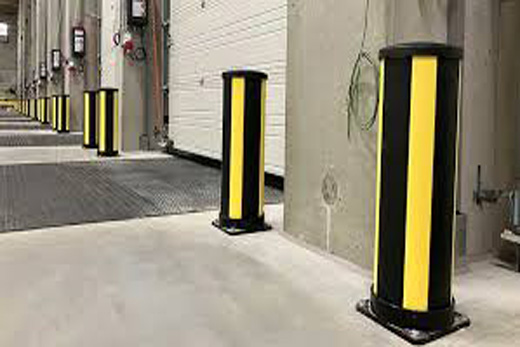
- Protective bollards extending the life of the guarding
Benefits:
- Reduced struck-by and pinch-point exposure.
- Improved lockout/tagout discipline
- Clear demarcation of robot and pallet motion zones
Conveyor Line Guarding & Zone Segmentation
Conveyors often span long distances, crossing pedestrian aisles and work areas.
Solutions included:
- Guarded transfer points and nip locations
- Fixed and removable panels for service access
- Visual separation between walkways and moving equipment.
Benefits:
- Reduced entanglement risk
- Improved traffic flow and operator awareness
- Cleaner, more organized warehouse layout
Stretch Wrapper Safety Enclosures
Stretch wrappers pose unique risks due to rotating arms, turntables, and film carriages.
Solutions included:
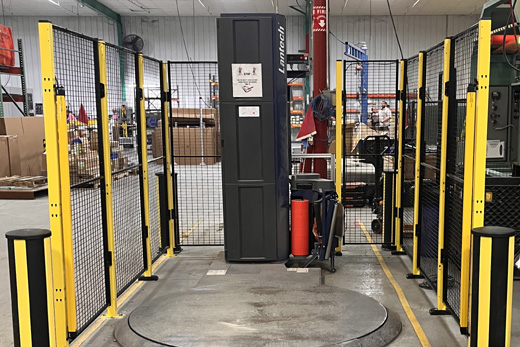
- Full height guarding around rotating zones.
- Interlocked access doors for roll changes and maintenance
- Safety-rated stopping tied to wrapper controls.
Benefits:
- Eliminated exposure to rotating components.
- Reduced near-miss incidents.
- Faster, safer film changeovers
Operational Results & Measurable Benefits
1. Improved Safety Performance
Following implementation, the warehouse packaging areas saw:
- Fewer near-miss reports related to packaging equipment.
- Improved compliance during internal and third-party audits
- Increased operator confidence when working near automated systems.
By addressing hazards at the engineering level, safety became built-in, not enforced.
2. Reduced Unplanned Downtime
While guarding is often perceived as a productivity constraint, the opposite proved true.
- Clearly defined access points reduced unsafe shortcuts.
- Interlocks prevented damage from improper machine entry.
- Maintenance teams spent less time troubleshooting safety issues.
The result was more predictable uptime and smoother shift transitions.
3. Greater Workforce Buy-In
Because guards were designed around actual workflows, operators did not feel “boxed out” of their jobs.
- Visibility was preserved.
- Access was logical and intuitive.
- Training requirements were simplified.
This increased compliance and reduced the temptation to bypass safeguards.
4. Scalable, Future-Ready Design
As packaging volumes and layouts evolve, modular guarding systems allow:
- Relocation of panels and posts
- Expansion of guarded zones
- Integration with new equipment
This protects the initial investment while supporting growth.
Why Tailored Guarding Matters in Warehouse Packaging
Warehouse packaging areas sit at the intersection of production pressure and safety responsibility. Generic guarding solutions often fail because they do not account for how people actually work.
PowerSafe Automation’s tailored approach ensures that:
- Guarding aligns with operational needs.
- Safety controls integrate seamlessly with existing equipment.
- Compliance supports productivity instead of fighting it.
Conclusion: A Smarter Standard for Packaging Safety
For multi-wall packaging operations, warehouse safety cannot be an afterthought. It must be engineered with the same rigor as the packaging process itself.
Through risk-driven design, modular construction, and integrated safety controls, PowerSafe Automation helped transform warehouse packaging areas into safer, more efficient, and more adaptable environments—without compromising throughput or flexibility.
The result is not just compliance, but confidence: confidence that people can work safely, equipment can run reliably, and operations can scale responsibly. To learn more about how tailored machine guarding can support your warehouse packaging operations, visit our Industries Served page.