Machine guarding decisions used to be straightforward. Steel was available, familiar, and strong enough to get the job done. But as manufacturing environments have grown more dynamic — faster changeovers, collaborative automation, flexible production lines, tighter compliance timelines — the material question has become more consequential.
T-slotted aluminum extrusion and welded steel each bring genuine strengths to the table. Understanding where those strengths apply is the difference between a guarding system that supports your operation for years and one that becomes an obstacle the moment your process changes.
This article breaks down both options across the categories that matter most to safety managers and plant engineers: installation speed, reconfigurability, compliance validation, safety device integration, and total cost of ownership.
Head-to-Head Comparison
| Category | T-Slot Aluminum Extrusion | Welded Steel |
| Installation Speed | 30–50% faster; no welding or painting | Slower; on-site fab, grinding, paint |
| Reconfigurability | Fully modular; bolt-on changes | Cut, grind, re-weld to modify |
| Safety Device Integration | Precise mounting, adjustable brackets | Requires drilling or welded brackets |
| Impact Resistance | Strong for standard guarding loads | Superior in heavy-impact environments |
| Weight | Lightweight; 1–2 person install | Heavy; often requires hoist/forklift |
| Compliance Validation | Easier to validate safety distances | Risk of gaps from warping or poor welds |
| Total Cost of Ownership | Lower over 5–10 years; reusable | Higher; painting, rust, rebuild costs |
| Ideal Environment | Automation, food, pharma, flexible lines | Outdoor, high-impact, fixed machines |
Material Overview
T-Slotted Aluminum Extrusion
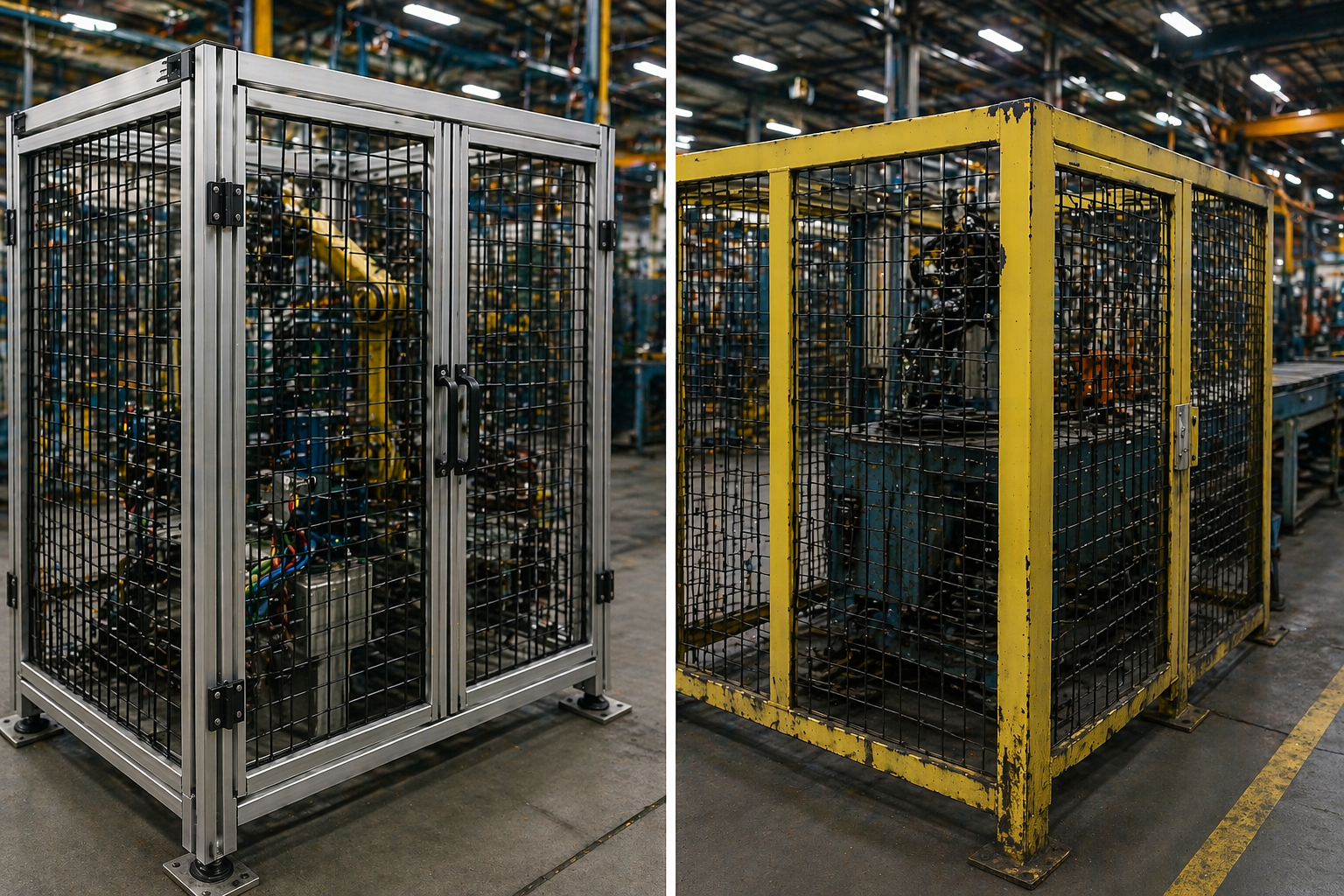
T-slot extrusion uses lightweight, anodized aluminum profiles with continuous channels that accept brackets, panels, doors, and accessories without welding or drilling. The system is inherently modular — components bolt into place, can be repositioned as conditions change, and are compatible with polycarbonate, wire mesh, and aluminum infill panels.
The practical implication is a guarding system that evolves with your facility rather than constraining it.
Welded Steel Guarding
Welded steel uses cut steel tubing, welded joints, and fixed panel frames. It is rigid, extremely durable under heavy impact, and well-suited for environments where the machine, process, and risk profile are permanently fixed.
The trade-off is inflexibility. Any change to a welded steel guard requires cutting, grinding, and re-welding — or scrapping the section entirely.
Installation Speed and Downtime Impact
T-slot extrusion ships pre-cut and pre-assembled, ready for on-site installation without welding, grinding, or paint curing. For most guarding projects, this translates to 30–50% faster installation compared to welded steel — which means less production downtime, faster compliance, and lower total installation cost.
For facilities running weekend installs or rapid-response safety upgrades, the timeline difference alone often determines which material makes sense.
Welded steel guarding requires on-site fabrication or pre-built frames, fire safety precautions during welding, secondary grinding and painting, and extended curing time before the area can return to production. The result is longer shutdowns and more complex project coordination.
Reconfigurability and Long-Term Adaptability
If there is one category where aluminum extrusion provides an unambiguous advantage, it is long-term adaptability. Panels, doors, light curtains, area scanners, and cable trays can be added, repositioned, or replaced without generating scrap or requiring fabrication resources.
This matters most in facilities with evolving SKUs, expanding automation, or plans to integrate collaborative robots into existing work cells. Guarding that can adapt to those changes is an asset. Guarding that cannot becomes a recurring cost.
Welded steel treats every modification as a fabrication project. Permanent structures that made sense at installation often become bottlenecks when process flow changes — and the cost of rebuilding them accumulates over time.
Strength and Durability
Welded steel has a genuine advantage in applications involving extreme structural loads: high-tonnage presses, heavy impact zones, forklift traffic lanes, and outdoor or harsh-environment installations. Welded joints form a rigid frame designed to absorb significant force without deforming.
For standard machine guarding applications — robot cell perimeters, multi-machine enclosures, conveyor guarding, and overhead frameworks — modern T-slot extrusion profiles (45mm and 90mm series) are engineered to meet OSHA and ANSI performance requirements without issue. The material is stronger than it appears.
Steel for extreme-impact environments. Extrusion for standard guarding loads.
Safety Device Integration and Cable Management
Modern machine safeguarding is rarely just a physical barrier. Light curtains, area scanners, safety interlocks, E-stops, and cable management systems need to mount precisely, stay aligned over time, and integrate cleanly into the safety circuit.
T-slot extrusion handles all of this natively. Adjustable brackets allow safety devices to be positioned exactly where performance level calculations require. Internal cable routing keeps wiring protected and accessible. Polycarbonate infill panels maintain visibility to the hazard zone for both monitoring and troubleshooting. When devices need to be repositioned — due to a process change or a validation gap — no additional fabrication is required.
Welded steel requires drilling or welded mounting brackets to add devices, limits alignment adjustability, and typically pushes cable management to surface-mounted conduit. When a device needs to move, it becomes a fabrication task.
Compliance and Validation
Both materials are capable of meeting OSHA 1910.212, ANSI B11 series standards, ISO 13857 safety distance requirements, and ISO 13849-1 performance level criteria. The distinction is in how easily those requirements can be validated — and maintained over time.
T-slot systems allow panels and safety devices to be aligned precisely to satisfy ISO 13857 reach-distance tables. Field adjustments do not compromise structural integrity. If a task-based risk assessment identifies a gap in safeguarding geometry, the fix is a bracket reposition, not a rebuild.
Welded steel systems introduce compliance risk through inconsistent mesh spacing, weld gaps, or frame warping that can allow unintended reach-through access. These gaps are often discovered during inspections rather than during installation — when the cost of remediation is significantly higher.
Cost: Upfront vs. Total Cost of Ownership
The perception that welded steel is the lower-cost option is driven by material price. That comparison changes when total cost of ownership is measured across a 5–10 year horizon.
| Guarding Type | Material Cost | Fabrication Labor | Installation |
| T-Slot Extrusion | Moderate | Low | Low |
| Welded Steel | Low | High | High |
Over time, extrusion eliminates painting and rust maintenance costs, avoids the fabrication expense of modifications, and can be redeployed to other projects rather than scrapped. Most facilities that track both upfront and lifecycle costs find T-slot aluminum delivers 20–40% lower total cost of ownership — even when initial quotes are comparable.
When Each Option Makes Sense
T-Slot Extrusion Is the Right Choice When:
- The facility runs automated equipment, robot cells, or collaborative workstations
- Production lines change frequently or are being expanded
- Safety device integration is part of the guarding scope
- Fast installation timelines are required to minimize downtime
- The environment demands cleanliness, visibility, or a professional appearance
- Long-term reusability and lower lifecycle cost are priorities
- The application involves extreme impact loads or heavy forklift exposure
- The installation is outdoor or in a harsh, corrosive environment
- The machine and process are permanently fixed with no anticipated changes
- In-house welding capacity makes steel fabrication a low-cost option
Welded Steel Is the Right Choice When:
- The application involves extreme impact loads or heavy forklift exposure
- The installation is outdoor or in a harsh, corrosive environment
- The machine and process are permanently fixed with no anticipated changes
- In-house welding capacity makes steel fabrication a low-cost option
How PowerSafe Approaches Material Selection
PowerSafe Automation takes a material-agnostic engineering approach. Our starting point is always the risk profile of the machine and the operational realities of the facility — not a preference for one system over another.
In practice, most machine guarding projects we deliver use T-slot extrusion, because most manufacturing environments benefit from the speed, flexibility, and safety device integration it provides. But for high-impact zones, harsh environments, or fixed-machine applications where welded steel is the better engineering answer, that is what we specify.
Our turnkey scope covers custom T-slot extrusion and welded steel guarding systems, hybrid configurations, interlocked safety doors, integrated safety controls, 3D scanning, CAD design, Performance Level calculations, and on-site installation. The goal is a guarding system that performs the way the standards require — and keeps performing as your facility evolves.
Ready to Select the Right Guarding for Your Application?
Whether you’re evaluating a new machine installation, retrofitting legacy equipment, or planning a compliance upgrade, PowerSafe Automation can help you determine the right material and system design for your environment. Contact us today to start the conversation.