Introduction: The Hidden Compliance Gap in Mergers and Acquisitions
When a company acquires an existing manufacturing operation—whether a single facility or a multi-site national footprint, there is often an assumption that the new owner has time to bring legacy equipment “up to standard.” Many leadership teams believe OSHA offers some sort of grace period, transition window, or phased compliance schedule for machine guarding after taking over an operation.
This belief is wrong.
Under federal law, OSHA does not provide a deadline, buffer period, or adjustment timeline following an acquisition. From the moment a company assumes ownership and begins operating the facility, it becomes fully responsible for ensuring compliance with OSHA 1910.212 (Machine Guarding), 1910.219 (Mechanical Power Transmission), and the General Duty Clause.
This creates one of the largest—and most misunderstood—gaps in post-acquisition risk management. And today, with OSHA increasing enforcement activity and penalties at record highs, the exposure is only growing.
This blog explains what OSHA expects, why there is no grandfather clause, how companies should approach post-acquisition safety, and how structured programs like PowerSafe Automation’s Risk Reduction Prioritization Program (RRPP) help new owners protect workers and accelerate compliance.
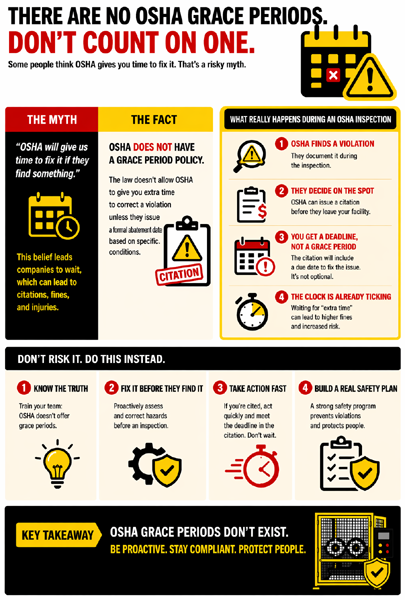
Does OSHA Give You Time to Comply After Acquisition?
Short Answer: No. OSHA Requires Immediate Compliance.
OSHA’s machine guarding rules are hazard-based, not ownership-based. This means OSHA evaluates the condition of the machine—not how long you have owned it.
If a hazardous motion exists—rotating shafts, pinch points, nip points, flywheels, belts, shears, cutting tools, or any unguarded moving part—OSHA can issue a citation on Day 1 of your ownership.
There is no “We just bought this place” defense. There is no “We’re working on it” exemption. There is no “Give us 90 days” clause.
And unlike environmental regulations or certain building codes, OSHA does not offer transitional compliance periods for newly acquired operations.
Why OSHA Does Not Offer a Grace Period
1. Machine guarding regulations are universally applicable
1910.212 and 1910.219 apply to all machines—regardless of age, use, or ownership history.
2. Employee exposure creates immediate liability
Hazards are cited the moment workers are exposed. OSHA does not consider acquisition status when determining whether a hazard exists.
3. The General Duty Clause reinforces immediate responsibility
If a recognized machine hazard could cause serious injury, the employer must protect workers immediately—even if the machine has been running for decades.
4. “Legacy equipment” is never grandfathered
Unlike NFPA electrical codes or certain building codes, OSHA has repeatedly stated that no machine is exempt from guarding requirements, no matter how old.
Post-Acquisition Reality: OSHA’s Enforcement Approach
Although OSHA provides no formal grace period, they do consider whether a company is acting in good faith to correct hazards.
This does not protect you from citations, but it can reduce penalties and help demonstrate due diligence.
OSHA compliance officers commonly look for:
1. A documented post-acquisition machine safety audit
This should include photos, machine lists, and identified hazards.
2. A prioritized risk reduction plan
Not all hazards are equal—OSHA expects the worst risks addressed first.
3. Interim safeguarding
Examples:
- Temporary barrier panels
- Light duty guarding
- Lockout/tagout procedural controls
- Limiting employee access
4. Evidence of scheduled corrective actions
Purchase orders, vendor quotes, installation plans, and project timelines all demonstrate that the employer is actively working toward compliance.
Most importantly:
If an injury occurs before guarding upgrades are completed, acquisition status does not protect the employer from OSHA penalties, civil lawsuits, or workers’ compensation impact.
Why This Matters for Manufacturing Leadership
After acquisitions, companies often focus on financial integration, product flow, culture, and leadership alignment. Machine safety is rarely at the top of the list—until it becomes an emergency.
The biggest risks in newly acquired facilities include:
- Aging machines with no guarding
- Tribal knowledge instead of written procedures
- Missing or disabled safety devices
- Modified equipment without documentation
- No lockout/tagout program
- Inconsistent machine guarding between facilities.
- Differences in safety culture between legacy and new operations
This creates a perfect storm of:
- OSHA exposure
- Inconsistent risk
- Employee confusion
- Insurance vulnerability
- Operational disruptions
The smartest companies take a proactive approach by conducting a structured, engineering-led risk review immediately after acquisition.
No Grandfather Clause: What OSHA Actually Requires
OSHA’s position is clear:
Every machine must meet current guarding standards, regardless of age or ownership history.
Even if:
- The machine was compliant under a previous employer.
- It came with the acquisition.
- It “has always been run this way.”
- It was installed before the current rules existed.
- No injury has ever occurred.
The moment employees are exposed to hazardous motion, the employer is required by law to install effective guards or devices.
OSHA specifically cites:
- 1910.212(a)(1): “One or more methods of machine guarding shall be provided…”
- 1910.219: Requires guarding of all mechanical power transmission components
- General Duty Clause: Requires employers to provide a workplace free of recognized hazards.
No exceptions. No delays. No grandfathering.
The Business Case: Why Immediate Guarding for Risk Reduction Protects More Than Safety
1. OSHA penalties are increasing
Machine guarding continues to be one of the Top 10 most cited OSHA violations, with fines commonly reaching tens of thousands per machine.
2. Insurance premiums depend on demonstrated safety practices
Carriers closely monitor unresolved hazards after mergers or acquisitions.
3. Injuries on legacy machines create immediate legal exposure
When an operator is injured, attorneys routinely argue:
“The employer knowingly purchased unsafe equipment and allowed employees to operate it without guarding.”
This eliminates many legal defenses.
4. Standardizing guarding across facilities improves operations
Companies with consistent guarding, signage, and safety devices see:
- Higher operator confidence
- Reduced downtime
- Fewer injuries
- Predictable maintenance
- Better audit results across all plants
5. Machine guarding projects are easier to justify during post-acquisition integration
Budget cycles naturally allow for capital improvements during transitions—and safety improvements offer some of the highest ROI per dollar.
How Companies Should Respond After Acquiring a Facility
To reduce OSHA exposure and accelerate compliance, companies should follow a structured roadmap. This is the same framework used in PowerSafe Automation’s RRPP program.
Step 1: Conduct an Engineering-Led Machine Guarding Assessment
This assessment should:
- Document each machine.
- Identify hazard sources.
- Evaluate existing guards or devices.
- Capture images for the compliance record.
- Prioritize risk reduction opportunities.
- Provide budgetary recommendations.
A plant cannot fix what it cannot see.
Step 2: Create a Prioritized Risk Reduction Plan
Not all hazards carry equal severity. A scoring system (such as PAS RRPP or TBRA severity rankings) helps facilities determine:
- Immediate fixes
- Short-term corrections
- Capital projects.
- Long-term engineering redesigns
OSHA looks favorably on documented, structured plans.
Step 3: Implement Interim Safeguards
While permanent guards are being designed and fabricated, companies should protect employees using:
- Temporary guarding
- Visual barriers
- Administrative controls
- Enhanced lockout/tagout procedures
- Restricted access zones
This reduces risk and demonstrates good faith.
Step 4: Design and Install Permanent Machine Guarding Solutions
Custom guarding ensures risk reduction with:
- OSHA 1910.212
- OSHA 1910.219
- ANSI B11.19
- ISO 13849–1
- RIA/R15.06 for robotic cells
Solutions commonly include:
- T-slot aluminum extrusion barriers
- wire mesh or polycarbonate guarding
- interlocked access doors
- presence-sensing light curtains
- 3D radar systems
- ergonomic work platforms
- conveyor guarding
This creates a durable, standardized safety ecosystem.
Step 5: Validate and Document Risk Reduction
Post-installation, facilities should maintain documentation including:
- Updated risk assessments
- Guarding photos
- Device validation tests
- Operator training records
- Lockout/tagout updates
- Preventive maintenance plans
Documentation is often the difference between a citation and a warning.
How RRPP Helps New Owners After Acquisitions
PowerSafe Automation’s Risk Reduction Prioritization Program (RRPP) is specifically designed for facilities in transition—especially those acquired through mergers, capital investment firms, or multi-site consolidation.
RRPP provides:
- A full safeguarding audit of the facility
- High-resolution images used in risk reduction records.
- Practical risk reduction recommendations
- Budget estimates for each improvement
- A structured roadmap for leadership teams
- Guarding designs and turnkey installation
- Recurring review to ensure risk reduction as processes evolve.
Most importantly, your facility receives:
- A prioritized list of hazards ranked by severity.
- Clear timelines and implementation options
- Documentation OSHA expects to see during an inspection.
RRPP fills the gap between “We acquired this plant” and “This plant is safe, compliant, and standardized.”
Key Takeaway: OSHA Does Not Offer Time Extensions—But You Can Control the Risk
A company may acquire equipment, processes, and people—but it never acquires a grace period.
The moment the acquisition closes, OSHA expects:
- Guarded machinery
- Protected employees
- Documented risk reduction
- Active implementation plans
While there is no official timeline, there is a clear expectation: Act quickly, act intentionally, and act with engineering expertise.
Facilities that identify hazards, prioritize them, and begin remediation immediately are not only safer—they are significantly less exposed during OSHA inspections, insurance audits, and legal reviews.
Need Help After an Acquisition? PowerSafe Automation Can Support You Nationwide
If your company recently acquired a facility, is consolidating operations, or is planning a transition, PowerSafe Automation can help:
- Turnkey machine guarding solutions.
- Engineering-led risk assessments
- RRPP risk reduction roadmap
- Budget planning support
- Custom T-slot guarding, doors, fencing, and safety devices.
- Installation and integration nationwide
Your machines may be legacy, but your risk reduction cannot be.