
A Safety-First, Standards-Driven Integration Guide by PowerSafe Automation
Audience: Safety Managers · EHS Leaders · Manufacturing Engineers · Controls Engineers · Operations & Plant Leadership Branding: Yellow · Black · Red Prepared by: PowerSafe Automation
- Table of Contents
- Executive Summary
- The Evolution of Collaborative Robotics in Manufacturing
- Overview of JAKA Collaborative Robot Technology
- Collaborative Robots vs. Traditional Industrial Robots
- Why “Collaborative” Does Not Mean “Risk-Free”
- Regulatory and Standards Landscape for Collaborative Robots
- Task-Based Risk Assessment for Collaborative Robot Applications
- Understanding Collaborative Robot Safety Functions
- End-of-Arm Tooling (EOAT) and Secondary Hazard Risk
- Work cell Design Principles for Collaborative Robotics
- Safety Architecture Design for JAKA Cobot Systems
- Application-Specific Use Cases for JAKA Collaborative Robots
- Integrating Collaborative Robots into Existing Facilities
- PowerSafe Automation’s Turnkey JAKA Integration Packages
- Controls Engineering, Electrical Design, and Validation
- Functional Safety, Documentation, and Audit Readiness
- ROI, Productivity, and Operational Impact
- Scaling Collaborative Robotics Across Multi-Facility Enterprises
- Why PowerSafe Automation Is the Right Integration Partner
1. Executive Summary
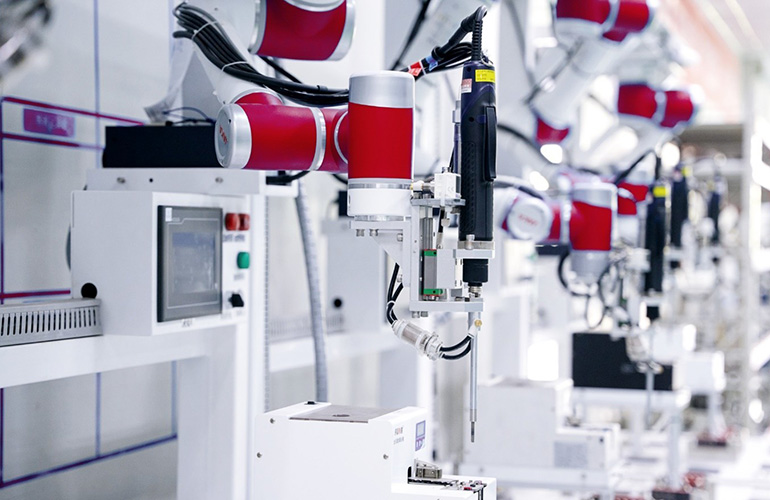
Collaborative robots—commonly referred to as cobots—have fundamentally changed how manufacturers approach automation. Unlike traditional industrial robots that require complete physical separation from personnel, collaborative robots are designed to operate in closer proximity to people, enabling flexible automation in areas historically dominated by manual labor.
However, the rapid adoption of collaborative robots has also introduced significant misconceptions about safety, compliance, and risk ownership. Many organizations mistakenly believe that selecting a collaborative robot automatically eliminates the need for guarding, safety controls, or formal risk assessment. Collaborative robotics does not reduce an employer’s obligation to identify hazards, assess risk, and implement appropriate risk-reduction measures.
This whitepaper provides a standards-driven, engineering-focused examination of JAKA collaborative robots and explains how PowerSafe Automation integrates these systems into real-world manufacturing environments using a safety-first, risk-reduction methodology. It is written for decision-makers who require both technical rigor and operational practicality, ensuring collaborative automation delivers measurable productivity gains without introducing unmanaged risk.
2. The Evolution of Collaborative Robotics in Manufacturing
For decades, industrial robots were synonymous with isolation. High speeds, large payloads, and limited sensing capability meant that robots were physically separated from workers using hard guarding, interlocked gates, and safety fencing. While effective, this approach created several challenges:
- Large floor-space requirements
- High capital costs
- Reduced flexibility for product changeovers
- Long deployment timelines
As manufacturing shifted toward high-mix, low-volume production, traditional robotic automation became less practical for many applications. Collaborative robots emerged to address these limitations by combining advanced sensing technology with force-limiting designs and intuitive programming interfaces.
Cobots enabled manufacturers to:
- Automate repetitive or ergonomically hazardous tasks
- Deploy automation in smaller footprints
- Adapt quickly to changing production requirements
- Lower the barrier to robotic adoption
Despite these advantages, collaborative robots did not eliminate risks; they changed the nature of it. Instead of relying on separation alone, collaborative robotics requires intelligent risk management, making safety engineering more critical—not less.
3. Overview of JAKA Collaborative Robot Technology
JAKA Robotics develops collaborative robots designed for flexible automation across a wide range of manufacturing environments.
Core Technical Characteristics
JAKA collaborative robots typically offer:
- Payload capacities ranging from light assembly to heavier material handling
- Compact arm and base designs for space-constrained environments
- Integrated joint torque sensors
- Power-and-force-limiting (PFL) capabilities
- Support for hand-guiding, teach pendant, and offline programming
These features allow JAKA cobots to be deployed in applications such as:
- Machine tending
- Assembly and fastening
- Pick-and-place operations
- Inspection and testing
- Packaging and palletizing
However, the robot itself is only one component of a safe system. The surrounding tooling, fixtures, controls, and operating procedures determine whether a collaborative application is acceptable from a risk perspective.
4. Collaborative Robots vs. Traditional Industrial Robots
While collaborative and traditional robots share many mechanical and control components, their intended operating philosophies differ significantly.
Traditional industrial robots are designed for:
- High speed
- High payload
- Minimal human interaction
Collaborative robots are designed for:
- Reduced speed
- Limited force and energy
- Conditional human interaction
The key distinction is not capability, but risk exposure. Collaborative robots trade raw performance for reduced potential harm during unintended contact. This tradeoff makes them ideal for certain applications—but unsuitable for others.
From a safety perspective, the robot type does not determine compliance. Risk assessment does.
5. Why “Collaborative” Does Not Mean “Risk-Free”
A common misconception in manufacturing is that collaborative robots are inherently safe in all situations. Cobots can still create hazardous conditions, including:
- Impact injuries from moving arms
- Pinch and crush points between robot and fixed structures
- Sharp or abrasive end-of-arm tooling
- Dropped or ejected parts
- Unexpected motion during faults or programming errors
ISO/TS 15066 explicitly states that collaborative operation is conditional and depends on:
- Contact force limits
- Body region exposure
- Tool geometry
- Speed and payload
- Task frequency and duration
In practice, many collaborative applications require additional safeguards, including physical guarding, safety scanners, or reduced operating speeds. PowerSafe Automation treats collaboration as a mode of operation, not a blanket designation.
6. Regulatory and Standards Landscape for Collaborative Robots
Collaborative robot safety is governed by a combination of U.S. regulations and international standards, including:
Key Regulations and Standards
- OSHA 29 CFR 1910 (General Industry)
- ANSI/RIA R15.06 – Industrial Robot Safety
- ISO 10218-1 and ISO 10218-2 – Robots and Robotic Devices
- ISO/TS 15066 – Collaborative Robot Safety
- ISO 13849-1 – Safety-Related Parts of Control Systems
These documents collectively require employers and integrators to:
- Identify hazards
- Estimate and evaluate risk
- Implement risk-reduction measures
- Validate safety performance
- Document the process
Importantly, no standard allows collaborative robots to bypass risk assessment. Compliance is achieved through process discipline, not equipment selection.
7. Task-Based Risk Assessment for Collaborative Robot Applications
PowerSafe Automation applies task-based risk assessment methodologies, evaluating not just normal production, but all foreseeable interactions with the system.
Typical Tasks Evaluated
- Automatic operation
- Manual loading and unloading
- Teaching and programming
- Maintenance and troubleshooting
- Clearing jams or faults
Each task is analyzed for:
- Severity of potential injury
- Frequency of exposure
- Possibility of avoidance
This structured approach ensures safeguards are appropriate, justified, and defensible, avoiding both under-protection and unnecessary over-guarding.
8. Understanding Collaborative Robot Safety Functions
Collaborative robots may utilize one or more of the following safety strategies:
1. Safety-Rated Monitored Stop
The robot stops when a person enters the collaborative workspace and resumes only after they leave.
2. Hand Guiding
The operator directly manipulates the robot using force-sensing joints.
3. Speed and Separation Monitoring (SSM)
The robot dynamically adjusts speed or stops based on the distance to a person.
4. Power and Force Limiting (PFL)
The robot limits force and energy during contact.
Most real-world applications require hybrid safety strategies, combining collaborative functions with physical safeguarding.
9. End-of-Arm Tooling (EOAT) and Secondary Hazard Risk
The robot arm itself is rarely the most hazardous component. End-of-arm tooling often introduces risks such as:
- Sharp edges
- Rotating components
- Pneumatic or hydraulic energy
- Vacuum loss and dropped parts
PowerSafe Automation evaluates EOAT as a separate hazard source, often applying:
- Tool redesign
- Speed reduction
- Guarding
- Additional sensing
This prevents collaborative assumptions from being invalidated by tooling hazards.
10. Work cell Design Principles for Collaborative Robotics
Effective collaborative work cells are designed around:
- Predictable motion paths
- Clear operator access points
- Ergonomic reach zones
- Modular construction
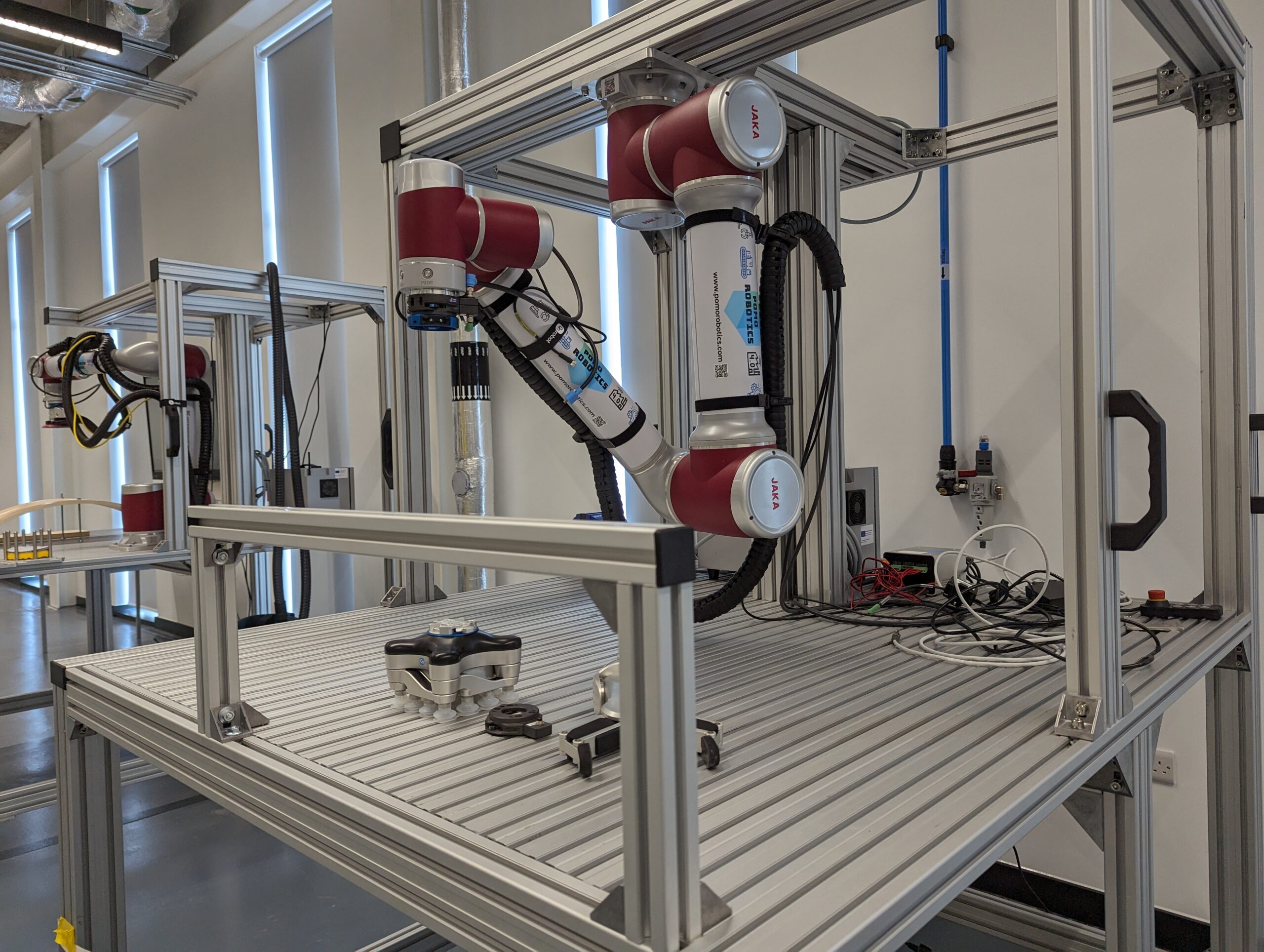
PowerSafe Automation uses modular aluminum framing and steel guarding to create work cells that are:
- Easy to modify
- Visually intuitive
- Consistent across facilities
11. Safety Architecture Design for JAKA Cobot Systems
A typical safety architecture may include:
- Safety-rated PLCs
- Dual-channel emergency stops
- Safety scanners or light curtains
- Interlocked access doors
- Safety-rated communication networks
Each architecture is designed to achieve the required Performance Level (PL) per ISO 13849-1 and validated before commissioning.
12. Application-Specific Use Cases for JAKA Collaborative Robots
CNC Machine Tending
Hybrid collaborative/guarded cells reduce operator exposure while maintaining throughput.
Assembly and Fastening
True PFL collaboration supports ergonomic improvement and consistency.
Packaging and Palletizing
Speed and separation monitoring allows productivity without sacrificing safety.
Each application demands unique risk controls.
13. Integrating Collaborative Robots into Existing Facilities
Brownfield environments introduce challenges such as:
- Limited space
- Legacy controls
- Existing guarding constraints
PowerSafe Automation specializes in retrofitting collaborative automation without disrupting production.
14. PowerSafe Automation’s Turnkey JAKA Integration Packages
Package Tiers
- Pilot Collaborative Cell
- Production-Ready Semi-Automated Cell
- Fully Automated Guarded Robotic System
Each includes mechanical, electrical, controls, and safety engineering.
15. Controls Engineering, Electrical Design, and Validation
Deliverables include:
- UL-compliant panels
- Safety circuit schematics
- I/O mapping
- Network architecture
16. Functional Safety, Documentation, and Audit Readiness
PowerSafe delivers:
- Risk assessment reports
- Safety validation records
- Operator and maintenance documentation
This ensures long-term defensibility during audits and incidents.
17. ROI, Productivity, and Operational Impact
Collaborative robotics typically delivers:
- Reduced ergonomic injuries
- Improved consistency
- Faster changeovers
- Scalable automation
18. Scaling Collaborative Robotics Across Multi-Facility Enterprises
PowerSafe supports:
- Standardized work cell designs
- Replicable safety architecture
- Enterprise deployment strategies
19. Why PowerSafe Automation Is the Right Integration Partner
PowerSafe Automation differentiates itself through:
- Safety-first engineering culture
- Deep standards expertise
- Turnkey execution
- Long-term partnership mindset
20. Conclusion and Strategic Next Steps
Collaborative robots unlock powerful automation opportunities—but only when deployed with disciplined safety engineering.
PowerSafe Automation ensures JAKA collaborative robot systems:
- Protect people
- Improve productivity
Scale responsibly