
Machine safety compliance can feel overwhelming.
Between ANSI standards, OSHA expectations, ISO 13849 performance levels, safety PLC upgrades, documentation requirements, and capital budgeting — many facilities freeze.
The result?
Hazards remain exposed while long-term architecture discussions drag on.
There is a better way.
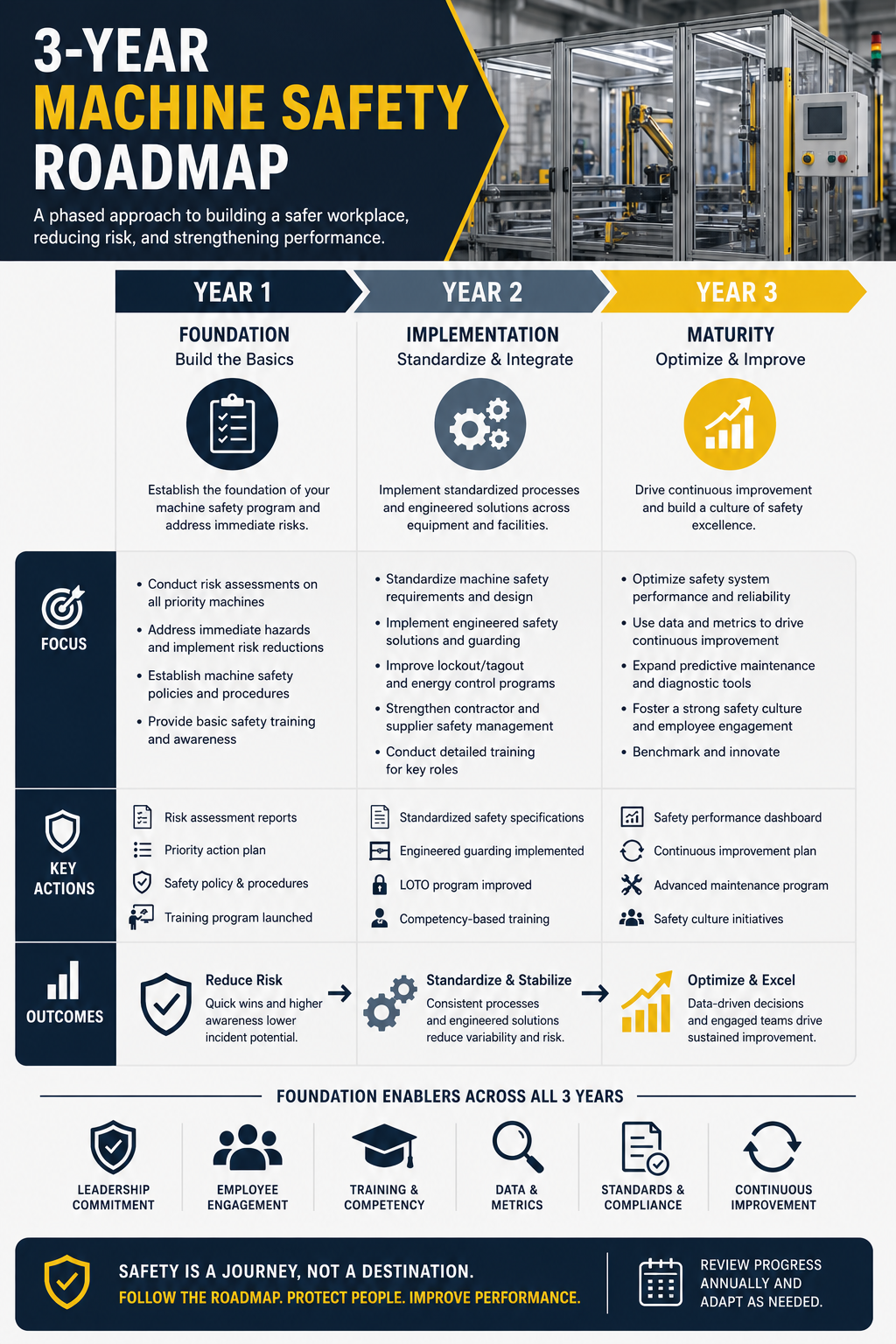
Instead of treating machine safety as a single large capital event, treat it as a 3-year strategic directive — with urgency where it matters most:
- Year 1: Protect operators from hazards (Input Side)
- Years 2–3: Engineer and validate the control system (Output Side)
Let us walk through what that looks like.
First: Understand the Two Sides of Machine Safety
Before building a roadmap, it is important to understand the difference between:
The Input Side – Physical Risk Exposure
This is where:
- Operators load material.
- Adjustments are made.
- Jams are cleared.
- Maintenance access occurs.
This is where injuries happen.
Machine guarding, interlocks, light curtains, perimeter fencing — this is about removing access to moving parts and reducing exposure.
This is where urgency belongs.
The Output Side – The Brain of the System
This includes:
- Safety relays
- Dual-channel circuits
- Safety PLC architecture
- Performance Level (PL) calculations
- Control reliability validation.
This is about ensuring the system:
- Detects faults.
- Responds correctly.
- Meets ISO 13849 requirements.
Important — this work is critical, but it can be phased.
Why a Phased Approach Works
Trying to upgrade every machine to full functional safety architecture at once often leads to:
- Budget rejection
- Project delays
- Scope creep
- No progress
A phased machine safety strategy allows you to:
- Reduce injury exposure immediately.
- Show measurable compliance improvement.
- Spread capital costs across budget cycles.
- Avoid rework by planning architecture intentionally.
Year 1: Immediate Risk Reduction (Input Side Priority)
Objective: Remove operator exposure to hazards.
This year should focus heavily on ANSI-compliant machine guarding aligned with OSHA 1910.212 requirements.
Step 1 – Perform a Task-Based Risk Assessment
Evaluate:
- Severity of injury
- Frequency of exposure
- Possibility of avoidance
Identify machines where operators are physically exposed to mechanical hazards.
Step 2 – Implement Physical Safeguards
Prioritize:
- Fixed guarding
- Interlocked access doors
- Light curtains where appropriate
- Perimeter fencing
- Guarding around rotating shafts, pinch points, and shear hazards
This is not cosmetic.
This is life-changing risk reduction.
Step 3 – Design Guarding with Future Controls in Mind
Even in Year 1, ensure:
- Interlocks are dual channel capable.
- Devices are rated for future PLd/PLe architecture.
- Wiring plans consider upcoming upgrades.
You do not need a new safety PLC yet — but you must avoid installing components that force replacement later.
Year 1 KPI Goals
- 100% of high-severity exposure hazards guarded.
- Reduction in OSHA exposure citations
- Documented safeguarding improvements.
- Visible safety culture progress
This year sends a message:
We protect operators first.
Year 2: Control Reliability Evaluation (Output Side Planning)
Objective: Evaluate whether the “brain” of the system performs correctly.
Now that physical exposure is reduced, begin assessing:
- Single-channel circuits
- Lack of fault monitoring
- Relay redundancy gaps.
- Stop-time measurement validation.
- Performance Level requirements per ISO 13849
Step 1 – Circuit Architecture Review
Review:
- Safety relays
- Feedback monitoring
- Category rating
- Wiring diagrams
Determine:
- Current safety category
- Required performance level.
- Gaps in diagnostic coverage
Step 2 – Develop a Functional Safety Roadmap
Build a multi-year upgrade plan:
- Machines requiring PLd.
- Machines requiring PLe.
- Control panel upgrades.
- Safety PLC migration
- Validation documentation
This becomes your capital planning blueprint.
Year 2 KPI Goals
- 100% safety circuit audit completion
- Defined performance level targets
- Capital forecast for safety architecture upgrades.
- Reduced control reliability uncertainty
Year 3: Architecture Implementation & Validation
Objective: Achieve and validate functional safety compliance.
Now you execute:
- Install safety PLCs where required.
- Convert single-channel to dual-channel circuits.
- Add feedback monitoring.
- Implement fault diagnostics.
- Validate PL calculations.
- Document functional safety lifecycle.
This is where the output side becomes fully engineered.
Step 1 – Implement Upgrades in Priority Order
Start with:
- High-risk machines
- High-exposure frequency equipment
- Production-critical assets
Step 2 – Validate and Document
Perform:
- Stop-time testing.
- Functional validation
- Category confirmation
- ISO 13849 documentation
Now your safety program is defendable.
Year 3 KPI Goals
- Achieved PL targets on priority equipment.
- Validated control reliability
- Full documentation package
- Sustainable safety architecture
Why Urgency Belongs on the Input Side
Here is the hard truth:
Most catastrophic injuries occur due to direct exposure to moving mechanical hazards — not because of PLC software logic failure.
If an operator can reach a rotating shaft, shear point, or crush hazard, the risk is immediate.
That is why the phased strategy emphasizes:
Guard the hazard first.
Then engineer the system.
Common Mistakes to Avoid
- Waiting for full budget approval before guarding obvious hazards
- Installing guarding that is not compatible with future safety architecture.
- Upgrading controls before addressing exposure hazards
- Treating safety as a one-time project instead of a lifecycle
The Strategic Advantage of a 3-Year Directive
A structured 3-year machine safety plan:
- Reduces legal exposure.
- Protects operators immediately.
- Improves capital planning.
- Demonstrates proactive compliance.
- Builds leadership confidence.
- Creates measurable safety culture improvement.
Most importantly:
It turns overwhelming compliance into achievable progress.
Final Takeaway
Machine safety does not have to be all-or-nothing.
If compliance costs feel paralyzing, break the initiative into phases:
- Year 1 – Guard the hazard.
- Year 2 – Evaluate the brain.
- Year 3 – Engineer and validate functional safety.
Reduce risk now. Architect intentionally. Build toward full compliance strategically.