
Anonymous Manufacturer | Charlotte, North Carolina
Executive Summary
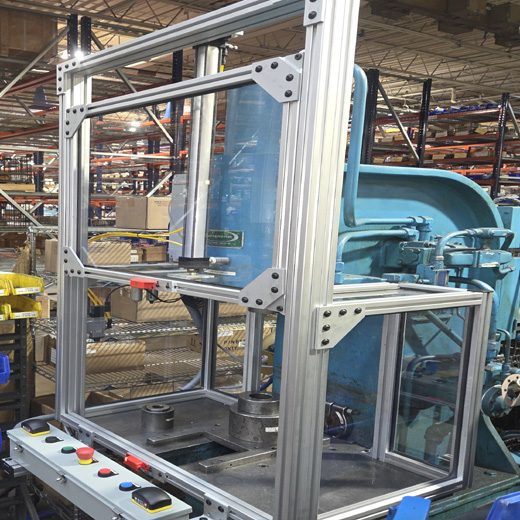
A manufacturing facility in Charlotte, North Carolina engaged PowerSafe Automation to correct a high-risk operator interaction involving a pneumatically driven vertical door. The door was part of a production process that required frequent manual access, creating a serious pinch-point and crush hazard during door actuation.
To eliminate unsafe hand placement and prevent intentional or unintentional bypassing, PowerSafe Automation designed and installed a safeguarding solution using Allen‑Bradley two-hand control devices with an anti-tie down safety relay. The solution enforced safe operator behavior, ensured deliberate door actuation, and significantly reduced the risk of hand injuries—without slowing production.
Customer Background
- Industry: Industrial component manufacturing
- Location: Charlotte
- Facility Type: High-mix production floor
- Primary Motion Hazard: Pneumatic vertical door
- Safety Concern: Operator hands in the hazard zone during door closure
The customer requested anonymity due to internal safety policies but approved the project for anonymous publication.
The Safety Challenge
Equipment Overview
The guarded equipment included:
- A vertically moving door actuated by air cylinders
- Manual loading and unloading beneath the door
- Repetitive, short-cycle operation
- Multiple operators across shifts
The door’s motion created a severe pinch/crush hazard at the lower closing edge.
Existing Risk Conditions
Prior to the upgrade, PowerSafe Automation identified several issues:
- Door actuation via single pushbutton
- No verification of hand position during closure
- Operators using one hand to trigger the door while the other remained near the hazard
- Reliance on operator awareness instead of engineered controls
While the door functioned correctly, unsafe human interaction was the root risk.
Why Two-Hand Control with Anti-Tie Down Was Required
Two-hand control systems are specifically designed to ensure that both of an operator’s hands are safely removed from the hazard zone before motion can occur.
Why This Method Was Selected
- Forces deliberate, conscious actuation
- Prevents one-hand or improvised triggering
- Ideal for short, repetitive machine cycles
- Highly effective for vertical or closing motion hazards
To prevent operators from defeating the system, an anti-tie down safety relay was required.
Engineering the Safeguarding Solution
Step 1: Operator Interaction Study
PowerSafe Automation conducted an on-site review focused on how operators actually used the machine, including:
- Hand placement during loading
- Timing between cycles
- Door travel speed and force
- Ergonomic reach distances
This real-world observation confirmed that behavioral controls alone were insufficient.
Step 2: Two-Hand Control System Design
The final design included:
- Two ergonomically spaced palm buttons
- Required simultaneous actuation (within milliseconds)
- Buttons positioned outside the hazard zone
- Compliance with two-hand control spacing principles
The system required continuous, intentional input to initiate door movement.
Step 3: Anti-Tie Down Safety Relay Integration
An Allen-Bradley anti-tie down safety relay was integrated to ensure:
- Both buttons must be released between cycles
- Taping, blocking, or wedging buttons is detected
- Fault conditions result in a safe stop
- Controlled reset behavior
This prevented bypassing and ensured long-term reliability.
Installation & Commissioning
Mechanical & Operator Interface Installation
- Two-hand control station mounted at ergonomic height
- Clear line-of-sight to the vertical door
- Button spacing verified to prevent one-hand actuation
- Durable industrial components rated for high-use cycles
Electrical & Controls Integration
- Relay wired into pneumatic valve control circuit
- Door actuation only permitted through safety relay
- Fail-safe behavior confirmed on power loss
- Clear status indication for operators and maintenance
Commissioning included multiple functional tests under real operating conditions.
Operator Experience & Acceptance
Operator-Focused Design
The system was designed to feel natural, not restrictive:
- Simple, intuitive operation
- No additional steps added to the process
- Predictable door response
- Immediate feedback if inputs were incorrect
Operators quickly adapted, and unsafe hand placement was eliminated.
Training & Reinforcement
PowerSafe Automation trained operators and supervisors on:
- Why two-hand control was required
- How anti-tie down prevents unsafe shortcuts
- Proper cycle initiation
- What to do if the system does not allow actuation
This reinforced consistent, safe behavior across all shifts.
Results & Measurable Outcomes
Safety Improvements
- Eliminated hand exposure during door closure
- Removed reliance on operator judgment
- Prevented intentional or accidental bypass
Productivity Impact
- No increase in cycle time
- Improved consistency between operators
- Reduced hesitation during door operation
- No reduction in throughput
Maintenance & Reliability
- Minimal maintenance required
- Clear fault detection
- Long service life under high cycle counts
Risk Reduction & Inspection Readiness
This project focused on engineered risk reduction, applying principles such as:
- Positive control of hazardous motion
- Enforced safe hand positioning
- Fail-safe pneumatic control
- Separation of safety and standard control logic
The solution supports modern expectations for machine safety and inspection readiness without unnecessary complexity.
Why Allen-Bradley Two-Hand Controls Were Effective
Key Advantages
- Proven industrial reliability
- Robust safety relay diagnostics
- Strong resistance to tampering
- Easy integration into existing control systems
Combined with correct ergonomic placement, the system delivered predictable, enforceable safety.
Standardization & Future Use
Following project success, the customer now has a repeatable safeguarding approach for:
- Other vertical doors
- Pressing or clamping operations
- Pneumatic tooling stations
- Legacy equipment retrofits
This consistency simplifies training and improves long-term safety outcomes.
Key Takeaways
- Vertical pneumatic motion presents serious pinch hazards
- Two-hand control enforces safe hand positioning
- Anti-tie down is critical to prevent bypass
- Operator behavior must be engineered—not assumed
Conclusion
This anonymous manufacturer in Charlotte, North Carolina significantly reduced risk associated with a pneumatic vertical door by implementing Allen-Bradley two-hand controls with an anti-tie down safety relay.
By forcing deliberate, two-handed actuation and preventing shortcuts, PowerSafe Automation delivered a safeguarding solution that improved operator safety, maintained productivity, and established a scalable safety standard for future equipment.