Anonymous Manufacturer | Lincoln, Rhode Island
Executive Summary
An advanced manufacturing facility in Lincoln, Rhode Island partnered with PowerSafe Automation to address growing safety risks around a highly interactive automated work cell. The operation required frequent operator movement, material staging, and mobile equipment traffic—conditions where traditional guarding and light curtains created productivity bottlenecks and blind spots.
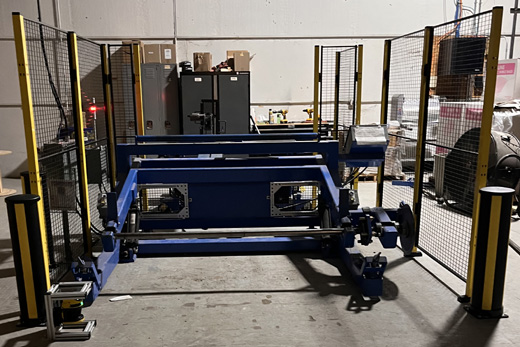
To solve this challenge, PowerSafe Automation engineered and installed a safety laser scanner–based safeguarding system that provided dynamic, floor-level area protection. The solution delivered real-time presence detection, flexible safety zones, and seamless integration with the machine’s safety controls—dramatically improving both safety performance and operational flow.
Customer Background
- Industry: Precision manufacturing & assembly
- Location: Lincoln
- Facility Type: Mixed manual and automated production floor
- Operating Model: High-mix, moderate-volume
- Primary Concern: Unsafe access and inconsistent separation between people and moving equipment
The customer requested anonymity due to internal corporate safety governance but approved the project for anonymous case study publication.
The Operational Challenge
Process Overview
The safeguarded area included:
- An automated work cell with servo-driven motion
- Manual inspection and secondary operations
- Forklift and cart-based material delivery
- Operators frequently entering and exiting the area
The machine itself was compliant when isolated—but the surrounding workflow introduced risk.
Identified Safety Risks
During PowerSafe Automation’s on-site assessment, several key hazards were documented:
- Operators entering hazardous areas during active motion
- No clear boundary between safe walkways and danger zones
- Reliance on floor tape and signage for separation
- Emergency stops used as primary safeguards instead of last-resort devices
Fixed perimeter guarding was not feasible without severely restricting workflow and material movement.
Why Safety Laser Scanners Were Selected
Safety laser scanners are ideal for applications requiring flexible, three-dimensional awareness of people and equipment movement.
Advantages Over Traditional Guarding
- Protect large, irregularly shaped areas
- Allow multiple configurable safety zones
- Adapt to changing operating modes
- Eliminate physical barriers where space is limited
For this application, a laser scanner offered dynamic safeguarding without disrupting the customer’s lean manufacturing layout.
Engineering-Led Solution Development
Step 1: Functional Risk Review
PowerSafe Automation began with a practical, engineering-driven safety review that focused on how people and machines interacted—not just how equipment was designed.
This included:
- Mapping operator travel paths
- Observing material handling patterns
- Identifying variable access points
- Evaluating machine stop response times
Step 2: Safety Laser Scanner Configuration
The selected safety laser scanner was configured with multiple protective fields, including:
- Warning Zone: Slows or alerts before hazardous motion
- Protective Stop Zone: Immediately stops motion when breached
- Reduced-Speed Zone: Enables safe collaborative interaction
These zones were carefully shaped to match real-world movement, not idealized layouts.
Step 3: Safety Control Integration
The scanner was integrated into the machine’s safety circuit through a dedicated safety controller, providing:
- Redundant, monitored safety channels
- Clear fault diagnostics
- Controlled restart logic
- Future expandability
This architecture ensured fail-safe operation under all conditions.
Installation & Commissioning
Mechanical & Floor-Level Integration
- Laser scanner mounted at optimal height and angle
- Protective fields validated against actual floor geometry
- Reflective surfaces mitigated through filtering and positioning
- No permanent barriers added to the workspace
Electrical & Controls Work
- Safety outputs wired into machine safety logic
- Scanner status tied into HMI indicators
- Reset stations placed outside hazardous zones
- Lockout/tagout compatibility maintained
The system was commissioned with minimal disruption to ongoing production.
Operator-Centered Safety Design
A major goal of the project was operator trust and acceptance.
Human-Focused Safeguarding
- No physical obstructions to workflow
- Clear visual cues when entering warning zones
- Predictable machine response
- No false trips during normal operation
Operators quickly understood the system and adjusted behavior naturally—without workarounds.
Training & Change Management
PowerSafe Automation conducted hands-on training covering:
- How the laser scanner detects presence
- Difference between warning vs stop zones
- Safe interaction expectations
- Reset and recovery procedures
This training reinforced consistent, safe behaviors across all shifts.
Results & Performance Outcomes
Safety Improvements
- Eliminated uncontrolled access to moving equipment
- Reduced reliance on emergency stops
- Improved spatial awareness across the work cell
Productivity & Workflow Gains
- Maintained open material flow
- No throughput reduction
- Improved efficiency during changeovers
- Better coordination between people and equipment
Maintenance & Reliability Benefits
- Minimal maintenance requirements
- Built-in diagnostics reduced troubleshooting time
- Clear fault conditions improved uptime
Compliance & Risk Reduction Perspective
Rather than treating safety as a documentation exercise, this project focused on engineered risk reduction through:
- Separation of people and hazards via monitored safety fields
- Redundant, fail-safe safety control logic
- Clear definition of operating modes
- Operator-informed safety boundaries
This approach aligns well with modern expectations for machine safety and evolving inspection practices.
Why Safety Laser Scanners Were the Right Fit
Key Capabilities Delivered
- Large-area protection without physical barriers
- Adaptability to layout changes
- Support for collaborative workflows
- Scalable safety architecture
For facilities where people, machines, and material handling overlap, laser scanners provide a level of flexibility that fixed guarding cannot.
Scalability & Future Readiness
The customer now has a safety platform that can easily be expanded to:
- Additional machines
- Mobile equipment pathways
- Future automation upgrades
- Multi-zone production areas
The scanner-based solution supports long-term growth without re-engineering the entire safety system.
Key Takeaways
- Safety systems must reflect how work is actually performed
- Dynamic safeguarding reduces risk without sacrificing efficiency
- Laser scanners are ideal for open, high-traffic manufacturing environments
- Operator buy-in is critical to long-term safety success
Conclusion
This anonymous manufacturer in Lincoln, Rhode Island successfully transformed a high-risk, high-traffic work area into a safer, more efficient production environment by implementing safety laser scanners integrated into a robust safety control architecture. By focusing on practical risk reduction, real-world workflows, and operator experience, PowerSafe Automation delivered a solution that enhanced safety performance while preserving productivity and flexibility.