
Anonymous Manufacturer | Benton, Arkansas
Executive Summary
An industrial manufacturer in Benton, Arkansas partnered with PowerSafe Automation to address a recurring machine safety challenge: operators accessing hazardous motion areas before the machine had reached a complete and verified stop. While the equipment was fitted with physical guard doors, the lack of guard locking created residual risk during rundown conditions and maintenance interactions.
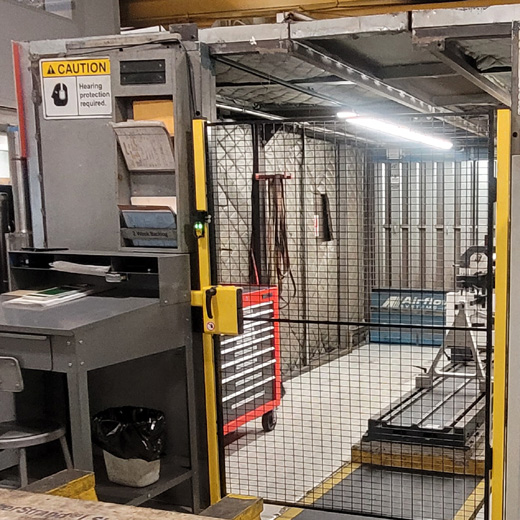
PowerSafe Automation engineered a turnkey safeguarding solution using Keyence locking solenoid safety switches, integrated into the machine’s safety control system. The result was a controlled-access machine guarding solution that prevented premature entry, improved operator discipline, and reduced safety-related downtime—without negatively impacting productivity.
Customer Background
- Industry: Heavy industrial manufacturing
- Location: Benton
- Facility Type: Single-line production facility
- Operating Environment: High-energy mechanical motion with long stop times
- Primary Safety Concern: Operators opening guard doors before hazardous motion had fully stopped
The customer requested anonymity due to internal safety governance requirements but approved the project for anonymous publication.
The Safety Problem
Machine & Process Overview
The safeguarded equipment was a large, mechanically driven machine with:
- Significant inertia and long stop times
- Multiple access doors for setup, jam clearing, and inspection
- Frequent operator interaction between production cycles
While fixed guarding was already in place, the doors relied on non-locking interlock switches, which allowed immediate access as soon as the machine stop command was issued.
Identified Risks
During an on-site engineering review, PowerSafe Automation identified several concerns:
- Guard doors opening while motion was still decelerating
- Operators assuming “stop command = safe condition”
- Increased risk during troubleshooting and short stoppages
- Inconsistent use of lockout/tagout for brief access
Emergency stops were functioning correctly—but were not designed to manage rundown hazards.
Why Locking Solenoid Safety Switches Were Required
Locking solenoid safety switches are specifically designed for applications where hazardous energy remains present after a stop signal.
Key Reasons for Selection
- Physically prevent guard opening until safe conditions are met
- Enforce safe access behavior without relying on operator judgment
- Integrate with machine safety logic for monitored release
- Ideal for machines with long stop times or stored energy
For this application, Keyence locking solenoid switches provided the right balance of robustness, diagnostics, and ease of integration.
Engineering the Solution
Step 1: Engineering-Led Guarding Assessment
PowerSafe Automation began with a guarding-focused safety assessment, emphasizing real-world operator behavior rather than theoretical compliance.
This assessment included:
- Observing how and when doors were accessed
- Measuring machine stop and rundown times
- Reviewing existing safety circuits
- Identifying where physical access control was required
Step 2: Locking Strategy Definition
Based on the findings, PowerSafe Automation developed a guard locking strategy that ensured:
- Guard doors remain locked during hazardous motion
- Unlocking only occurs once safe conditions are confirmed
- Manual override available for maintenance under controlled conditions
- Clear status feedback for operators and maintenance
Step 3: Safety Control Integration
Keyence locking solenoid safety switches were integrated into the machine’s safety system to:
- Monitor door position and lock status
- Control solenoid locking based on machine state
- Provide fault detection for misalignment or tampering
- Support controlled restart sequences
The solution used redundant, monitored safety channels to maintain a fail-safe architecture.
Installation & Commissioning
Mechanical Guard Door Integration
- Locking switches mounted directly to existing guard doors
- Actuators aligned to prevent nuisance faults
- Robust mounting to withstand vibration and repeated use
- No modification required to core machine structure
Electrical & Controls Integration
- Safety outputs wired into the existing safety relay system
- Lock control logic tied to verified safe stop conditions
- Manual reset stations located outside hazard zones
- Status indicators added for operator clarity
Installation was completed during a planned maintenance window to minimize production impact.
Operator Experience & Acceptance
A critical objective of the project was ensuring operators understood and trusted the new safety system.
Operator-Centered Design
- Doors unlock automatically when safe
- Clear visual feedback when unlocking is not permitted
- No guesswork or temptation to bypass
- Consistent behavior across all access points
Rather than slowing production, the system standardized safe behavior.
Training & Change Management
PowerSafe Automation provided targeted training covering:
- Why guard locking was necessary
- Difference between stop command and safe condition
- How the locking solenoid behaves during operation
- Proper response to locked-door conditions
This training significantly reduced unsafe workarounds.
Results & Measurable Outcomes
Safety Improvements
- Eliminated premature access during rundown
- Reduced reliance on operator judgment
- Improved consistency in safe access behavior
Operational Benefits
- No measurable impact on cycle time
- Faster recovery after stoppages
- Reduced safety-related delays
- Improved confidence during audits and inspections
Maintenance & Reliability
- Minimal maintenance required
- Clear diagnostics simplified troubleshooting
- Improved durability over previous non-locking switches
Risk Reduction & Inspection Readiness
This project focused on engineered risk reduction, not paperwork-driven compliance.
Key principles applied included:
- Physical prevention of unsafe access
- Monitored, fail-safe locking logic
- Separation of safety and standard control functions
- Clear distinction between production access and maintenance access
This approach supports modern expectations for machine safety and evolving inspection practices.
Why Keyence Locking Solenoid Switches Were Effective
Key Capabilities
- Strong holding force for high-risk applications
- Reliable lock monitoring
- Compact form factor for retrofits
- Robust industrial design
Combined with proper safety logic, the switches provided predictable, enforceable safety.
Scalability & Standardization
Following the success of this project, the customer now has a standardized guard-locking approach that can be applied to:
- Similar machines across the facility
- Future equipment purchases
- Retrofits on legacy equipment
This consistency reduces training time and improves long-term safety outcomes.
Key Takeaways
- Guarding without locking may not address rundown hazards
- Locking solenoid switches enforce safe access automatically
- Engineering-led assessments lead to better safety decisions
- Operator understanding is critical to system success
Conclusion
This anonymous manufacturer in Benton, Arkansas successfully reduced machine safety risk by implementing Keyence locking solenoid safety switches as part of a controlled-access guarding strategy.
By preventing premature entry, standardizing operator behavior, and integrating robust safety logic, PowerSafe Automation delivered a solution that enhanced safety without sacrificing productivity—demonstrating how thoughtful machine guarding design leads to sustainable risk reduction.