Introduction
Metal forming operations, by their very nature, present some of the highest risk factors in manufacturing. From fast-moving coil feeds and hydraulic presses to high-tonnage slitters and shears, the potential for serious injury is significant—especially when legacy equipment lacks modern safeguards.
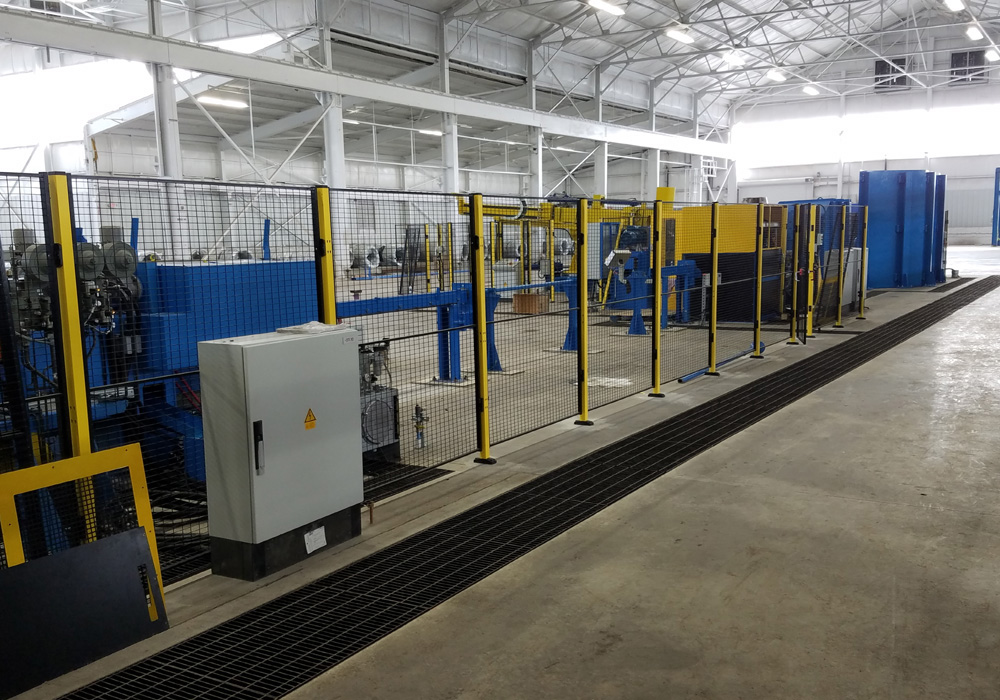
Atkore and Steel Technologies, both leaders in the production of electrical raceways, mechanical tubing, and precision processed steel, recognized this risk. They turned to PowerSafe Automation for engineered safety solutions designed not only to meet OSHA 1910.212 and ANSI B11 standards but to improve operational efficiency, machine uptime, and long-term compliance across multiple facilities.
This case study walks through how PowerSafe Automation’s Tailored Custom Machine Guarding program helped both companies transition from reactive safety strategies to proactive, production-friendly risk reduction systems.
The Safety Challenge in Metal Forming
Metal forming environments pose unique challenges that generic guarding simply cannot solve:
- High-speed production lines with continuous coil feed create severe pinch, shear, and crush hazards.
- Legacy equipment often lacks the mounting points or electronic interfaces required for modern interlocked safety devices.
- Frequent changeovers for tooling or material require frequent access to the machine—making fixed guards a hindrance if not designed for fast removal or repositioning.
- Operator and maintenance tasks frequently occur near energized equipment or during quick-stop scenarios, increasing exposure risk.
Atkore and Steel Technologies were experiencing:
- Inconsistent guarding across different machine types and facilities.
- Difficulty passing internal and third-party safety audits.
- Production delays caused by poor access to guarded areas.
- Safety incidents and near-misses that prompted immediate corrective action.
Why PowerSafe Automation?
Atkore and Steel Technologies selected PowerSafe Automation for several reasons:
- Engineering-Led Approach: Every solution is custom-designed by a safety-focused applications engineer familiar with ANSI, OSHA, and ISO 13849-1 standards.
- Turnkey Capabilities: From on-site risk assessment and design through fabrication and field installation, PowerSafe offers a single-source solution.
- Specialization in Metal Forming Equipment: With extensive experience in guarding presses, slitters, coil lines, and stackers, PowerSafe could speak the plant’s language.
- Flexible Guarding Designs: Modular, swing-away, and lift-off guard systems that support fast changeovers without compromising safety.
Project Scope and Strategy
1. Facility Walkthroughs and Risk Assessments
PowerSafe began with multi-site evaluations to assess:
- Guarding gaps on slitter lines, forming presses, decoilers, and stackers.
- Safety interlock compliance on access doors and maintenance panels.
- Opportunities to reduce maintenance downtime through better design.
- Operator workflow mapping to ensure guards do not interfere with throughput.
2. Customized Guarding Design
Based on each machine’s configuration and operator interaction zones, PowerSafe developed tailored solutions including:
- Welded steel and aluminum extrusion frame guards with polycarbonate or wire mesh inserts.
- Safety-rated interlocks from Keyence and Allen-Bradley tied into control systems.
- Sliding, swing-out, and removable panels to allow tool changeovers, jam clearing, and maintenance access.
- Integrated signage and color-coded zones to meet ANSI Z535 visual communication standards.
3. Control System Integration
To ensure the guards did not simply create physical barriers but functioned as active safety devices, PowerSafe’s controls team:
- Integrated safety interlocks with Category 3 and Category 4 safety circuits.
- Installed light curtains and area scanners in locations requiring walk-in access with automatic machine stop.
- Performed stop-time measurements (STM) to ensure light curtains met safe distance requirements.
4. Fabrication and Installation
All guarding components were custom-fabricated and shipped pre-assembled where possible. Install crews coordinated shutdown windows with plant managers to minimize production impact. Installation included:
- On-site safety checks and validation.
- Technician training on proper use, lockout/tagout, and resetting protocols.
- Documentation packets for OSHA compliance, including exploded diagrams and part numbers.
Results: Quantifiable Gains in Safety and Uptime
PowerSafe’s tailored guarding solution delivered measurable improvements:
| Metric | Before Implementation | After Implementation |
| OSHA Compliance Confidence | Low; failed audits in two plants | High; passed audits with zero citations |
| Maintenance Downtime | 4–6 hours per week for guard disassembly | Reduced to 1–2 hours per week |
| Operator Safety Incidents | Three near-misses and one recordable in prior year | Zero recordables, zero near misses in 12 months |
| Guarding Interference Complaints | Frequent; 2–3 complaints/month | None reported post-installation |
| Safety System ROI | Unclear, difficult to justify | ROI < 9 months based on downtime reduction |
Client Testimonials
“PowerSafe took a thoughtful, hands-on approach to our guarding. They did not just sell us metal and sensors—they engineered a safety solution that actually improved our uptime.” — Plant Manager, Steel Technologies
“The tailored guarding systems were a night-and-day difference. We are no longer holding our breath during audits, and operators love that the guards do not get in the way anymore.” — EHS Director, Atkore
Lessons for Other Manufacturers
If your facility operates metal forming, coil processing, or press machinery, here are key takeaways:
- Custom guarding is not a luxury—it is a necessity in environments where standard solutions cause operational headaches or compliance gaps.
- Integrating guarding into controls creates a layered safety approach that meets functional safety standards like ISO 13849-1 and prevents workarounds.
- Guard design must reflect operator workflows—if it is too rigid or difficult to remove, it will be bypassed or ignored.
- A turnkey provider like PowerSafe simplifies everything, eliminating finger-pointing between design, controls, fabrication, and installation vendors.
The PowerSafe Difference
PowerSafe Automation is not your average guarding vendor. They offer:
- Engineering-led design with ANSI B11 and OSHA 1910.212 compliance
- Tailored guarding that fits your machines, processes, and plant layout
- Full integration of safety controls (interlocks, scanners, light curtains)
- In-house fabrication and nationwide installation
- Ongoing support with risk scoring, audits, and safety plan development Whether you are operating legacy metal forming equipment or building out new capacity, PowerSafe delivers guarding solutions that are as safe as they are smart.