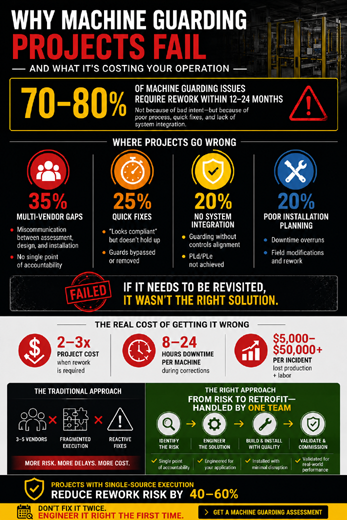
Most machine guarding projects don’t fail because of bad intentions. They fail because of gaps in process, communication, and execution—and those gaps show up later as rework, downtime, and risk that was never actually eliminated.
The warning signs tend to look the same across facilities:
- Guarding that reduces risk on paper but not in practice
- Systems that need to be reworked months after installation
- Delays, downtime, and internal frustration with the process
If a safety solution needs to be revisited, it wasn’t the right solution to begin with.
It’s Not the Guarding - It’s the Process
On paper, machine safety looks straightforward: identify the hazard, add guarding, confirm compliance. In real manufacturing environments, it rarely works that cleanly. Machines are often legacy assets that have been modified over time, built into complex production flows, and dependent on operator interaction and electrical safety systems that have to perform reliably under real conditions. That means the solution has to be engineered, not just installed.
An engineered approach accounts for how the machine is actually used, how operators interact with it, and how maintenance teams access it. It treats physical guarding, presence sensing, control reliability, and validation as one connected system. Projects that skip this thinking can look complete on day one, but problems tend to surface fast.
5 Reasons Machine Guarding Projects Fail
1. Too Many Vendors, Not Enough Ownership
In many facilities, a guarding project gets split across multiple vendors: one company performs the assessment, another handles engineering, a third supplies the guarding, and a fourth completes installation. Each group may be competent on its own, but the handoffs between them create risk, and no single team owns the outcome from start to finish.
More vendors usually means more coordination—and more risk. Details get lost between phases, designs don’t fully translate into field conditions, and installation teams end up making adjustments without the original engineering intent. The result is rework, extended timelines, and frustration for everyone involved.
2. Quick Fixes Instead of Engineered Solutions
It’s easy to install something that looks compliant on the surface: a guard added, a barrier installed, a device mounted to address an immediate concern. But if that solution doesn’t align with how the machine actually operates, it won’t hold up.
Quick fixes often interfere with production, which leads operators to bypass or remove them. They may not meet the required performance level or integrate properly with safety circuits. Over time, they get revisited, modified, or replaced entirely. The cheapest fix is often the one you pay for twice.
3. No Consideration for the Full Safety System
Machine safety isn’t just physical guarding. It includes presence-sensing devices, interlocks, safety-rated control systems, and validation. When these elements are treated independently instead of as one system, gaps emerge.
A guard installed without proper interlocking or restart prevention still leaves the hazard in place. A light curtain that isn’t integrated into a compliant safety circuit won’t deliver the protection it was meant to provide. A complete solution has to consider both the input side, physical protection, and the output side, control reliability, together.
4. Lack of Real-World Application Experience
Every manufacturing environment is different. Operator behavior, maintenance requirements, and production demands all shape how a safety solution actually performs once it’s installed. What works in theory doesn’t always work on the floor.
Without real-world application experience, designs can overlook access points, changeovers, or daily workflow. That produces guarding that’s inconvenient or impractical, which raises the odds it gets bypassed. If a solution doesn’t support production, it won’t last.
5. No Plan for Installation and Integration
Even a strong design can fail during execution if installation and integration weren’t planned properly. Machines are rarely identical to their drawings, and field conditions introduce variables that have to be managed in real time.
Without a coordinated plan, installation can disrupt production, force on-the-fly changes, and stretch out downtime. Components may not fit as intended, and field adjustments can compromise the original design. A successful project includes not just the design, but a clear path to execution.
The Hidden Cost of Failure
When a machine guarding project fails, the cost extends well beyond the original investment. Rework means additional design, materials, and labor. Unplanned downtime hits production schedules and revenue. Internal teams spend time managing problems instead of running operations.
There’s also the risk exposure that doesn’t go away. Incomplete or ineffective solutions can lead to safety incidents or compliance gaps, audits get more stressful, and confidence in the system erodes. Fixing a problem twice is always more expensive than doing it right once.
What Success Looks Like
A successful machine guarding project is more than an installation. It’s a system that works under real conditions: engineered for the specific application, aligned with safety standards, and built into the production process rather than bolted onto it.
The best solutions support both safety and productivity. They let operators do their jobs efficiently while reducing risk, they go in with minimal disruption, and they’re validated to confirm they perform as intended. When it’s done correctly, the solution doesn’t need to be revisited. It just works.
One Partner vs. Multiple Vendors
Most project failures trace back to a lack of accountability. When responsibility is split across multiple vendors, no one owns the final outcome.
A single-partner approach removes that gap. One team manages the entire process, from identifying risk to engineering the solution, building and installing the system, and validating performance. That continuity closes the gaps between phases, keeps communication consistent, and ensures the solution gets executed the way it was designed.
Take the Next Step
If you’re planning a machine safety project, or dealing with a guarding solution that isn’t holding up, the best place to start is with clarity on the full scope of risk and the real requirements of your operation. A structured, engineered approach ensures the result is compliant, effective, and built to last—not a project you’ll be revisiting in six months.
PowerSafe Automation manages machine guarding projects from initial risk assessment through engineering, fabrication, installation, and validation, as a single accountable partner. Contact us today to talk through your facility’s guarding project.